
Home spaces and the nervous system are in conversation all day. A room can tell the body, rest now or it can keep the body scanning for the next spill, beep, bill, cry, crumb or missing shoe. The fix is not a perfect house. The real answer is to lower the number of signals the body has to track.
That matters in a family home.
READ: The Calm Kid Play Method | A Simple System for Raising Emotionally Steady Kids
A mother can sit down and still feel standing up inside.
The sofa is there. The lamp is on. The children are finally quiet. Still, the chest stays high. The jaw stays ready. The body keeps listening.
Not because anyone is failing.
Because the house has been speaking all day.
READ: What we use for Emotional regulation at Home
Here is the part most home advice skips: the nervous system does not respond only to mess. It responds to friction. To unfinished edges. To small threats that are not dramatic enough to name.
A hallway that pinches. A kitchen counter that never lands. A bedroom that holds laundry, receipts, toys, chargers and sleep in the same breath.
The body notices.
Early Home Finds That Can Soften the Signals
A few low-stimulation pieces can help a room ask less from the body. Not more things for the sake of things. Fewer sharp cues. Softer routines. Easier landings.
SHOP SIMPLE HOME DECOR
SHOP SOFT DAY DRESSES
SHOP PARTY BALLOONS THAT DO NOT TAKE OVER THE ROOM
SHOP PRINTABLE FAMILY RESET PAGES
The goal is not a staged home. It is a home that gives the body fewer alarms.
The Nervous System Is Always Reading the Room
A room is not silent just because nobody is talking.
It has temperature. Light. scent. Sound. texture. Pathways. Piles. Memory. Every surface can hold a small instruction.
Pick this up. Avoid that corner. Find the missing form. Clean this before someone arrives. Watch the toddler near that edge. Hide the school project before the dog gets it.
The nervous system is built for survival, so it keeps taking notes.
This is useful when danger is real. It is exhausting when the danger is a laundry basket at the foot of the bed that has become a nightly landmark.
Research on the home environment backs up the idea that the home is not neutral. A 2022 scoping review on homes and wellbeing found connections between housing conditions, daylight, damp, cleanliness, safety and mental wellbeing. The review is available through PubMed.
A home does not need to be bare to be gentle.
It needs to be legible.
Meaning: the body can quickly understand what each space is asking.
A Simple Map of Space Signals
| Home signal | What the body may read | A calmer swap |
|---|---|---|
| A crowded entryway | No landing. Stay alert. | One basket per person, one hook zone, one clear floor strip |
| Bright overhead lights at night | Daytime is still happening | Warm lamps in the evening, dim bulbs, fewer ceiling lights |
| Half-finished piles | Something is unresolved | One closed bin for pending items |
| Loud rooms with hard surfaces | No sound buffer | Curtains, rugs, fabric bins, soft seating |
| Strong artificial scent | Air needs attention | Open windows when safe, fragrance-light cleaning |
| No clear adult rest corner | Everyone else has a place | One protected chair, tray, shelf or bedside zone |
| Toy zones in every room | Play never ends | A closing ritual with one final basket |
| Too many visible choices | Decide again and again | Edit the open view, store by use, not by category |
Small changes matter because the nervous system is not waiting for a magazine spread.
It is waiting for relief.
1. The Entryway Can Decide the Body’s First Breath
The front door is the first checkpoint.
For busy moms, it can become the place where everyone sheds the day. Shoes. Bags. lunch boxes. sports kits. scooters. envelopes. half-zipped coats. One child’s leaf collection that must never be touched.
The nervous system meets all of it before the person has fully arrived.
That first look can say, more work is waiting.
Not later. Now.
An entryway with no landing space makes the body keep holding the outside world. The school run comes inside. The commute comes inside. The rain comes inside. The argument in the car comes inside too.
A calmer entry does not need a full mudroom.
It needs a stop.
One mat that catches shoes. One container for school papers. One hook level children can reach. One small surface that is not allowed to become the family archive.
Here is the shift: the door should not open straight into decisions.
It should open into a handoff.

A Tiny Entry Reset
A family entry can work harder when it has three lanes.
One lane for bodies. One lane for bags. One lane for paper.
If those three things have a place within arm’s reach, the nervous system gets a signal of order before anyone says a word.
That is ownership.
The home says: this family lands here.
2. The Body Hates Unfinished Visual Loops
A pile is not only a pile.
It is an open tab.
The human brain is good at noticing unfinished things. In a mother’s day, that can mean a school form, a snack wrapper, a return parcel, a broken crayon, a cup under the sofa and a dinosaur in the pasta drawer.
Each one whispers, not done.
By bedtime, the room can look quiet and still feel loud.
This is where many organizing tips miss the point. The issue is not always the number of objects. The issue is the number of visible endings that never arrive.
A folded blanket has an ending.
A heap of blankets does not.
A closed basket has an ending.
A pile beside the basket does not.
The nervous system likes completion because completion lowers scanning. It tells the body, this part has stopped asking.
A home with children will always have movement. That is not the problem. The problem is when nothing ever looks allowed to end.
The Closed Basket Rule
Open storage looks lovely until life gets fast.
Closed storage can be kinder in family rooms because it hides the tiny unfinished stories. The action figures. The hair clips. The game pieces. The socks that somehow live near the television.
A basket with a lid can turn twenty little signals into one calm shape.
The object is not gone.
The demand is lowered.
3. A House Can Make a Mother Feel Watched
Some rooms have no soft place for an adult body.
There is a sofa but it faces the toy zone. There is a chair but it holds clean laundry. There is a bed but the nightstand holds medicine cups, receipts, baby wipes, and three books no one is reading.
So the mother’s body learns: rest spaces are also service spaces.
That message becomes physical.
Shoulders stay ready. Eyes keep scanning. Hearing stays wide. Even sitting down can feel like being on call.
This is one of the least discussed ways home spaces and the nervous system connect.
A mother needs a claimed spot that does not apologise for her.
Not a room. Not a renovation. A protected place.
A chair beside a lamp. A bedside drawer with only personal things. A tray that returns every evening. A bathroom shelf that is not shared with bath toys and expired sunscreen.
The point is not luxury.
The point is proof.
A mother’s nervous system needs evidence that she lives there too.
4. Sound Clutter Can Keep the Body Braced
Noise is not just volume.
It is unpredictability.
A blender is loud but expected. A sudden toy siren under the sofa can send the body into a small jolt. A phone ping from another room can pull attention across the house. A washing machine beat can become a background stressor when it never seems to stop.
Family homes have layers of sound.
Some are sweet. Some are necessary. Some scrape the edges of the day.
The nervous system is constantly sorting sound for meaning. Safe. unsafe. close. far. child. machine. outside. urgent. not urgent. This sorting takes energy even when nothing is wrong.
The strange part is that sound can be softened without making the house silent.
Silence is not the goal in a home with children.
A softer landing is.
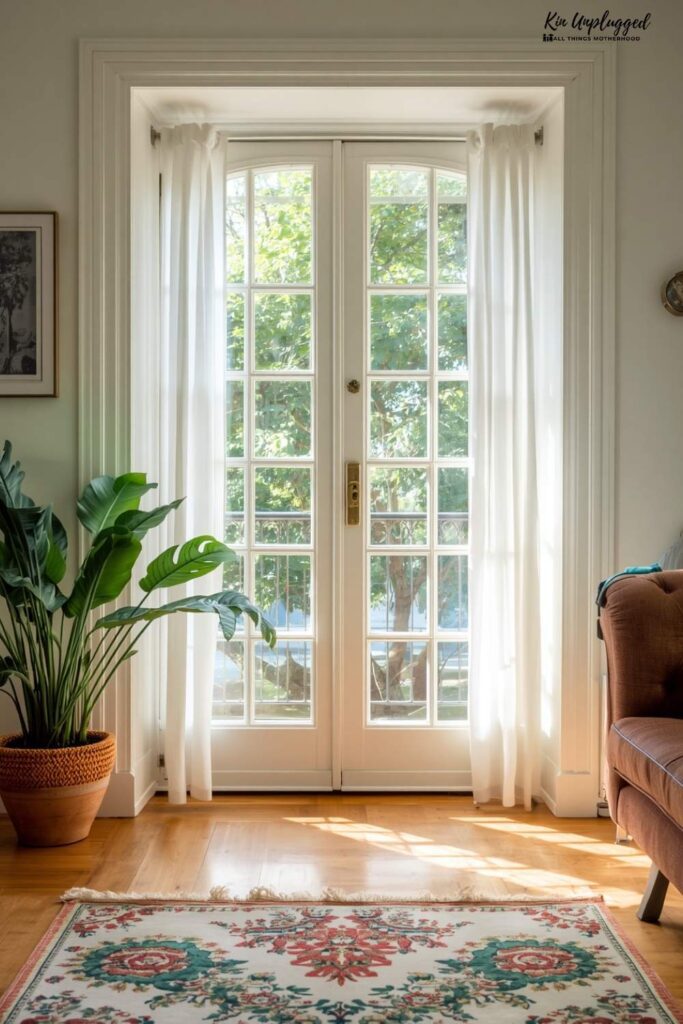
Curtains can absorb echo. Rugs can take the slap out of footsteps. Felt pads under chairs can stop the daily scrape. A fabric hamper can sound gentler than a plastic one. A basket for noisy toys can live farther from the evening seating area.
Tiny changes. Real relief.
The Evening Sound Boundary
Evening sound needs a border.
Not a severe rule. A rhythm.
Noisy toys can be moved into a daytime zone after dinner. The dishwasher can run after bedtime or before dinner, based on the house rhythm. Phone alerts can be lower in rooms used for sleep.
The body starts to learn that the day is stepping down.
So it steps down too.
5. Light Timing Can Matter More Than Paint Color
Paint gets attention.
Light runs the show.
Morning light tells the body that the day has started. Dimmer evening light helps the body understand that night is coming. Harsh light late at night can keep the brain acting as if there is still more to do.
This matters in a family home because evening is often the second shift.
Homework. baths. washing up. uniforms. lunch boxes. kitchen reset. little questions from small voices. big feelings from growing children.
The lights often get brighter right when bodies need the opposite.
That is the quiet trap.
The house says daytime, while the body begs for night.
A calmer plan is simple.
Bright mornings. Softer evenings. Darker bedrooms.
No drama.
The Lamp Line
After dinner, ceiling lights can step back in the rooms meant for rest.
Lamps can take over.
Warm bulbs can help the room feel less like a shop and more like a place where the day is closing. This is especially useful in bedrooms, living rooms and hallways near children’s sleep spaces.
The point is not mood.
It is timing.
6. Indoor Air Can Be a Hidden Nervous System Signal
Air can be invisible and still loud to the body.
Dust. strong cleaners. plug-in fragrance. old carpet. damp corners. smoke from cooking. scented sprays in small bathrooms. These do not only affect the nose.
They can affect sleep, headaches, breathing and the way a body feels inside a room.
The U.S. Environmental Protection Agency notes that people spend about 90 percent of time indoors and that source control, ventilation and filtration can reduce exposure to indoor pollutants.
That is not a call to fear the house.
It is a call to stop masking air that needs care.
A room that smells heavily perfumed can feel finished but the body may read it as another thing to process. For children with asthma, allergies, migraine tendencies or sensory sensitivity, scent-heavy rooms can be too much.
The better question is not, what can make this room smell stronger?
It is, what would make this room need less covering?
Open windows when safe. Use the extractor fan. Clean dust from vents. Store strong products away from bedrooms. Choose unscented basics when possible. Keep damp areas watched.
Fresh air is not a trend.
It is a body need.
7. Pathways Can Make the Body Feel Trapped
A room can be beautiful and still hard to move through.
A coffee table too close to the sofa. A toy bin in the walkway. A pram blocking the hall. A chair that must be squeezed past every morning.
The body notices blocked routes as friction.
For a mother carrying laundry, a baby, groceries, a laptop or a child half-asleep after swimming, a blocked path is not small. It is one more negotiation.
Nervous systems like exits.
Not because danger is always present.
Because bodies prefer options.
A clear path tells the body, movement is available.
This is especially important in tight homes, shared bedrooms, rental spaces, and houses where children’s items grow faster than storage.
The fix can be unfussy.
Clear the route from bed to door. Clear the route from kitchen to table. Clear the route from entry to stairs. Clear one path through the living room that stays open even when toys are out.
This gives the house a spine.
The family can bend around it.
8. Rooms Without Endings Keep Everyone Awake Inside
Some homes do not have a time problem.
They have an ending problem.
The play does not end. The kitchen does not end. The laundry does not end. The work laptop does not end. The children’s needs do not end, because growing up is a long road and someone still has to buy the toothpaste.
So the rooms keep carrying open chapters.
A kitchen with no closing ritual can keep calling from the dark.
A living room with no final basket can keep asking after bedtime.
A bedroom with work items in sight can make sleep feel like a meeting that got moved to a pillow.
The nervous system needs cues that a role has ended for the day.
Mother. worker. cook. driver. cleaner. comforter. referee. finder of missing things.
One person cannot drop every role if every room is still holding the uniform.
The Five-Minute Closing Signal
The house can close in small ways.
A blanket folded over the sofa arm. A basket placed by the stairs. A kitchen cloth hung to dry. A lamp turned on in the same corner each night. A school paper moved to one tray instead of floating on the counter.
These are not cleaning tasks.
They are nervous system punctuation.
The day gets a full stop.
9. The Home May Be Holding Too Many Versions of the Family
A family home has layers.
Baby bottles that stayed too long in a cupboard. Toddler toys in a room now used by a teen. Old craft kits from a season that has passed. Party plates from three birthdays ago. Clothes for a body that changed after birth, grief, stress, age, illness or just time.
That is life.
But sometimes the house becomes a museum of every version of the family.
The nervous system can feel this as drag.
Not sadness exactly. Not clutter exactly. More like being asked to live in all eras at once.
For busy moms, this can be tender.
The baby stage mattered. The little shoes mattered. The old dress mattered. The birthday balloons mattered. The handprint art mattered.
Still, not everything sacred has to stay in daily view.
Some items deserve memory storage. Some deserve a photo. Some deserve to be used. Some deserve to leave kindly.
A current home should have room for the current family.
That includes the current mother.
10. Texture Can Keep the Body in Defense
Texture sounds small until the body is tired.
Scratchy bedding. sticky counters. rough towels. cold floors in the morning. a dining chair that presses into the back. a rug that sheds. a sofa fabric that catches crumbs and never releases them.
These details can keep the body irritated in tiny waves.
For children, texture can shape behavior too.
A child may resist a room without knowing why. The blanket is wrong. The chair is too hard. The floor feels cold. The pajamas itch. The table edge presses into the arm during homework.
A home with fewer texture fights can feel safer.
Not fancy.
Kinder to skin.
A few soft swaps can matter: breathable bedding, washable throws, smooth placemats, comfortable dining cushions, socks by cold floors, towels that do not scrape after bath time.
The nervous system lives in the skin too.
11. Scent Can Bring Back a Season Before the Mind Catches Up
Smell is fast.
A certain cleaner can bring back a hospital hallway. A perfume can bring back an old house. Damp laundry can bring back a stressful flat. A candle can carry a holiday, a person, a loss, a kitchen, a time when life felt easier or harder.
This is not imagination.
The sense of smell is closely tied to emotion and memory systems. That is why scent can change the feeling of a room before a thought has time to form.
For mothers, scent can become part of the family archive.
Baby shampoo. toast. raincoats. school bags. sunscreen. wet grass. marker pens. dinner starting. dinner burning. someone’s hair after sleep.
The key is not to perfume every room.
It is to notice which scents settle the body and which ones stir it.
A room can be reset by removing a scent, not adding one.
That may mean washing cushion covers, clearing bins, airing bedding, changing cleaning products, or letting a room smell like nothing for a while.
Nothing can be a relief.
12. Decision Hotspots Can Drain the Day Before It Begins
Some spaces ask too many questions.
The wardrobe asks what to wear, what fits, what feels like the current body, what is clean, what needs mending, what belongs to work, what belongs to school run, what belongs to a life that no longer fits the calendar.
The fridge asks what to cook, what will be rejected, what expires today, what snack is safe for school, what everyone has eaten too much of, what nobody will touch.
The toy area asks what to keep, what to rotate, what has missing pieces, what causes fights, what needs batteries, what is too young, what is too precious.
A decision hotspot is any place where small choices gather until they feel like fog.
The fix is to reduce the number of visible options.
For clothing, that may mean a five-outfit rail for the week.
For snacks, one reachable basket.
For school forms, one tray.
For toys, one daily basket and one stored basket.
The body calms when the room stops asking the same question in ten different ways.
13. A Home Can Lack a Place for Big Feelings
Children have feelings in hallways, kitchens, bathrooms, cars, beds, doorways and directly beside the only clean pile of laundry.
A family home needs somewhere for big feelings to land.
Not a punishment corner. Not a perfect calm corner. A low-demand place.
A chair. A cushion. A soft mat. A blanket. A basket with paper, crayons, a fidget item or a book.
The important part is not the stuff.
It is the message: feelings do not have to spill across the whole house.
This helps adults too.
A mother with no place to pause may keep moving until the body forces a pause through tears, snapping, numbness or a headache.
The pause place says, one body can stop here without the whole house falling apart.
That is not indulgent.
That is repair.
14. The Bedroom Can Accidentally Become a Control Room
The bedroom is often treated like the overflow department.
Laundry. returns. baby items. work bags. old boxes. gifts to wrap. things with no home. things that need a decision but not today.
Then sleep has to compete with evidence of everything unfinished.
For the nervous system, this is confusing.
A bedroom should lower vigilance. Many bedrooms raise it.
The first fix is not a full cleanout.
It is a boundary.
No paperwork beside the bed. No laundry on the sleeping surface. No bright overhead light as the last light of the night. No open basket of tasks in the first line of sight from the pillow.
A nightstand can be a small altar to rest without becoming precious about it.
Water. lamp. book. lip balm. one personal item. That is enough.
The body needs a room that does not report the whole day back at midnight.
15. Children’s Spaces Affect Adult Bodies Too
A playroom may belong to children but its sound and sight spill outward.
Bright colours. flashing toys. plastic bins. costumes. puzzle pieces. school projects. tiny furniture. half-built forts.
This is part of family life.
But when every shared room becomes a child-led sensory zone, the adult nervous system may never get a visual exhale.
The answer is not removing childhood from the home.
The answer is giving childhood borders.
A rolling cart that parks away at night. A play rug that defines the area. One shelf that holds the current favourites. A birthday or party box that leaves the living room after the celebration.
Children often do better with borders too.
Too many choices can make play thinner.
Fewer visible toys can make play deeper.
The room gets less frantic.
So does the body.
16. The Most Restful Homes Have Predictable Repetition
The nervous system likes knowing what comes next.
This does not mean strict routines or a house run like a timetable. It means repeated cues that become friendly.
The same lamp at dinner cleanup.
The same basket at the stairs.
The same hook for keys.
The same tray for school papers.
The same blanket on the same chair after bedtime.
These small repetitions become signals.
The body does not have to learn the house again every morning.
For a family with toddlers, teens, work calls, school messages, sports bags, birthday plans, and changing appetites, repetition is mercy.
It removes tiny negotiations.
It gives the home a language everyone can learn.
A Room-by-Room Nervous System Reset
This does not need a weekend overhaul.
It can happen in rooms already carrying the most pressure.
Kitchen
The kitchen is often the command centre but it can also be the place where the body gets the most interrupted.
Start with the counter section that is seen first in the morning.
Clear only that section. Add one tray for daily papers. Put one pen there. Let the rest of the kitchen be real life.
Specific answer: a clear first-look surface can reduce the immediate sense of demand.
Living Room
The living room often holds two jobs: family connection and visual recovery.
That is a hard job when every surface carries a toy, sock, wrapper, remote, cup and forgotten hair tie.
Use one final basket at night. Fold one blanket. Turn one lamp on. Let the room signal that the day has softened.
Specific answer: the living room needs an evening version, not a perfect version.
Bedroom
The bedroom should stop reporting.
Move visible tasks away from the pillow view. Lower the light. Keep one tiny rest surface clean.
This is not about aesthetics.
It is about not making the nervous system sleep beside a to-do list.
Specific answer: the bed area should not hold open jobs.
Bathroom
Bathrooms can become overstimulating fast.
Too many bottles. strong scent. bright light. damp towels. bath toys. mirrors. noise.
A calmer bathroom starts with less on the edge of the sink and fewer scent layers.
Specific answer: a bathroom reset often begins with air, not decor.
Children’s Rooms
Children’s rooms can hold too much choice.
This can affect bedtime, getting dressed, and morning speed.
Keep current favourites visible and move the rest into rotation.
Specific answer: children often settle better when the room gives fewer instructions.
What Makes This Different From Decluttering
Decluttering asks, what should go?
A nervous system view asks, what is this room asking the body to do?
That question changes everything.
A room can be full and still feel safe.
A room can be minimal and still feel cold, loud or demanding.
The nervous system does not care about trends.
It cares about cues.
Can the body move easily? Can the eye rest anywhere? Can the room get darker at night? Can sound soften? Can scent settle? Can roles end? Can a mother find proof of her own place in the home?
Those questions matter.
They are not small.
They are the difference between living in a house that constantly calls and living in one that sometimes answers back.
The Calmest Change Is Usually the One Closest to the Body
The best place to start is often not the most visible room.
It is the room that touches the body most.
The bed. The chair used after school drop-off. The kitchen corner where coffee goes cold. The bathroom mirror where the day begins. The entry mat crossed with full hands.
Pick the place where the body tightens first.
Then ask what signal can be lowered.
Light. noise. scent. texture. visual demand. blocked movement. unfinished tasks. too many choices.
One signal at a time.
That is enough.
A mother does not need to fix the whole house to feel one breath return.
One breath is data.
It means the body heard the change.
FAQs
Can a home affect the nervous system?
Yes. A home can affect the nervous system through light, sound, air quality, temperature, scent, layout, texture and visual demand.
The body reads these signals constantly. A room that lowers sensory demand can help the body move out of high alert more easily.
How does clutter affect stress?
Clutter can act like unfinished work in the line of sight.
It may increase stress by giving the brain more to scan, sort and remember. For busy moms, clutter often carries extra meaning because it is tied to care tasks, family routines and time pressure.
What room affects stress the most?
The most stressful room is usually the one with the most decisions.
For many families, that is the kitchen, entryway, bedroom or laundry area. The strongest starting point is the space that is seen first during a stressful part of the day.
Does lighting affect mood and sleep?
Yes. Light helps set the body clock.
Bright daylight supports daytime alertness, while harsh light at night can confuse the body’s timing. Softer evening lighting can help the day feel like it is ending.
Can indoor air quality affect how a person feels at home?
Yes. Indoor air quality can affect comfort, breathing, headaches, sleep and irritation.
Dust, damp, smoke, fragrance-heavy products and poor ventilation can make a room harder on the body. The best first steps are source control, ventilation and filtration.
Why does a house feel stressful even when it is clean?
A clean house can still feel stressful if the layout, lighting, sound, smell, or room purpose keeps the body on alert.
A spotless bedroom with bright light and work papers beside the bed can still feel demanding. Calm is not only cleanliness. It is the number of signals a space sends.
How can a family home feel calmer without a big budget?
Start with what is already there.
Clear one pathway. Dim one room at night. Close one basket. Remove one scent layer. Protect one adult rest spot. Give one room a five-minute ending ritual.
Small changes can give the nervous system a new message.
Finally…
A home is not just walls, furniture and the things a family has gathered along the way.
It is a nervous system weather system.
It can press. It can buzz. It can call from every corner. It can also soften, hold and give a body somewhere to land.
The goal is not a perfect home. A family lives there. Children grow there. Clothes change sizes there. Shoes appear in places no shoe should ever be.
Still, the house can ask less.
A clear path. A softer lamp. A closed basket. cleaner air. a lower-scent room. one protected chair. one finished corner. one evening signal that says the day has done enough.
That is where the shift begins.
Not in a showroom.
At home, where the body has been waiting to exhale.
 0
0

 278
278