
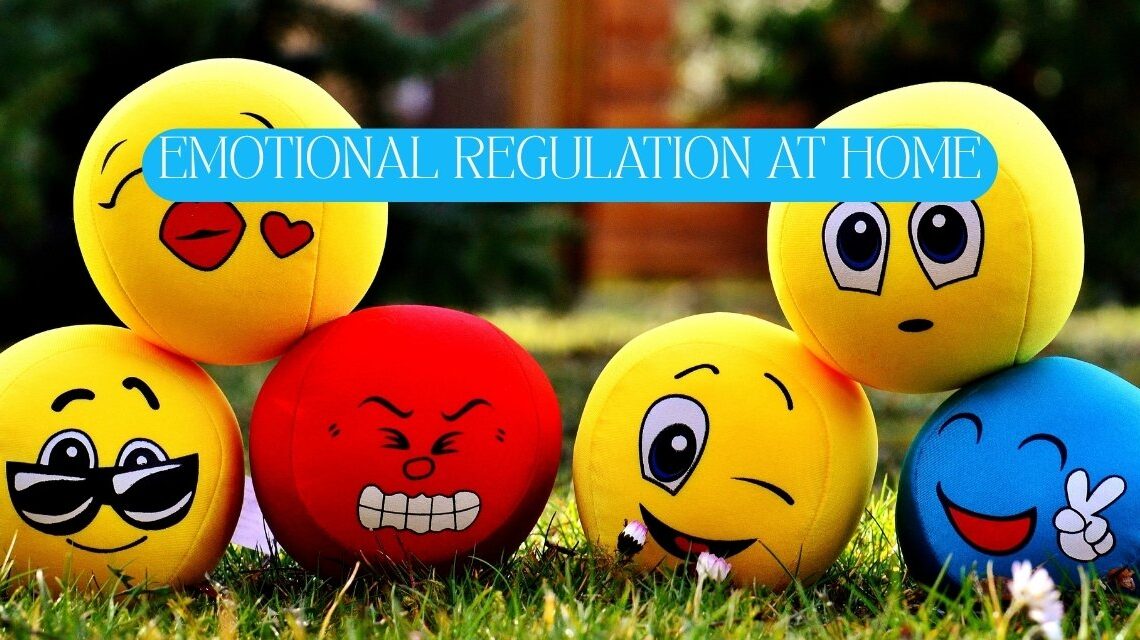
If your child goes from fine to furious in four minutes or your evenings feel one spilled drink away from tears, this guide to emotional regulation at home is for you. What we use is not fancy and it is not built for perfect parenting. It is a small set of things we reach for again and again because they help children slow down, feel safe and get back to themselves without turning the whole house into a courtroom.
Experts are clear that emotional regulation is a skill children build over time and that supportive relationships and repeated practice matter. The American Academy of Pediatrics says children develop emotional skills through safe, stable relationships and daily experiences, while Child Mind Institute notes that helping kids name feelings, slow down and practice calming strategies can improve self control.
READ: The Calm Kid Play Method
Right at the top, here are two things many families like to keep close by so the tools are easy to reach when a child is already starting to unravel.
This is not a post about raising a child who is calm all the time. It is about having a handful of steady, useful supports ready when a child is upset, overwhelmed, wound up, stuck or simply worn out.
And because most moms reading this are tired and busy, I am going to answer the real question early. What do we use for emotional regulation at home? We use a short list of repeatable things: a calm down basket, visual feeling tools, movement breaks, breathing prompts, lower lights, music, a quiet corner, predictable phrases, snack and water and a few simple body based activities that help a child come back to baseline.
If your hardest time is after school, read our exact after school routine. If bedtime is the pinch point, go next to quiet evening habits that help kids sleep better. If you are dealing with sibling tension, try what helps when siblings keep snapping at each other.
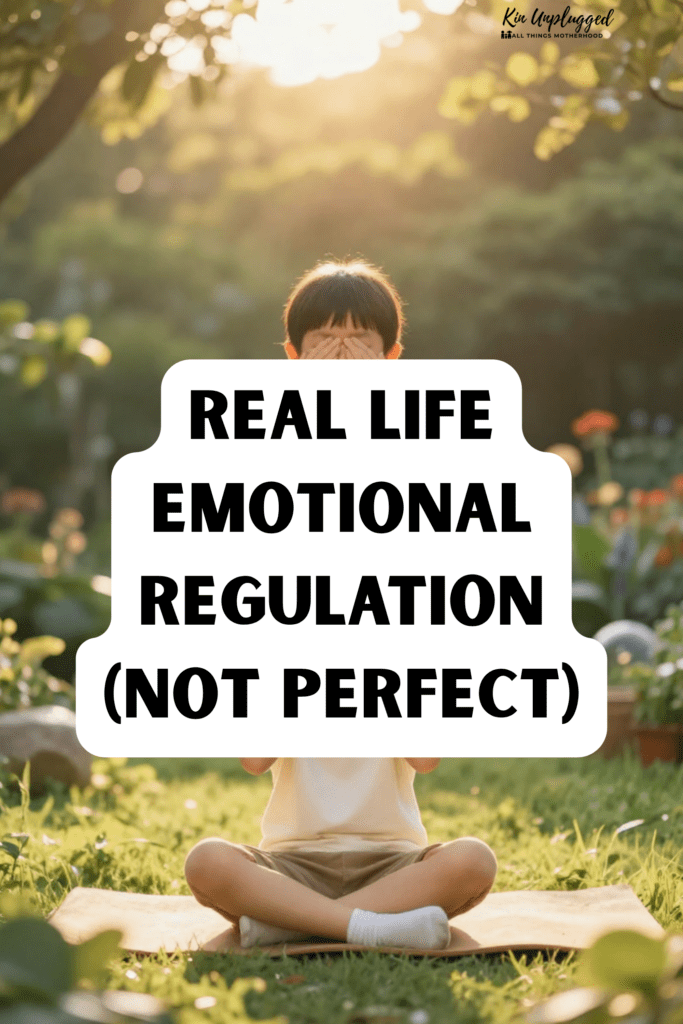
What emotional regulation at home really looks like
Most of the time, emotional regulation at home does not look inspiring. It looks like noticing a child is getting too loud, too still, too sharp or too teary and stepping in before the whole thing tips over.
Sometimes that means helping a child name what is happening. Sometimes it means saying very little and handing them cold water, a snack or a familiar object.
Child Mind explains that kids often need adults to help them calm down by modeling calm, planning ahead for rough moments and teaching them how to notice and label feelings. That is part of co-regulation, which means the adult helps steady the child instead of expecting the child to do it all alone.
That is why I think the home part matters so much. School can teach social emotional skills but home is where children rehearse them in real life, on the day their socks feel wrong, their brother looked at them oddly and the toast came out cut the wrong way.
What we use for emotional regulation at home
Here is the shortlist first. Then I will break down each one and tell you when it helps most.
| Tool or habit | What we use it for | Best time to use it |
| Calm down basket | Fast access to familiar soothing items | Early signs of overwhelm |
| Feelings chart or cards | Naming emotions | After upset starts to settle |
| Movement breaks | Releasing physical tension | After school, before homework, before dinner |
| Breathing prompts | Slowing the body | Mild to moderate upset |
| Quiet corner | Reducing stimulation | When noise or activity is too much |
| Water and snack | Helping the body first | Hunger, fatigue, school pickup |
| Predictable phrases | Keeping the adult steady | During tears, anger, frustration |
| Music and lower lights | Softening the room | Late afternoon, pre-bedtime |
| Sensory tools | Helping focus or release tension | Waiting, transition times, homework |
| Tiny routines | Reducing daily friction | Repeated stress points |
The best tools are the ones your child will use when upset.
1. A calm down basket that lives in one place
This is one of the most useful things we keep at home. It is not huge and it is not beautiful in a magazine way but it is familiar.
Ours usually includes a soft ball, one or two fidgets, a small notebook, crayons, tissues, headphones, a feelings card, a chewy snack and sometimes something cool to hold. The point is not to fill it with twenty items. The point is that the child already knows what is in there and what it is for.
That familiarity matters because children do not make great decisions when they are overloaded. A known set of options is far more useful than a long speech in the middle of a meltdown.
If you want a full setup, go next to what to put in a calm down basket for kids. If your child is sensory seeking, simple sensory ideas that help at home may be the better next read.
2. A feelings chart we keep simple
We use a very plain feelings chart. Not because children need a poster to feel their feelings but because naming an emotion gives the brain something to do besides react.
Child Mind says that teaching kids to recognize and name emotions can help them gain more control instead of going straight to outbursts. The AAP also points to emotional development as something built through communication, relationships and daily practice.
For younger kids, I keep it basic. Mad. Sad. Worried. Tired. Frustrated. Excited. Embarrassed.
For older kids, I like adding words like disappointed, left out, overwhelmed and annoyed. Those words help because a child who can say I am overwhelmed is already one step closer to help.
We do not force the chart in the heat of the moment. We use it once the sharpest edge has passed.
3. Movement before talking
This is one of the biggest shifts we have made. I used to think I had to talk through every upset immediately.
Now I know that some children need to move before they can make sense. A few minutes of jumping, pushing against a wall, carrying something heavy, walking outside or doing ten slow stretches can do more than a long conversation at the wrong time.
The CDC notes that physical activity supports overall health in children and teens and many parents can see plainly that movement also changes the emotional weather of the room. For some kids, their body has to settle before their words can.
This is especially useful after school and before homework. If your child hits a wall right after pickup, read the after school reset that helps my kids most.
4. Breathing prompts
I do use breathing but only the versions that feel natural enough to use on a real day. If a child is very upset, a dramatic breathing script can make them feel worse.
So we keep it plain. Smell the soup, cool the soup. Blow the feather. Pretend the candle is flickering, not going out. Trace your fingers and breathe up and down.
These are easier for younger kids because they give the body something specific to do. For older kids, I sometimes just say, let your shoulders drop first, because a body cue can be more acceptable than a big emotional one.
The point is not to force calm. It is to give the nervous system one small path back.
5. Lower lights and less noise
This is one of the least glamorous tools and one of the most effective. We often change the room before we try to change the child.
That might mean turning off the television, lowering lights, reducing background noise or moving away from the busiest room in the house. Some children are not only upset. They are also overfull from noise, hunger, social demand and too many small inputs all day.
The AAP notes that safe, stable, responsive relationships and healthy daily routines support children’s mental and emotional development. In practice, that often means making the environment feel less jangly and more steady.
This is one reason the kitchen is not always the best place to help a child regulate, even though that is where family life tends to pile up. Sometimes the best move is simply leaving the busiest room.
6. Cold water, a snack and the unromantic basics
This section may sound too ordinary but I think it belongs near the top. A hungry, thirsty, tired child is often a child with fewer emotional reserves.
We use water, a simple snack and a very fast check on the obvious things first. Did they eat lunch. Are they exhausted. Have they had too much noise and not enough quiet. Have they been holding it together all day at school.
This is not a cure for every upset but it keeps us from treating a body need like a behavior issue. It also helps me remember that not every emotional moment needs deep analysis.
If your worst stretch is 3 to 5 pm, read filling snacks for the 4 pm hunger crash and our exact after school routine.
7. Predictable phrases
When children are upset, I do not think they need my best original monologue. They need steadiness.
So we use the same few phrases over and over. You are safe. I am here. Your body looks overwhelmed. We can get through this. I will help you. We are not doing this alone.
Child Mind’s guidance on co-regulation centers on the adult managing their own response so the child has something calmer to lean on. The CDC also tells parents of teens that being calm helps you coach them more effectively through emotions.
That matters because children borrow our nervous systems all the time. Not perfectly and not instantly but often enough that the adult tone really counts.
8. A quiet corner that is not a punishment space
I think the best quiet corners feel normal and welcoming, not like exile with cushions. Ours is not framed as go away until you behave.
It is framed as a place you can use when the room feels too much, your feelings feel too big or your body needs help getting back under you. That difference matters.
A quiet corner can include a beanbag, blanket, soft toy, noise reducing headphones, books, fidgets and a feelings chart. Keep it simple enough that it still feels restful.
If you want a fuller post on this, go to how to set up a calm corner without overdoing it.
9. Sensory tools
Not every child needs sensory tools but many children do benefit from them. We use a few very basic ones because they help the body focus or release tension without a lot of words.
Good options include a stress ball, putty, a weighted lap pad, a stretchy band on a chair, a chew necklace if appropriate and noise reducing headphones for loud moments. The right tool depends on the child and the situation and not every item works for every nervous system.
The most important thing is that the tool fits the moment. A fidget that helps during homework may not help during anger. A weighted item may feel great to one child and awful to another.
That is why we test slowly and keep only what actually earns its place. If you are in that season, read sensory tools that helped my child more than I expected.
10. Tiny routines for the repeat trouble spots
A lot of emotional blowups happen at predictable times. Shoes on. Homework start. Bath transition. Screen off. Bedtime. Out the door.
For those places, what helps us most is not a new consequence chart. It is a tiny routine that removes some friction before feelings get too big.
Child Mind notes that planning ahead for difficult situations and giving warnings before transitions can reduce meltdowns. That is one reason routines and visual cues help so much at home.
So instead of waiting for trouble, we use little sequences. Two minute warning. One more turn. Shoes by the door. Backpack packed before bed. Bathroom first, then story. Small things but they matter.
If transitions are your family’s weak spot, read what helps when transitions keep going badly.

What helps by age
Children need different supports at different stages and I think many articles get too vague here. The same strategy that helps a six-year-old can feel patronizing to a twelve-year-old.
Here is the version I keep in mind.
| Age | What often helps most | Best tools |
| 3 to 5 | Body first, words later | Movement, cuddly corner, simple feelings words, breathing games |
| 6 to 8 | Clear naming and short routines | Feelings chart, snack, movement, predictable phrases |
| 9 to 12 | Privacy plus practical tools | Journal, headphones, calm basket, short check-ins |
| Teens | Respect, space, steady presence | Calm tone, options, walk, music, water, fewer words |
The CDC advises parents of teens to coach when calm and not take teen emotions personally. That is very useful, because older kids often want support without a performance around it.
So with older kids, I use fewer obvious tools and more side by side support. A walk. Music in the car. Tea. A check in later, not always in the hot moment.
What we do in the moment when a child is already upset
This part matters because it is where good intentions often disappear. When a child is already escalated, I try to do less, not more.
First I lower my voice. Then I cut extra language. Then I look at the body need, the noise level and the immediate trigger.
Only after the child starts to settle do I talk much about what happened. Child Mind recommends helping children learn calming skills and naming emotions but also being realistic that these skills are taught over time, not demanded on command.
That means sometimes success looks like this: no one got hurt, the child cried, we got through it and the repair came later. That still counts.
What has not helped us
A giant lecture in the middle of a meltdown has not helped us. Asking too many questions too soon has not helped us either.
A reward chart for every feeling also did not help. Feelings are not the problem. The goal is helping a child handle them without getting lost in them.
What does help is a shorter response, a calmer room and one or two familiar tools. The less theatrical I get, the better it usually goes.
How we keep it from feeling mechanical
This matters to me a lot. I never want emotional regulation at home to sound like a system I run on my children.
The tools only work if they sit inside warmth, timing and a sense that the child is known. One child wants closeness. One wants space. One wants a cup of something cold and a chance to stomp outside before speaking a word.
So I think of these tools as supports, not scripts. They are there to help us meet the child in front of us, not flatten every child into the same response plan.
The AAP’s guidance on emotional development centers relationships for a reason. Kids build these skills with us, not away from us.
A note for moms who are already doing a lot
If you are reading this and thinking, we already do half of this and it still gets hard, that does not mean you are failing. Emotional regulation is a long skill to build and some children need more repetition, more support and more co-regulation than others.
AACAP notes that learning to regulate emotions is a normal part of growing up, while some children and teens have outbursts that are more extreme and impairing. If the level of distress feels severe, dangerous or far beyond what the situation seems to call for, it is worth speaking with your child’s pediatrician or a qualified mental health professional.
There is a big difference between a child who is still learning and a child who needs more support than home strategies alone can provide. Knowing that difference is part of good parenting too.
Stay close for more practical family ideas
I write for the parent who needs things that work on an ordinary day, in an ordinary home, with ordinary energy levels and a child who is not a case study but a real person. If this post helped, keep going with our exact after school routine, quiet evening habits that help kids sleep better and what helps when transitions keep going badly.
And if you like practical family writing that feels steady and personal, join my email list here: Join my email list.
FAQs
These answers reflect common Google-style questions parents ask around emotional regulation at home, answered clearly and simply.
What is emotional regulation in children?
Emotional regulation is a child’s ability to notice feelings, manage reactions and return to a steadier state over time. It is a skill that develops gradually and is shaped by relationships, practice, language and brain development.
How can I help my child regulate emotions at home?
Start with co-regulation, not correction. Stay calm, reduce stimulation, use fewer words, help the child name the feeling once they are calmer and offer simple tools like movement, water, a quiet space or a familiar calming object.
What are good emotional regulation activities for kids?
Good options include movement breaks, finger tracing breaths, squeezing a stress ball, quiet drawing, listening to soft music and using a feelings chart. The best activity depends on the child’s age, temperament and what their body needs in that moment.
At what age should a child regulate emotions?
Children begin learning emotional regulation very early but they do not master it quickly. Young children often need a lot of adult support and many school age children still need help naming feelings, handling frustration and calming their bodies.

What is co-regulation?
Co-regulation is when an adult helps a child settle by offering calm presence, empathy and guidance. Over time, children borrow those patterns and slowly build more self regulation of their own.
When should I worry about emotional dysregulation?
It is worth getting professional advice if your child’s outbursts are intense, frequent, dangerous, far beyond what seems typical for their age or clearly affecting school, friendships or family life. AACAP notes that some children and adolescents
Finally…
What we use for emotional regulation at home is not a miracle kit. It is a steady collection of ordinary supports that help children feel less alone inside big feelings and help me respond with a little more clarity when the house starts tipping sideways. The tools that matter most are usually the least dramatic ones: a familiar basket, a quiet corner, a shorter sentence, a movement break, a snack, a calmer room and the repeated message that feelings can be hard without becoming frightening.
 0
0

 278
278