
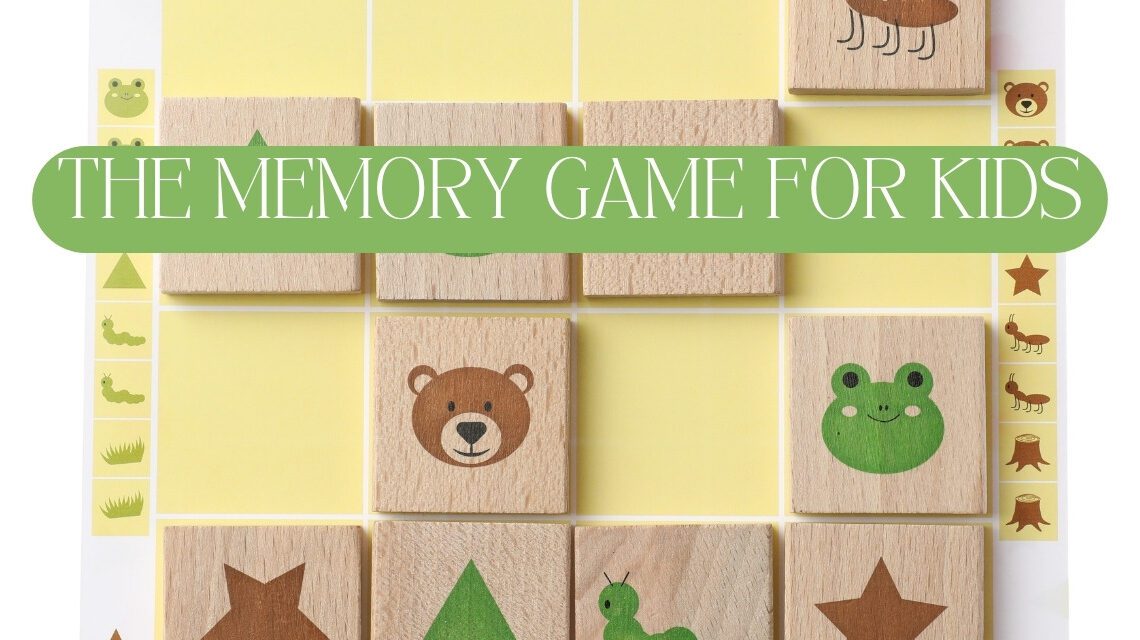
If you’re searching how to play the memory game for kids, here’s the whole thing in one breath. Shuffle the pairs, lay them face down, then players take turns flipping two cards to find a match. If the cards match, you keep the pair and take another turn.
If they don’t match, flip them back in the same spot and the next player goes.
That’s it.

Now I’ll show you how to make it work for toddlers, big kids, mixed ages and those nights when you have exactly seven minutes of patience left.
SHOP A CLASSIC MEMORY GAME
SHOP A WOODEN MEMORY SET
One more thing before we start.
If you want my done for you 5 minute setup cards and scripts for every age, grab the free kit at the end, because it turns this into a calm little ritual instead of a project.
What the memory game really teaches (so you feel good saying yes)
Memory is not just about remembering.
It’s attention, self control and holding information long enough to use it.
A simple memory card game supports working memory and executive function skills, especially when kids play with an adult or a small group.
And research on game based training shows structured games can improve motivation and cognitive performance in children, including attention related skills.
This game is sneaky practice for focusing, waiting, losing politely and trying again.
Your kid might just need the right number of cards.
What you need (and the easiest swaps if you have nothing ready)
You can play with a store bought set.
You can also play with household items in under two minutes.
You need:
- Pairs of something identical, cards, pictures, objects, socks, Lego pieces, toy animals
- A flat surface
- A tiny bit of space to leave it out for round two
No printer, no problem.
Grab 6 pairs of anything that matches and you’re in business.
If you want a screen free quiet time plan: Quiet time ideas for kids
If your child melts down when they lose, you’ll want the cooperative mode section later.
Yes, it exists and yes, it works.
The classic rules
This is the standard version used in most Memory style games.
Once kids know it, you can change the rules for your house.
Step 1: Set up the cards.
Shuffle the cards and place them face down in a grid.
Step 2: Choose who goes first.
Youngest goes first or do rock paper scissors or let the cat decide.
Step 3: Flip two cards.
The player flips two cards, one at a time, so everyone can see.
Step 4: Match or miss.
If they match, the player keeps the pair and takes another turn.
If they don’t match, both cards go back face down in the same spots and the next player goes.
Step 5: The end.
When all pairs are collected, the player with the most pairs wins.
That’s the whole game.
Now let’s make it easier, faster and less likely to end with tears.
The table busy moms actually use
Here’s the cheat sheet I wish every game came with.
| Child’s age | Start with this many pairs | Best grid | Round length | One tweak that changes everything |
| 2 to 3 | 3 to 6 pairs | 2×3 or 3×4 | 3 to 6 minutes | Keep misses face up for 3 seconds |
| 4 to 5 | 6 to 10 pairs | 4×4 or 4×5 | 6 to 10 minutes | Use a hint token once per game |
| 6 to 8 | 10 to 18 pairs | 6×6 (smaller set) | 10 to 15 minutes | Add a timer for your turn |
| 9 plus | 18 to 36 pairs | full grid | 15 to 25 minutes | Add scoring twists, see below |
| Mixed ages | older kid set, toddler mini set | two grids | 8 to 15 minutes | Play team mode, one adult per team |
If your child is brand new, go smaller than you think.
Starting easy feels like magic, because they succeed fast and ask for again.
The fastest way to make the game harder is not adding cards.
It’s changing what counts as a match.
Setup that takes less than 60 seconds (my no fuss grid)
Your grid matters more than people admit.
A messy layout makes kids lose track, then you lose your will to live.
Do this:
- Put pairs in a pile
- Shuffle
- Deal them into neat rows
- Leave a finger width between cards
If you have a toddler, keep the grid tight and close to them.
If the cards are far away, they’ll stand up, then the grid becomes confetti.
If you want to play while you make dinner, set it up on a tray.
You can slide the tray away fast when you need the counter.
Decision path: if your child throws cards, try my floor tape grid trick here: Games for kids who throw things.
How to explain it to kids in one sentence (and get started)
Big explanations invite debate.
You want one sentence and a smile.
Say this: We are going to find pairs by flipping two cards and we put them back if they don’t match.
Then start.
Kids learn the rules faster by watching you do one turn.
So do a demo turn, slowly, then hand it over.
If they try to flip four cards at once, you’re not failing.
They’re excited and you just repeat the sentence.
The toddler version (2 to 3 years) that actually works
Toddlers can play a version that feels like the real game.
The goal is attention and turn taking, not perfection.
Use 3 to 6 pairs.
Bigger sets backfire fast.
Rule tweak: if they miss, keep the cards face up for a slow count of three.
This gives their brain a chance to file the picture away.
Winning tweak: skip winner and play let’s fill the basket with pairs.
Toddlers often handle a shared goal better than a scoreboard.
If your toddler is matching but not remembering, that’s still a win.
Matching is the warm up skill that comes before full memory play.
If you want more toddler friendly games like this, go here: 2 minute games for toddlers.
The preschool version (4 to 5 years) that builds confidence fast
Preschoolers love being good at something.
So give them a setup that lets them be good early.
Use 6 to 10 pairs.
Keep it short enough that the finish line feels real.
Add one tiny ritual.
Before the first turn, say: Eyes on the grid, take a picture with your brain.
Then do the hint token trick.
Each player gets one hint per game where they can ask, Where did we see the frog?
This turns the game into teamwork plus thinking.
It also reduces the pressure that can trigger quitting.
Want more preschool games that help with attention?
Try: Rainy day games that don’t require supplies.
The school age version (6 to 8 years) that stops boredom
This is the age where kids can handle strategy.
They also start to get dramatic about fairness.
Use 10 to 18 pairs.
Pick a set that takes 10 to 15 minutes max.
Add a simple rule for pace.
You get 10 seconds to choose your second card.
This keeps the game moving and it stops the stare down that makes siblings melt.
If a child needs more time, you can do 15 seconds but keep it consistent.
If your child loves competition, add streak scoring.
Each match in a row counts as one extra point until you miss.
Decision path: if competition causes fights, jump to cooperative mode below.
Or go here next: Sibling games that reduce arguing.
The big kid version (9 plus) that feels fresh again
Older kids can handle bigger sets.
They also want something that does not feel babyish.
Here are three twists that make it feel new.
1) Category matching.
Instead of identical pairs, match things that go together, like toothbrush and toothpaste.
2) Memory plus story.
When you find a pair, you must say one sentence that links them, like The astronaut took the rocket to the moon.
3) Reverse Memory.
Cards start face up for 20 seconds, then you flip them all down and play as normal.
Reverse Memory is so simple and so good.
It lets older kids use planning, not just recall.
Mixed ages in one game (the two grid solution)
This is the real life problem, right.
One kid is two, one is eight and everyone wants to play.
Here’s what works.
Set up two grids side by side.
Toddlers get 4 to 6 pairs, older kids get 10 to 18.
They play the same rules but on their own grids.
Everyone finishes around the same time and nobody feels set up to fail.
If you want them on the same grid, do teams.
One adult per team is ideal but a big sibling can be the helper too.
Team play also builds language, because kids talk through guesses.
That social part matters in brain development, especially in play.
Cooperative mode (for sensitive kids and peace keeping moms)
Some kids shut down the second they start losing.
That does not mean they are sore losers, it means the game is too sharp for their nervous system that day.
Try this version.
Goal: beat the deck together.
You all win if you clear the grid in a certain number of turns.
Pick a turn limit that feels possible.
For 10 pairs, try 22 turns as a starting point.
When you miss, you still flip them back.
But nobody gets the cards, you just move them to a matched pile when found.
This mode is also amazing for playdates.
It turns the vibe into we did it instead of you beat me.
If this is your child, you might like: Gentle competitive games for kids.
The objects on a tray memory game (no cards needed)
If you have small kids, this one is gold.
It’s also great if you lost half the cards to the sofa.
Put a few objects on a tray and cover them.
Let your child look for one minute, cover again, then ask them to name the objects.
To make it harder, remove one item and ask what is missing.
This keeps the game fresh without buying anything.
This is also perfect for grandparents.
It feels like magic but it’s just simple attention practice.
If you want more use what you have play, go here: Kitchen table games.
How to keep kids interested
You don’t need a big performance.
You need one small hook.
Try these.
Make the cards personal.
Use family photos as pairs, pet photos, favourite characters or your own drawings.
Use a theme of the week.
Animals this week, food next week, then things in our house.
Add a tiny job.
Let your child be the shuffler or grid builder first.
Kids love ownership.
When they helped set it up, they stick around longer.
Scroll hook: my favourite twist is a mystery pair.
One pair is blank and the person who finds it gets to pick the next theme.
The gentle scripts that stop arguing
You don’t need to lecture.
You need a few lines ready.
If someone flips too many cards:
Two cards, then we flip back. You can do it.
If someone is upset they missed:
Missing is how we learn the grid. You’re building your map.
If siblings accuse cheating:
Hands in lap until your turn, then two cards. We play the same rules for everyone.
If a child refuses to play:
Okay. You can watch for one round, then choose to join.
Watching is still learning.
Kids often step in once the pressure drops.
How to make it stick as a habit in real mom life
You don’t need nightly game time.
You need a repeatable moment.
Pick one anchor.
After dinner, before bath, right after school snack or while a baby is nursing.
Keep the game in a basket where kids can reach it.
Out of sight is out of mind and you’ll forget too.
Make it short on purpose.
A 7 minute win is better than a 25 minute grind.
If you want this as a routine, I mapped a simple weekly plan here: Screen free week plan.
A few research grounded reasons this game is worth your time
Play supports brain development and kids need both adult connection and space to play in ways that fit their stage.
Memory style games are often used to support executive function skills like working memory and they work well in small groups.
Also, there is evidence that game based training can improve working memory outcomes in young children, including effects that last beyond the session.
That does not mean one card game changes everything but it does mean your time is not wasted.
Here’s my favourite part.
Memory games are low pressure, repeatable and feel like connection, not homework.
Smart variations that make your article stand out (and keep kids asking for more)
Most posts stop at flip two cards.
You’re going to have a whole menu, so moms save it and come back.
1) The Whisper Match
When a child flips a card, they whisper what they see.
This slows the moment and boosts attention.
It also helps kids who rush.
Quiet makes the brain notice details.
2) The Movement Match
Before a turn, the player does one quick movement, like two jumps.
Then they flip.
This can help wiggly kids regulate and focus.
Some research suggests a game like context and action can support memory processes in young children.
3) The One Hand Rule
Kids flip cards using one hand only.
It sounds silly but it slows impulsive flipping.
This is great for kids who slam cards.
And it keeps the game from turning into speed flipping.
4) The Tell Me Where Round
After every miss, you ask: Where do you think the match is, top row or bottom row.
It trains visual scanning and planning.
Nobody has to be right.
It just keeps their brain engaged.
5) The Memory Detective
One parent plays detective and narrates clues.
Example: I saw the banana near the corner.
Kids love it.
And you are modeling strategy without making it a lesson.
If you want my printable variation cards you can pull out like prompts, I keep them inside my free kit for subscribers.
It’s at the end and it’s genuinely useful.
Troubleshooting (so you can fix the problem in 10 seconds)
Problem: My child flips randomly.
Fix: Use fewer pairs and keep misses face up for 3 seconds.
Problem: They get bored halfway through.
Fix: Shorten the grid, add a 10 second turn timer or stop at best of 10 matches.
Problem: Siblings argue the whole time.
Fix: Switch to cooperative mode for a week, then return to regular scoring.
Problem: Toddler eats the cards.
Fix: Use objects or large sturdy cards and keep the set tiny.
Problem: My child cries when they lose.
Fix: Team play or shared goal play, plus a script that normalizes missing.
If you want a quick list of calm games for tough days, try: Low prep calm activities.
FAQs
How do you play the memory game with kids?
Shuffle the cards, lay them face down, then take turns flipping two cards to find a matching pair.
If the cards match, you keep them and go again and if not, you flip them back and the next player goes.
What age can kids start playing a memory matching game?
Many kids can start with a simplified version around preschool age, especially with fewer pairs and adult support.
For toddlers, using objects or a very small set can work better than a full card grid.
How many cards should you use in a memory game for kids?
Start with 3 to 6 pairs for toddlers, 6 to 10 pairs for preschoolers and 10 to 18 pairs for early school age kids.
If the game ends in frustration, reduce the number of pairs before changing anything else.
How long should a memory game take?
Aim for 5 to 15 minutes.
Short wins are what get kids asking for another round.
What skills does the memory game help with?
It supports working memory, attention and turn taking and can also build strategy and flexible thinking over time.
It’s also a simple way to get connection during play, which matters for development.
Finally…
You don’t need a perfect setup, a giant grid or a child who sits still.
You just need the right number of pairs, one clear sentence and a version that fits the day you’re actually having.
 0
0

 278
278