

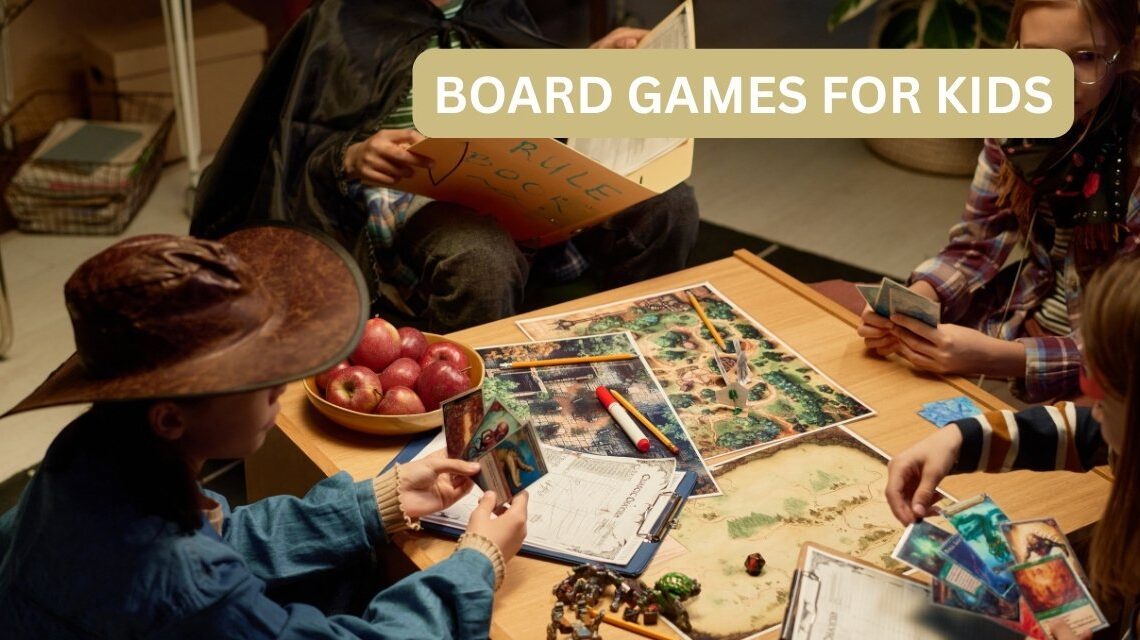
If you’ve got kids in different stages, board game shopping can feel like a trap. One child is bored, one child cries when they lose and you end up thinking, “We should’ve just watched something.”
This list fixes that. These are board games for kids of every age that work in real homes, on normal nights, with busy moms who want less arguing and more together time.
Grab a Visual Timer (ends “one more turn” battles)
Shop a Card Holder Set (helps small hands instantly)
Those two little tools make game night smoother across ages.
They also help you keep the mood kind when everyone is tired.
READ (Age-based): The Best Dice Games for Kids (easy, fast and fun)
The one minute rule that makes kids stick with board games
Most families quit board games because the first five minutes feel hard.
Rules feel long, pieces go missing and someone “doesn’t get it.”
Here’s the fix: if you can’t teach the first round in one minute, you teach too much.
You teach only the goal, the turn and how to win, then you start.
Once they’re playing, you add rules as you go.
Kids learn faster in motion than in lectures.
Quick supplies you’ll use again
These are not extra.
They’re the small things that remove friction.
A visual timer for turn limits and ending on a good note
Card holders for younger players (less dropping, less frustration)
A zip pouch for small pieces
A parts tray (even an ice cube tray) so nothing rolls away
A simple score pad for older kids who love tracking points
If game night often ends with big feelings, start with one change.
End the game before the first child gets hungry.
House rules that stop meltdowns
You can keep your games and keep your peace.
These rules help more than buying new ones.
1) No elimination for young kids
If the game has “you’re out,” swap it.
Make it “do a reset job and rejoin next round.”
2) Team up the early learner with the big kid
Put one confident player with one newer player.
It stops the “I’m losing” spiral.
3) Use “kind win” language
Say: “We’re practicing turns, not proving who’s best.”
Kids relax when the point is skill, not status.
4) Quit while it’s still going well
This feels counterintuitive but it works.
Stop after a good moment and they’ll ask again tomorrow.
If you’re also trying to protect family time from screens, the AAP has a Family Media Plan tool that helps families set boundaries and routines that fit their values.
You don’t need strictness. You need clarity.
Best board games for ages 2–3 (short rounds, big pieces, simple wins)
At this age, the goal is not strategy.
The goal is turn taking and finishing.
1) My First Orchard (HABA)
This is a cooperative orchard game with simple matching.
Kids love that everyone works toward the same goal.
Why moms like it: no sore winners, no sore losers.
It’s a calm entry point into board games.
2) First matching games (picture match or memory sets)
Two or three pairs only, then build up.
Kids get a win fast.
Keep it short: one round is enough.
End before attention drops.
3) Roll and move with a twist (use what you have)
If you already own a basic roll-and-move board, add a theme.
“Roll a 3 and do three bunny hops.”
That turns it into a body reset too.
And toddlers love movement.
If you need more toddler-friendly, low-prep options for that stage, link this into your night routine.
Best board games for ages 4–5
This is where board games start to feel genuinely fun for you too.
Kids can follow simple rules and stay in a game longer.
Board game publishers and parenting resources often highlight benefits like turn-taking, basic counting and fine motor skills at this stage.
4) Outfoxed!
Cooperative mystery, picture-based clues, easy to explain.
It feels like a grown-up game, without the heavy reading.
Why it works: kids get to deduce without pressure.
And the teamwork keeps the mood stable.
5) Animal Upon Animal (HABA)
A stacking game with animals and balance.
It trains patience and careful hands in the sneakiest way.
Mom tip: play on a tray so pieces don’t fly.
Short rounds keep it fun.
6) Spot It! (Dobble)
Fast matching game that packs small.
Perfect for waiting rooms, travel and “I need 10 minutes” moments.
Best for: kids who like speed and quick wins.
Also brilliant for mixed ages.
7) Zingo
Picture matching with a tile dispenser.
It’s easy, satisfying and keeps kids engaged.
If you’re shopping in this age group, awards lists can help you avoid junk.
The Kinderspiel des Jahres is a well-known children’s game award and lists like this are a useful starting point when you want games built for kids.
Best board games for ages 6–7 (reading starts, attention grows, rules can deepen)
Kids at 6–7 often want games that feel “real.”
They also start to tolerate light competition.
8) Ticket to Ride: First Journey
This is a junior route-building game designed for younger players.
It’s often recommended as a strong “family game that kids can handle.”
Why it works: simple goals, clear choices, satisfying pieces.
Playtime stays manageable.
9) Labyrinth (junior-friendly with support)
The moving maze mechanic feels magical to kids.
You can help younger players by talking through options.
Mommy tip: narrate choices out loud.
It teaches planning without pressure.
10) Guess Who?(with a house rule)
Keep it moving by limiting questions.
Set a timer and say, “Two minutes to solve it.”
Specific win: you get language practice without homework vibes.
And it’s easy to pack away.
11) Connect 4 and other classic short games
Some classics work because they’re quick.
They fit into a busy evening.
A quick game is often better than no game.
And it keeps the habit alive.
Best board games for ages 8–10 (strategy starts, arguments start too)
At 8–10, kids want agency.
They want choices that matter.
This is also when rules-lawyering appears.
So pick games with clear turns and clean endings.
12) Kingdomino
Tile-laying with simple scoring.
It’s strategic but not heavy.
Why moms like it: the rounds move quickly.
Kids can learn by doing.
13) Sushi Go!
Card drafting with adorable art and fast rounds.
It teaches planning and reading the table.
Best for: families who want a 15-minute game that still feels clever.
It’s also good for siblings.
14) Dragonwood
Cards, dice and light fantasy.
It has enough excitement to keep kids in it.
Mom tip: remind them it’s luck plus choices.
That reduces “It’s not fair” moments.
15) Qwirkle
Pattern and color logic with tactile tiles.
It’s calm but still competitive.
Best for: kids who enjoy puzzles.
Also strong for grandparents and kids together.
Best board games for tweens (11–12) who think family night is cringe
Tweens want respect and challenge.
They also want games that don’t feel babyish.
16) Codenames (or Codenames Pictures)
Word association, teamwork, laughs.
The Pictures version helps when reading levels vary.
Why it works: tweens feel smart.
Adults enjoy it too.
17) Azul
Tile drafting with pattern building.
It’s beautiful and satisfying, with real strategy.
Mom tip: play a practice round with open hands.
It speeds up learning.
18) Exploding Kittens
Silly, quick and wildly popular with this age.
Great for reluctant players.
Keep it kind: remove any take-that cards if your house needs gentler play.
You’re allowed to edit the deck.
Best board games for teens and family nights (the ones adults actually want to play)
This is where you want games with depth but not a 45-minute explanation.
You also want games that don’t split the room into “gamers” and “bored people.”
19) Just One
Cooperative word guessing.
It plays well with a range of ages.
Specific win: everyone gets to contribute without being put on the spot.
It feels social, not stressful.
20) Wavelength
Team guessing with conversation.
It’s hilarious and surprisingly bonding.
Best for: families who like talking and debating.
Also great at holidays.
21) Pandemic (if your family likes teamwork)
Cooperative world-saving.
It’s more intense but it’s a true team experience.
If you’ve got sensitive kids, keep your tone light.
This is not a performance.
22) Cascadia
Tile-laying with nature themes and calm scoring.
It’s often praised as a relaxing strategy game for families.
23) A newer award winner to watch: Bomb Busters
This cooperative deduction game was highlighted in late 2025 coverage tied to major board game awards.
If your teens like puzzles and missions, it can be a strong pick.
Sibling sets that work for mixed ages (so you’re not buying separate games)
Mixed ages are hard because the youngest needs clarity and the oldest needs challenge.
These picks bridge the gap better than most.
24) Cooperative mystery (Outfoxed!)
Young kids can help search and deduce with support.
Older kids can handle the logic.
25) Quick matching (Spot It!)
Everyone plays at their level.
You can handicap older kids by limiting their hand.
26) Tile games (Kingdomino, Qwirkle)
Younger kids can play for patterns.
Older kids can play for points.
27) Party conversation games (Just One)
No reading-heavy rulebook.
Lots of laughing, low pressure.
How to choose board games that don’t end in tears
This is the section that saves you money.
A “good game” on the internet can still be wrong for your house.
Check 1: Can your child recover from losing right now
If the answer is no, start with cooperative.
You can move into competition later.
Specific answer: Start cooperative if losing triggers tears.
It’s not a character flaw, it’s development.
Check 2: How much reading does it require
A game can say “ages 8and” and still be reading-heavy.
If your child is tired after school, reading rules will flop.
Choose picture-based or low-text games on weekdays.
Save wordy games for weekends.
Check 3: How long is one round
Long rounds invite boredom and side quests.
Short rounds keep kids invested.
Specific answer: For weeknights, aim for 10–30 minutes.
Longer games are for special nights.
Check 4: Does it punish mistakes
Some games are mean by design.
If your house is already tense, skip those for now.
Pick games that allow recovery.
Kids feel safer when one bad turn doesn’t ruin everything.
Game night pacing, snacks and cleanup (so it actually happens more than once)
You don’t need a perfect tradition.
You need a rhythm that fits your life.
The 45-minute “real life” game night flow
5 minutes: set up, pick roles, pick music.
20–30 minutes: play one game.
5 minutes: quick reset and pack away.
That’s it.
Your kids will remember consistency, not length.
Ownership trick that gets buy-in
Let one child be the “setup captain.”
Let another be the “piece counter.”
Kids take games more seriously when they have a job.
And you stop doing everything.
Snack rule that protects the mood
Feed first, play second.
Hunger makes kids brittle.
If you want a calm corner option for big family gatherings, add a station game set.
A quick note for the mom who feels guilty asking for game night
If you’re thinking, “This is another thing I have to do,” pause.
Game night is not one more job, it’s a shortcut to connection.
And if you’re in a season where you feel drained, touched-out or short-tempered, it makes sense.
You’re doing a lot.
FAQs
What are the best board games for kids?
The best board games for kids match the child’s age, attention span and tolerance for losing. For many families, cooperative games (like Outfoxed!) and short, fast games (like Spot It!) work well because they reduce arguments and keep rounds moving.
What board games can a 4-year-old play?
Many 4-year-olds do well with picture-based matching games and simple cooperative games, plus short dexterity games like stacking. Publishers and kids’ game lists commonly recommend options like Outfoxed!, Animal Upon Animal and similar early games.
What are good family board games for mixed ages?
Look for games with simple turns and flexible skill levels, such as quick matching games, cooperative mysteries and tile-laying games where younger players can play for patterns while older players play for points.
How do I get my kids interested in board games?
Teach the first round in one minute, start playing immediately and stop while it’s still fun. Kids return to what feels easy to start and good to finish.
Are board games good for kids?
Board games are often linked with practicing skills like taking turns, basic counting, communication and fine motor control, especially in early years.
Finally…
You don’t need a perfect family game night to get the benefits of it.
You need one game that fits your kids right now and a plan that makes starting easy.
So tonight, pick one short game. Teach only the goal, the turn and how to win, then start. End early, pack it away neatly and let that be enough.
 0
0

 278
278