
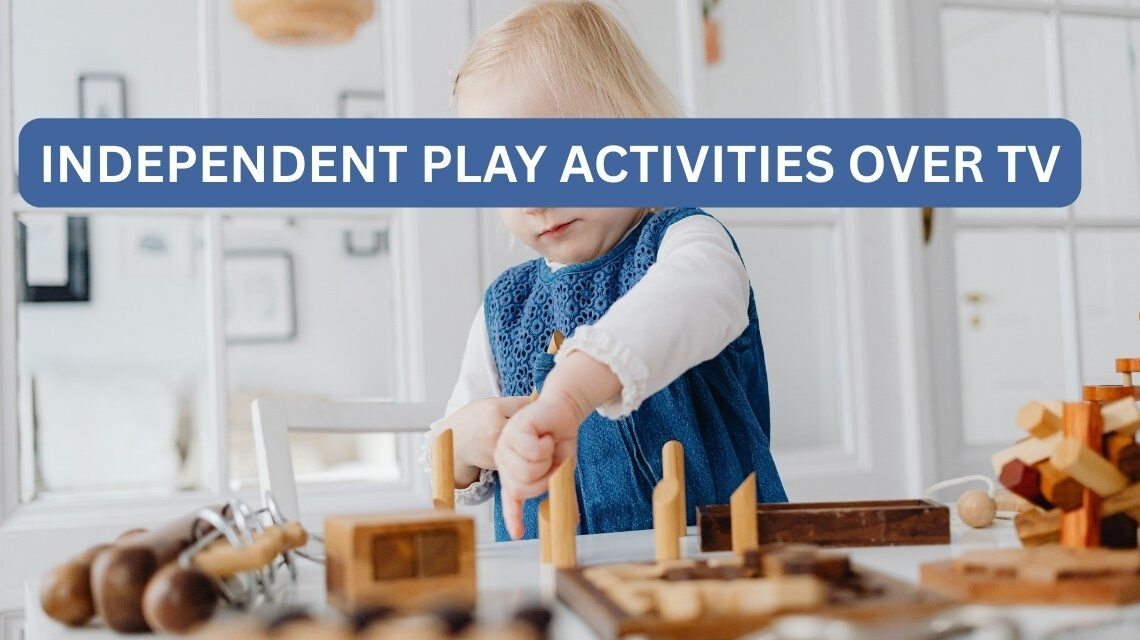
You want a break and you also want your child off the TV without a meltdown. This article gives you independent play activities instead of TV for kids that actually work in real homes, on real days, with real mess limits.
Pick 3 activities from the lists below, set them out in yes zones, and you can buy yourself 20–40 minutes today without negotiating screen time like it’s a hostage exchange.
GET: Visual timer
GET: Set of Activity Trays (instant independent play)
One more tiny win: the ideas are grouped so you can skim fast, set up in minutes and rotate before boredom hits.
Quick supplies you’ll use again
These are the items that get reused across dozens of activities, so you’re not reinventing the wheel.
Visual timer (so you stop being the timer)
Painter’s tape (roads, borders, parking bays, letters, hop paths)
Trays or shallow boxes (one activity per tray)
Washable markers and crayons
Stickers (reward, sorting, scenes, patterns)
Pipe cleaners and pony beads
Scissors and glue stick (for older kids)
Play dough or modeling compound
Small figures (animals, cars, people)
A yes basket (safe items only, always available)
If you only do one thing, do this: put the supplies in one tote.
When TV temptation hits, you grab the tote, not your phone.
The TV swap rule that stops arguments
This is the line that changes the mood.
“TV can happen after you try one play tray.”
Not after you “behave.”
Not after you “help.”
Just after one short, doable activity.
That’s it.
It turns TV into a follow-up, not the opener.
This matters because screen time limits are easier to manage when you have a plan.
The American Academy of Pediatrics and other pediatric guidance often emphasizes boundaries, quality content and routines that protect sleep, play and family time.
Also, for preschoolers, many sources commonly recommend keeping screen time modest and focused on high-quality programming.
You just need things to be workable.

Set up your house for independent play (without buying loads)
Independent play is less about your kid’s personality and more about the environment.
1) Make one “yes zone”
Pick one spot that stays consistent.
A corner of the living room is enough.
Put only safe items there.
No tiny parts for toddlers, no glitter, no paint you’ll resent.
2) Put the TV remote away early
If the remote is visible, kids ask.
If it’s gone, kids pivot faster.
This is not about being strict.
It’s about removing the trigger.
3) Rotate, don’t store everything out
Kids stick with activities longer when options feel fresh.
Rotation also keeps clutter down.
A simple system: 4 trays out, the rest put away.
Swap them every few days.
4) Match the activity to their body
Some kids need hands-busy calm.
Some kids need big movement.
This article includes both because a one-size list never works.
Zero prep swap-ins (fast alternatives when they ask for TV)
These are “I need something now” ideas.
No printing required.
1) Sticker Rescue
Hand them a sheet of stickers and a blank page.
Task: fill the page with patterns, rows or scenes.
For toddlers: big stickers only.
For older kids: add a challenge like “only triangles can touch.”
2) Tape Road
Lay painter’s tape roads on the floor.
Add parking bays and a “gas station” square.
Hand them cars and walk away.
It hits instantly.
3) Sock Match Mission
Dump a basket of clean socks.
Task: match pairs and stack them.
It’s real life help but it feels like a mission.
Win for you.
4) Toy Bath
Put plastic toys in a tub with a cloth and a little soapy water.
Task: wash, rinse, line up to dry.
This buys time and resets mood.
Also, toys get cleaned.
5) Post Office
Give them scrap paper and envelopes or folded paper.
Task: write or draw messages and “deliver” them to family doors.
Even pre-writers can do pictures.
Older kids can add stamps (stickers) and sorting.
6) Book Stack Challenge
Task: build the tallest book tower without it falling.
Then rebuild it in rainbow order or size order.
It looks simple.
It holds attention longer than you’d think.
7) Treasure Basket
Put 12 random safe items in a basket.
Task: sort into groups (soft, hard, round, not round).
For preschoolers, sorting is gold.
It uses focus without screens.
Set-it-and-forget-it activity trays (your quiet-time secret)
This is the part that makes independent play repeatable.
A tray is one contained activity with a clear start and finish.
Kids love that it looks “official.”
Tray rules that help it work
One tray, one job
No more than 10 pieces for toddlers
Store the tray exactly as you want it used
Put a small “finished spot” next to it
Now the trays.
8) Pom Pom Transfer Tray
Tools: spoon, tongs or an empty ice cube tray.
Task: move pom poms from one bowl to another.
Upgrade: time them with a sand timer.
It turns into focus play.
9) Bead Threading Tray
Tools: pipe cleaners, pony beads.
Task: fill the pipe cleaner, then bend into a bracelet.
Toddlers can use big beads and shoelaces.
Older kids can follow a color code.
10) Button Sorting Tray
Tools: buttons, muffin tin.
Task: sort by size or color.
Add a twist: “Only three buttons per cup.”
They have to plan.
11) Puzzle Swap Tray
Put one puzzle on the tray, nothing else.
Task: finish it, then put it back exactly as found.
It trains independence and follow-through.
And it’s calm.
12) Mini Figure Scene Tray
Tools: small animals or people, a piece of fabric as “land,” and blocks.
Task: build a scene and tell the story.
Story play can run long.
This is your quiet-time friend.
13) Washi Tape Art Tray
Tools: washi tape and card.
Task: tape lines, shapes, roads, then color inside.
No mess.
Big payoff.
14) Magnet Letters Tray
Tools: magnet letters on a cookie sheet.
Task: find letters in their name, then build simple words.
For preschoolers, do letter hunts.
For early readers, do word building.
15) LEGO Prompt Tray
Put a small pile of bricks and a prompt card.
Prompt: “Build a bridge,” “Build a bed,” “Build a tiny shop.”
It stays open-ended without you leading it.
Kids love prompts.
16) Play Dough Tool Tray
Tools: play dough, a roller, plastic knife, cookie cutters.
Task: make 10 “cookies,” then arrange by size.
Older kids can add a menu.
Toddlers can just press and squash.
17) Sticker Dot Counting Tray
Tools: dot stickers and paper with circles drawn.
Task: match dots to circles, count out loud.
It’s a math snack.
And it’s quiet.
18) “Fix It” Tray
Tools: a small screwdriver toy set and safe items that “need fixing.”
Task: tighten, take apart, put back.
This is fantastic for kids who need hands-busy calm.
Also strong for focus.
Table activities that don’t wreck your house
These are calm, contained activities.
Perfect for after school, before dinner or when everyone is tired.
19) Drawing Prompts Jar
Write 20 prompts on paper and put in a jar.
Examples: “Design a snack shop,” “Draw your dream bedroom,” “Invent a pet.”
They pick one and draw.
You don’t have to think.
20) Collage Box
Give them a box of safe scraps: old magazines, wrapping paper, flyers.
Task: cut and glue a themed page.
Theme ideas: “Things that fly,” “Blue page,” “Food page.”
Older kids can do a mini poster.
21) Card Sorting
A simple deck of cards works.
Task: sort by color, suit, number.
Add a mission: make patterns like red-black-red-black.
It’s calming and structured.
22) DIY Sticker Book
Give them a notebook.
Task: group stickers by theme over time.
This stretches one sticker pack across days.
It’s also oddly soothing.
23) “Menu Maker”
Task: write or draw a pretend menu.
Then “open” their cafe for teddies.
This is role play but it’s seated.
And it runs itself.
24) Stamp Station
Tools: stamps and ink pad.
Task: stamp patterns, stamp scenes, stamp letters.
Add a challenge card: “Make 3 rows of repeating patterns.”
Keeps it going.
25) Tape Measure Play
Tools: tape measure and objects.
Task: measure 10 things and write the numbers.
For younger kids, measure and compare: long, longer, longest. Kids love real tools.
Big-body indoor activities (still independent, still screen-free)
Some kids ask for TV because their body is asking for a reset.
This is where movement saves the day.
26) Obstacle Path Cards
Write 8 simple moves on cards.
Examples: crab walk, hop, tiptoe, bear walk, spin, jump, crawl.
Put cards in a line.
They follow the path.
27) Tape Hop Trail
Tape shapes on the floor.
Task: hop only on circles, step only on squares, tiptoe only on triangles.
It’s a brain and body task.
And it’s quiet enough for apartments.
28) Laundry Basket Basketball
Use soft balls or rolled socks.
Task: shoot from different spots.
Add levels: close, medium, far.
Kids can score themselves.
29) Balloon Keep-Up
Task: keep balloon off the floor for 2 minutes.
Add a rule: only elbows, only knees, only one hand.
It looks silly.
It works.
30) Dance Freeze
Music on, music off, freeze.
Kids pick the dance style.
This is basically mood medicine.
And it takes zero gear.
Outdoor independent play that runs itself
Outdoor time often boosts mood and focus.
It also reduces the “I need a show” vibe for many kids.
A recent UK conversation around play has highlighted how important access to play and outdoor activity is for children’s wellbeing.
You don’t need a big garden to use these.
31) Chalk Mission List
Write missions on the ground: hopscotch, target circles, number line.
They do the missions in order.
Add a “finish line.”
Kids like a clear ending.
32) Nature Color Hunt
Task: find something green, something rough, something smooth.
Put finds in a bucket, then sort.
This can take 20 minutes easily.
Even on a small walk.
33) Water Brush Paint
Tools: a bucket of water and a paintbrush.
Task: “paint” fences, walls, paving stones.
No paint.
No mess.
34) Mud Kitchen Lite
Tools: old pots, spoons, water, soil.
Task: mix, pour, strain.
Put it in one corner.
Contain it.
35) Ball Wall Games
Task: bounce a ball against a wall and catch.
Or roll it to a chalk target.
This builds coordination.
And it scales for ages.
Car and travel independent play
Screens feel tempting because travel is long.
These ideas keep hands busy.
36) Window Spotting Cards
Make simple cards: car, dog, bus, red door, bike.
Task: tick them off.
No printing needed if you write it on paper.
It works instantly.
37) Pipe Cleaner People
Tools: pipe cleaners.
Task: twist into people, pets, letters.
Add a prompt: “Make a person doing a sport.”
Keeps it interesting.
38) Sticker Scenes on a Clipboard
Tools: clipboard, paper, stickers.
Task: make a scene, then tell the story.
It’s quiet.
And it packs flat.
39) Audio Story Time
An audio player or audiobook can replace TV without the same zoning-out effect.
It also keeps hands free for LEGO or drawing.
If you want a calm corner idea that works for many ages, audio is a strong one.
It’s also nice for your nervous system.
Sibling-friendly independent play (so you aren’t refereeing)
Independent play doesn’t always mean alone in separate rooms.
It can mean “they can do it without you managing every second.”
40) Build a Town
Tools: blocks, cars, figures.
Task: build roads, houses, shops.
Add roles: one builds roads, one builds houses.
Then swap.
41) Toy Library
Task: set up a “library” with books and a checkout desk.
One child is librarian, one is reader.
Add a stamp card.
It feels official and lasts.
42) Restaurant at Home
Task: set up tables for teddies and dolls.
Write down orders, serve pretend food.
This often runs 30 minutes.
And you can fold laundry nearby.
43) LEGO Build Battle
Each child gets a small pile of bricks.
Prompt: “build something that moves,” then show and explain.
Explaining takes time.
Time is the point.
44) Board Game Basket
Put 3 simple games in one basket.
Task: pick one game and play.
READ: The Best Dice Games for Kids (easy, fast and fun)
The part nobody tells you: independent play starts small
If your child has been on TV a lot lately, expecting 45 minutes of solo play is a setup for disappointment.
Independent play time builds with practice and attention spans vary by age and temperament.
Some parenting resources describe very short independent play windows for very young children, then longer windows as kids grow.
So start tiny.
Aim for 5 minutes, then 8, then 10.
The goal is not silence.
The goal is “I can stay with something without you entertaining me.”
Transitions, timers and what to say (so it sticks)
This is the glue that makes the activities work.
Use a timer you can point to
A visual timer takes you out of the bad-guy role.
It becomes neutral.
Say this once: “When the red is gone, I’m available.”
Then follow through.
Give a start job
Kids begin faster if the first step is obvious.
Examples: “Open the tray,” “Put the pieces in the bowl,” “Pick one prompt.”
Keep TV as a planned choice
Screen time goes better when it’s scheduled, not begged for.
Guidance from pediatric and child health sources often points to boundaries, quality content and family routines as key.
If you want a tool that helps you set home rules without arguing, the AAP’s Family Media Plan exists for exactly this.
Use a calm closing line
When they finish, say: “You did that on your own. That’s a big skill.”
Kids repeat what gets noticed.
A pacing tip that saves the whole afternoon
Rotate every 10–20 minutes.
Do not wait for them to get bored.
A simple rotation that works for most ages:
- Tray activity
- Big-body indoor activity
- Snack
- Outdoor mission or chalk play
- Book or audio
This rotation keeps the day moving.
It also makes TV feel less necessary.
Make it feel personal: the quiet time menu that busy moms love
If you want independent play to last, give it a name.
Kids respond to simple rituals.
Try this: Quiet Time Menu.
It’s just 6 options written on paper.
Example menu:
- One tray
- One drawing prompt
- One puzzle
- One LEGO prompt
- One book
- One music or audio story
They pick one.
You stop negotiating.
And if you’re in a season where you feel touched-out and guilty for needing space, you’re not alone.
This is also a good moment to take a small step for you: READ: How to Start a Self-Love Journey (for Busy moms who want results in 30 Days)
If you need high-energy games for a family night that still avoid TV, you’ll like this:
READ:45 Best Christmas Games for Kids (Easy, no prep and classroom friendly)
If you have younger kids and need simple wins that don’t demand a big setup:
READ: Over 20 Magical Christmas Activities for Toddlers
Those posts also help you build a no screen toolkit across seasons.
More pageviews, more calm, more options.
FAQs
What is independent play?
Independent play is when a child plays without an adult directing every step even if the adult is nearby.
How do I get my child to play independently instead of watching TV?
Start with a short timer, offer one simple activity tray and keep the TV as a planned follow-up instead of the default.
How much screen time is recommended for preschoolers?
Many child health sources commonly recommend about one hour a day of high-quality programming for ages 2–5, with parents staying involved when possible.
Why is play important for kids?
Research reviews link play with benefits across cognitive, social, emotional and physical development.
How long should a toddler play independently?
Independent play time varies a lot by age and temperament. Some parenting resources suggest toddlers may manage short bursts at first, then build up over time with practice.
What are good quiet-time activities for kids?
Trays, puzzles, drawing prompts, sticker activities and simple building prompts tend to work well because they have clear start and finish points.
The part I want you to remember
You don’t need to ban TV to change your afternoons.
You just need a plan that shows up faster than the remote does.
Start with four trays, a timer and one yes zone.
Then use the swap line: “TV can happen after you try one play tray.”
Your child learns a skill that matters and you get something back too.
A few quiet minutes, a smoother dinner or the feeling that you’re not carrying the whole day alone.
If you want this to be even simpler, I’ve got you.
Pop your email in the box below and I’ll send you my Quiet Time Menu straight to your inbox. It’s a two-page printable your kids can actually use: pick one option, set a timer and start while you get 20 minutes back.
Send me the Quiet Time Menu 👇
One printable and a small tray rotation can change the next seven days more than a lecture ever will.
 0
0

 278
278