

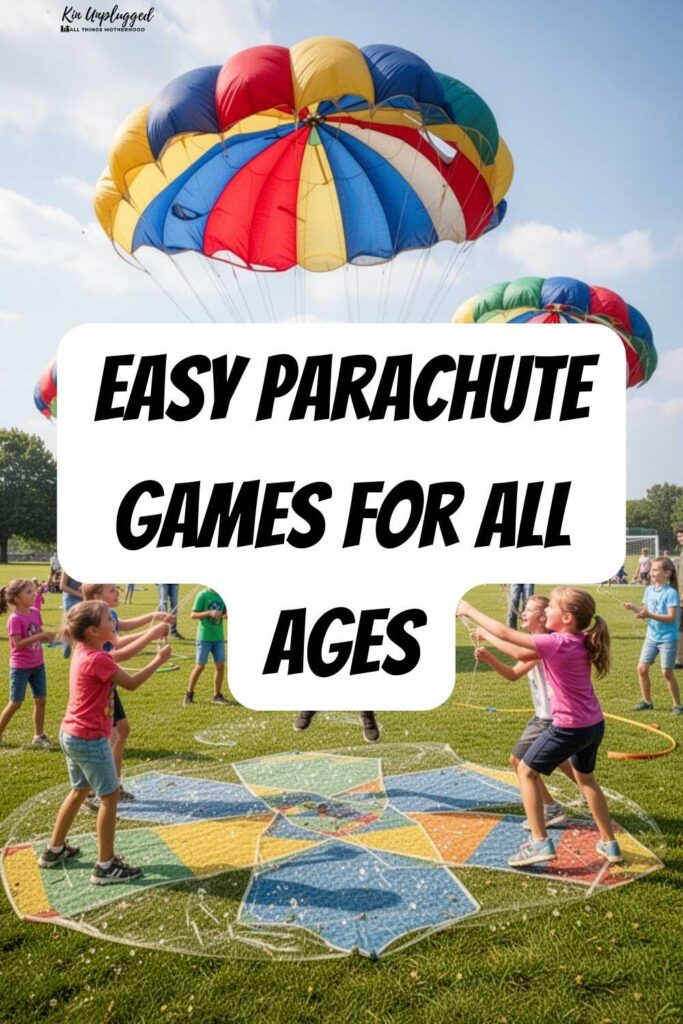
If you’re looking for parachute games for kids that work for toddlers, big kids, mixed ages and even those “help, I have 18 kids and a tiny space situations”, this post is your shortcut. A parachute is one of the few play tools that gets kids moving together without needing a bunch of equipment.
The trick is choosing games that match your group’s age, energy and attention span. You’ll find options below that are fast to explain, quick to reset and actually doable.
If you need a quick gear win before you plan anything else:
SHOP: 12–20 ft Kids Parachute (handles and carry bag)
SHOP: Foam Balls Set for Parachute Play (soft, quiet, safe indoors)
Those two things cover most games in this guide. After this, you’re set for months.
What makes parachute games work so well?
Parachute games naturally teach teamwork. They also teach timing, turn-taking and body control without kids feeling like they’re being taught anything.
Group movement games like this are often used in PE because they support coordination and social skills. The CDC also highlights play and movement as key parts of child development, including social interaction and self-regulation.
That’s the real benefit. It’s fun on the surface and skill-building underneath.
Quick supplies you’ll use again
Keep this simple. You do not need a cupboard full of props.
- Parachute (size depends on group, see next section)
- 6–12 foam balls
- 10 beanbags (optional)
- Painter’s tape (for start circles or boundary spots)
- A timer (phone is fine)
If you’re running this in a classroom or club, store each game’s props in a labeled zip bag. It saves your day.
Parachute size guide for real life

Pick based on your group size, not your ambition.
| Group size | Suggested parachute size | Best for | Notes |
| 4–8 kids | 6–10 ft | small groups, home play | fewer handles needed issues |
| 8–16 kids | 12 ft | parties, small classes | easiest all-rounder |
| 16–24 kids | 16 ft | PE, large groups | needs a wider space |
| 24–40 kids | 20–24 ft | big classes, events | outside is easier |
If you’re working with mixed ages, go slightly bigger. Bigger gives you margin.
Safety rules that stop injuries fast
These are quick. They matter.
Rule 1: Kids hold handles, not fabric edges.
Handles reduce finger pinches and grip slips.
Rule 2: No wrapping the parachute around bodies.
It turns fun into panic fast.
Rule 3: Choose soft items only.
Use foam balls, scarves or beanbags. Skip hard plastic.
The American Academy of Pediatrics supports active play for healthy development but also emphasizes age-appropriate safety and supervision.
Game picker table (choose in 30 seconds)
Use this when you’re tired and need a fast decision.
| Game | Best ages | Space | Noise | Mess | Energy |
| Popcorn | 3–12 | medium | medium | low | high |
| Mushroom | 4–12 | medium | medium | low | medium |
| Color Switch | 5–12 | medium | low | low | medium |
| Treasure Island | 3–10 | small | low | low | low |
| Clean-Up Storm | 4–12 | medium | medium | low | high |
| Shark Attack | 6–12 | larger | high | low | high |
| Quiet Waves | 2–8 | small | low | low | low |
If you’re in a classroom, pair one high-energy game with one calmer game. It keeps the room manageable.
Parachute games for toddlers and preschoolers
1) Tiny Waves
Adults and kids hold the parachute low. Make gentle waves like the sea.
Add a script: Small waves. Big waves. Sleepy waves.
Toddlers follow rhythm better than rules.
Best for: calming down after active play.
2) Peekaboo Lift
Everyone lifts the parachute up and down slowly. When it goes up, kids can peek underneath.
Keep it slow.
Fast lifts overwhelm little ones.
Best for: shy toddlers joining in without pressure.
3) Teddy Bear Ride
Place 2–4 plush toys in the middle. Make waves without tossing them off.
Goal: Keep teddy safe.
Kids love a mission.
Best for: teaching control.
4) Treasure Island
Put beanbags or soft toys in the middle. Kids gently float them to one edge and collect.
Switch roles so different kids get the collector job.
It builds turn-taking naturally.
Decision path: If your child struggles with turn-taking, check out 25 Simple Turn Taking Games for Toddlers, Preschoolers and Big Kids.
5) Color Hunt Lift
Call a color. Kids wearing that color step under the parachute for a quick hello, then step back.
Keep it quick.
Long turns cause wandering.
Best for: mixed groups where toddlers need structure.
Parachute games for mixed ages
6) Popcorn (the classic but make it smarter)
Put 6–10 foam balls on the parachute. Shake to make them bounce.
New rule that keeps it controlled: Only wrist shakes, no full-arm yanks.
Count how many stay on after 20 seconds.
Why it works: it’s loud fun with built-in teamwork.
7) Popcorn with Jobs
Assign roles:
- Shakers (all kids)
- Spotters (2 kids count balls)
- Rescuers (2 kids pick up fallen balls)
Rotate every round.
This reduces bossy behavior because everyone gets a job.
8) Clean-Up Storm
Scatter foam balls around the room. Kids must use the parachute to scoop balls onto it by dragging gently along the floor.
Then do Popcorn for 10 seconds.
Then deliver balls into a basket.
Best for: rooms that get messy fast.
9) The Quiet Engineer
Put 3 beanbags on the parachute. Goal: move them to a marked landing zone (taped circle) without dropping.
No talking for the first round.
Talking optional after.
This turns loud play into focused teamwork.
10) Moonwalk Relay
Kids walk in a circle holding handles while the parachute stays steady at waist height.
Add a twist: Walk like a slow astronaut.
It lowers energy without killing fun.
This is a great reset before snack time.
Parachute games for big kids
11) Shark Attack (controlled version)
One child is the shark under the parachute. They gently pull foam balls through a hole to steal them.
Kids on top must protect balls by moving them away with waves.
Safety note: No grabbing ankles. No yanking bodies. Shark only pulls balls.
12) Volcano
Put balls in the middle. Kids start with small waves and slowly build bigger waves until balls erupt.
Add a countdown.
Big kids love a build-up moment.
Best for: groups that need a clear start and finish.
13) Parachute Soccer
Place one foam ball in the middle. Split the parachute into two teams.
Goal: work together to roll the ball off the other team’s side.
Rule that keeps it fair: hands stay on handles the whole time.
If a hand comes off, the point doesn’t count.
14) Pattern Switch
Call out patterns:
- Two small waves, one big wave.
- Left side up, right side down.
- Freeze.
This turns play into listening practice without kids noticing.
15) Handle Swap Sprint
Kids walk clockwise and every 10 seconds swap to the next handle.
This is excellent for coordination.
It also quickly shows who needs more support.
Keep it short. Two rounds max.
Parachute games that build confidence for shy kids
Shy kids often join in faster when they have a role that isn’t loud.
16) The Gatekeeper
One child is in charge of opening the gate by lifting a small section so others can pass under.
It gives power without performance.
Decision path: See Games for shy kids for more low-pressure play.
17) Secret Message Pass
Kids stand holding the parachute. You quietly tell one child a simple instruction like make tiny waves and they lead the group without speaking.
Kids feel capable.
No spotlight.
18) Star Keeper
Place one special star object (gold foam ball) in the middle. Group goal is to keep it centered for 30 seconds.
This is teamwork without competition.
Shy kids often like cooperative goals.
Classroom-friendly parachute games
If you’re using this at school, transitions matter more than the game itself.
19) Station Timer Waves
Run parachute games as a station for 6–10 minutes. Then rotate.
This pairs perfectly with your classroom format.
20) Silent Start
First round is silent. Second round can be normal.
This immediately changes classroom tone and stops volume creep.
Teachers love it because it feels controlled.
21) Number Call Under
Call a number. That number of kids runs under the parachute and back to their handle.
Keep numbers small.
This prevents pile-ups.
Unique parachute games people aren’t posting everywhere
These are the ones that help your post stand out.
22) Meadow Fireflies
Give 6–10 kids tiny battery tea lights (or glow sticks for older kids). Everyone holds the parachute low and gently waves so the lights glide across.
Goal: guide fireflies into a taped jar zone.
It looks amazing at evening events.
It also stays calm.
23) The Library Slide
Put laminated letter cards in the middle. Kids must slide one chosen letter to an edge using controlled waves.
Then the group says one word starting with that letter.
This mixes movement with language.
It’s great for K–2.
24) Weather Report
Kids pick the weather:
- Drizzle = tiny waves
- Wind = medium waves
- Storm = big waves
- Sunrise = slow lift and hold
- Night = parachute down and still
It’s imaginative without needing props.
25) Handle Buddies
Pair kids as buddies. They must keep their handles level with each other the whole round.
This reduces rough play because kids anchor to a partner.
It also supports kids who struggle with coordination.
How to run parachute games without losing control
Here’s your format.
1. Explain in one sentence.
2. Demo for 5 seconds.
3. Set a timer.
4. Stop while it’s still going well.
That last part matters.
Kids will beg for one more round.
That’s when you stop.
A 20-minute parachute session plan
If you want a simple structure, use this.
- 3 minutes: Tiny Waves
- 5 minutes: Popcorn
- 5 minutes: Clean-Up Storm
- 4 minutes: Pattern Switch
- 3 minutes: Quiet Waves close
FAQs
What are parachute games for kids?
Parachute games are group movement activities using a play parachute where kids work together to lift, wave, bounce and coordinate objects or actions.
What age are parachute games suitable for?
Most parachute games can work from ages 2–12 with simple modifications like slower waves for toddlers and more structured rules for older kids.
How many kids do you need for parachute games?
You can play with as few as 4 kids but 8–20 kids is ideal for most classic parachute games.
Are parachute games safe for toddlers?
Yes, with supervision and gentle wave games. Use handles, avoid wrapping the parachute around bodies and use soft props only.
What is the most popular parachute game?
Popcorn is one of the most popular parachute games because it’s quick, energetic and easy to understand.
If you want this to be even easier next time, join my email list. I send practical, low-prep game ideas you can use immediately, plus simple planning shortcuts for busy moms who don’t have time to hunt for ideas every day.
You’ll get fewer decisions and better playdays.
 0
0

 278
278