
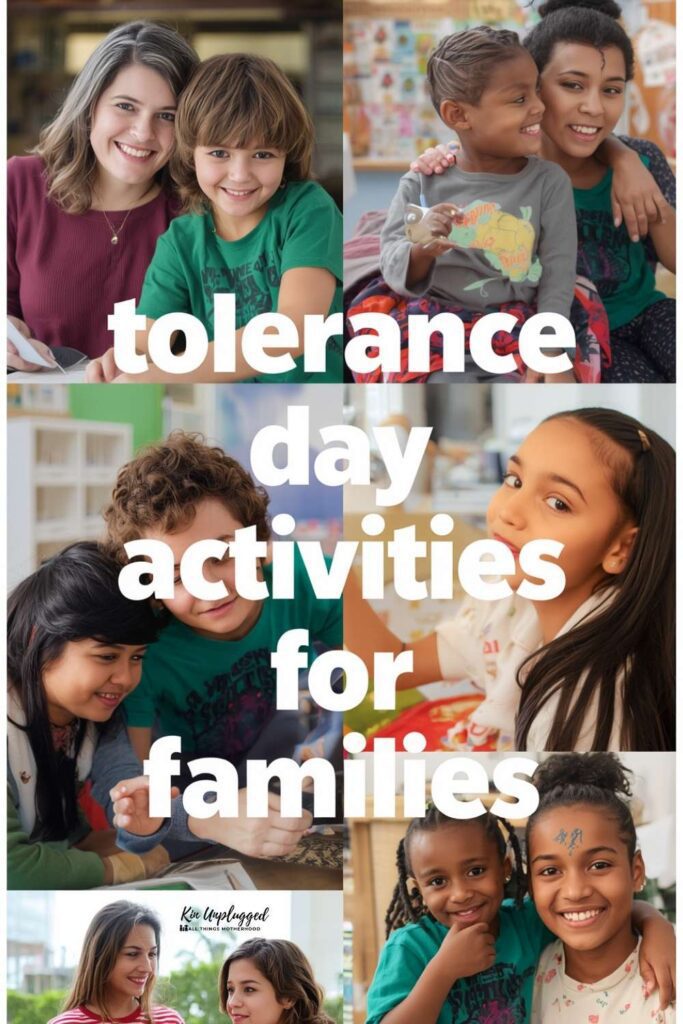
The best Tolerance Day activities for families with kids help children listen, notice unfairness and respond respectfully when someone’s life looks different from their own. Choose one story, one perspective-taking game and one small family action, then keep the conversation going during ordinary moments after the activity ends.
International Day for Tolerance takes place every year on November 16. The aim is not to convince children that every opinion is correct; it is to teach respect, fairness and the dignity of people across differences in culture, religion, language, race, ability, family structure and belief.
A six-year-old does not need to deliver a keynote speech on peaceful societies before lunch. Children need short, honest experiences that connect tolerance to playgrounds, family conversations, online spaces and the deeply serious politics of who gets the blue cup.
SHOP CHILDREN’S BOOKS ABOUT DIFFERENCES | UK
SHOP FAMILY CONVERSATION CARDS | UK
SHOP SKIN TONE ART SUPPLIES | UK
Tolerance Day Family Activity Planning Table
Most families only need a few basic supplies. Books, paper, colouring materials, conversation cards and a world map can support several activities long after November 16 has passed.
| Activity style | Best age range | Time needed | Useful materials | Main family skill |
|---|---|---|---|---|
| Picture-book discussion | 3 to 8 | 15 to 25 minutes | Inclusive storybook, cushions | Listening and noticing feelings |
| Family identity map | 5 to adult | 30 minutes | World map, stickers, photographs | Belonging and family history |
| Fair or equal experiment | 5 to 12 | 15 minutes | Cups, blocks or snacks | Understanding fairness |
| Respectful disagreement game | 7 to adult | 20 minutes | Conversation cards, timer | Calm disagreement |
| Advertising detective activity | 8 to adult | 30 minutes | Magazines or saved adverts | Recognising stereotypes |
| Accessibility walk | 6 to adult | 30 to 60 minutes | Notebook, phone camera | Noticing barriers |
| Community welcome project | 6 to adult | 45 minutes | Cards, paper bags, local information | Practical inclusion |
| Digital comments workshop | 10 to adult | 25 minutes | Sample comments, paper | Online responsibility |
| Family listening circle | Every age | 15 minutes | Talking object or timer | Listening without interrupting |
| Seven-day family pact | 4 to adult | 10 minutes daily | Printed chart, pens | Repeated action |
For one simple family evening, pick a book discussion, the Fair or Equal experiment and a seven-day family pact.That combination explains the idea, lets children test it and gives the family something useful to practise afterward.
What International Day for Tolerance Means for Children
UNESCO describes tolerance as active respect and appreciation for human diversity, supported by knowledge, communication and freedom of thought. It is more substantial than reluctantly putting up with somebody while making a face that could curdle milk.
Tolerance also has limits. Children should never be taught to accept bullying, discrimination, cruelty, harassment or unsafe behaviour in the name of being tolerant.
A useful family definition is:
Tolerance means treating people fairly and respectfully, even when their beliefs, traditions, bodies, families, languages or choices differ from our own.
Children can disagree and still use respectful language. They can also defend a boundary, report harmful behaviour and challenge an unfair comment without becoming cruel themselves.
How to Make Tolerance Activities Feel Natural
Long lectures can make a useful subject feel like a punishment. Short activities work better when children are given something to examine, move, draw, taste, question or solve.
Perspective-taking can be practised through stories, discussion and role-play. Research involving young children has examined structured empathy activities and story-based role-play as ways to support empathy and understanding of other viewpoints.
The adult role matters too. Children listen to the lesson but they also notice who gets interrupted at dinner, which accents are mocked on television and how adults describe people they disagree with.
The strongest activity is followed by consistent family behaviour. Otherwise, tolerance becomes a paper sign on the fridge while everyone carries on as before.
1. Start With the Two-Viewpoint Breakfast
Place two chairs on opposite sides of the breakfast table. Read a short situation, then ask family members to explain what each person might be thinking.
A suitable example might involve two children who both believe they were first in a queue. One child may have been waiting nearby, while the other only noticed the space when it became free.
The goal is not to choose a winner immediately. The goal is to prove that two people can experience the same moment differently.
Make It Work for Different Ages
Young children can name one feeling for each person. Older children and teens can identify missing information and suggest questions that might prevent an unfair judgement.
2. Make a Family Name Story Board
Write each family member’s full name on a separate card. Add the meaning, pronunciation, origin, person who chose it or family story attached to it.
Some names may have several possible origins, while others may be recently invented or selected simply because somebody liked the sound. That is still part of the story.
End by practising the correct pronunciation of every name. Learning to say a person’s name properly is a small form of respect with a surprisingly high success rate.
3. Play the Say My Name Game
Choose names from books, sports, music, school friendships or local community life. Listen to reliable pronunciation recordings, repeat the names and notice which sounds feel unfamiliar.
Nobody should be asked to shorten a name merely because another person finds it inconvenient. A name is not an administrative problem wearing shoes.
Older children can discuss what happens when people repeatedly joke about, alter or avoid someone’s name. The family can then agree on one polite phrase for asking about pronunciation.
4. Try the Fair or Equal Experiment
Give every family member the exact same item, even when their imaginary needs differ. One person might receive a pencil despite needing scissors, while another receives a small chair despite being assigned a task at a high table.
Ask one question: Was everyone treated equally and was everyone treated fairly?
This activity shows that equality and fairness are related but not always identical. Giving everyone the same support can still leave some people unable to participate.
Keep the Example Sensible
Do not use real food restrictions, medical needs or family vulnerabilities as entertainment. Invented situations keep the discussion focused without putting one child’s private experience on display.
5. Read a Story and Stop Before the Ending
Choose a picture book or chapter that includes exclusion, a misunderstanding, a new arrival or an unfamiliar family tradition. Stop before the problem is resolved and ask what each character might need.
Avoid asking only, “Who was wrong?” That question can close the discussion before children have examined fear, confusion, habit, power or missing information.
After finishing the story, compare the family suggestions with the author’s ending. Research on story-based role-play suggests that reading, discussion, acting and reflection can work together to support perspective-taking.
6. Build a Family Belonging Map
Place a world map or local map on the table. Mark birthplaces, family moves, languages, meaningful trips, friendships and places connected to favourite family foods.
A family with roots in one small area still has a story worth mapping. The board can include places connected to neighbours, school friends, community events and books that have mattered.
The point is not to collect countries as decorative stickers. It is to show that identity develops through people, movement, memory and place.
7. Make a Recipe With a Real Story
Choose one family dish and record the story behind it. Include who usually makes it, when it is served, how the recipe changed and which family member refuses to follow the measurements.
Another family or culture’s recipe can also be explored but it needs context. Find out where the dish comes from, when it is commonly eaten and how people from that community describe it.
Food should open a conversation, not reduce an entire culture to one attractive plate and a themed napkin.
8. Set Up the Same Object, Different Meaning Challenge
Place an ordinary object on the table, such as a scarf, bowl, candle, shoe or piece of bread. Ask everyone to list different jobs or meanings that object could have.
A scarf might be clothing, religious dress, a dance accessory, sun protection, a family heirloom or part of a uniform. The object stays the same while its meaning changes.
This activity helps children pause before deciding that an unfamiliar practice is strange. “I have not seen that before” is accurate; “that is weird” is usually just impatience wearing a small hat.
9. Run a Respectful Disagreement Game
Write harmless opinions on cards: mornings are better than evenings, books are better than films, pineapple belongs on pizza or socks should never be worn in bed.
Each person must respond using one respectful sentence before giving a different opinion. Useful openings include, “I understand that point,” “My experience has been different,” and “What makes that important?”
The pineapple discussion may become heated because families have limits. Still, the language can remain civil.
Add a More Serious Round for Teens
Older children can discuss school uniforms, phone rules, public protests or community decisions. The aim is to separate a person’s humanity from agreement with every idea they hold.
10. Find the Invisible Rules
Ask family members to list unwritten rules they have learned at home, school, clubs or social events. Examples might include removing shoes indoors, greeting every adult, waiting to eat or avoiding eye contact with elders.
Compare the rules without ranking one family as better. Behaviour that appears rude in one setting may be respectful in another.
This is particularly useful for children who assume their household habits are universal laws. Every family eventually discovers that its completely normal way of doing something is, in fact, highly specific and baffling to everybody else.
11. Become Advertising Detectives
Collect age-appropriate adverts, toy catalogues or product photographs. Ask who appears, who is missing and what assumptions are being made about jobs, families, bodies, interests or gender.
Children can circle repeated patterns. Older children can examine who is presented as clever, attractive, powerful, helpless, funny or in need of rescue.
The goal is not to treat every advert like evidence in a major criminal case. It is to help children notice that repeated images can influence expectations without announcing what they are doing.
12. Redesign a Toy Shop Shelf
Draw a pretend shop shelf containing dolls, building sets, art supplies, sports equipment, books and dressing-up clothes. Ask family members to arrange it without dividing everything into rigid groups for boys and girls.
Add toys showing different skin tones, disabilities, family structures, ages and professions. Representation should be part of the full shelf, not a lonely special section placed near the floor.
Children can then design one product box that welcomes more people. The wording, images and colour choices all need to support that goal.
13. Fill the Missing Voice Page
Choose a familiar fairy tale, family story or historical account. Identify one character whose thoughts are barely mentioned, then write a short page from that person’s point of view.
The character might be a sibling, neighbour, newcomer, worker or person who arrives after the main action. Ask what information that person knows and what the original storyteller might have missed.
This teaches children that the loudest voice is not automatically the complete one. History, family arguments and group chats could all benefit from remembering that.
14. Make a Family Language Wall
Add greetings, thank-yous and welcoming phrases in languages connected to family, friends, school or the local community. Include audio practice so pronunciation receives as much attention as decoration.
Languages should be attached to real people and places where possible. Random words copied without context can turn a thoughtful display into linguistic wallpaper.
Leave room for children to add new phrases throughout the year. A living wall is more useful than a one-day craft that retires immediately to the recycling pile.
15. Carry Out an Accessibility Walk
Visit a familiar place and look for barriers without pretending to have a disability. Check entrances, signs, noise levels, seating, toilets, lighting, pathways and the amount of information available before arrival.
Do not blindfold children or ask them to mimic a physical condition. Disability simulations can oversimplify real lives and turn access needs into a short game.
Instead, examine the environment. The useful question is not “What would it feel like to be that person?” but “What is stopping more people from taking part?”
16. Test the Family Activity for Fair Access
Choose a common family activity such as a film night, picnic, game or day out. Ask what might make participation difficult for a toddler, older relative, person with sensory sensitivities, person with limited mobility or family member with a food allergy.
Change the plan so more people can take part without being treated as a problem. This may involve subtitles, quieter seating, food labels, shorter sessions or accessible transport.
The activity turns inclusion into practical planning. Good intentions are lovely but a venue with twelve steps and no alternative route remains twelve steps.
17. Make a Welcome Pack for a New Family
Put together a small pack for a new neighbour, school family or community member. It might include a card, local map, transport information, play-area details and carefully chosen sealed treats.
Avoid assuming language, religion, diet or family structure. A simple question about what would be useful is more respectful than presenting a bag full of guesses.
Children can write one welcoming sentence without demanding friendship or personal information. Inclusion begins with an open door, not an interrogation under hallway lighting.
18. Hold a Family Listening Circle
Choose a small object to show whose turn it is to speak. Each person answers one question while everyone else listens without correcting, solving or interrupting.
Good prompts include:
- When did someone make space for a different opinion?
- What helps a person feel welcome?
- What makes it hard to speak honestly?
- Which family habit shows respect?
- What could happen differently next time?
Adults should follow the same rules as children. A listening circle loses some credibility when a parent interrupts every answer to explain what the child actually thinks.
19. Sort Different, Unkind and Unsafe
Write short situations on cards and sort them into three groups: different, unkind and unsafe. Children need to know that these categories are not interchangeable.
Eating unfamiliar food, speaking another language or wearing different clothing belongs under different. Name-calling may be unkind, while threats, violence and targeted harassment belong under unsafe.
Tolerance applies to human difference, not to harmful behaviour. Unsafe situations require help, boundaries and action.

20. Run a Digital Comments Workshop
Write fictional online comments ranging from respectful disagreement to jokes, exclusion, rumours and direct abuse. Ask older children and teens what each comment does to the conversation.
For each harmful comment, write three possible responses: report it, challenge it calmly or leave the exchange and seek help. Not every stranger on the internet deserves a family member’s time, energy and twelve carefully numbered paragraphs.
Discuss screenshots, group chats and forwarding private content. Digital tolerance still requires boundaries and accountability.
21. Begin a Seven-Day Notice, Ask and Include Pact
Finish Tolerance Day with one small family practice for the following week. Each day includes three actions: notice someone being left out, ask one respectful question and include someone in a practical way.
The action might involve learning a name, making room at a table, checking access needs or listening without preparing a reply. Record actions without turning them into a competition.
At the end of the week, discuss which action felt natural and which required more thought. The family can keep one practice as part of its ordinary routine.
Tolerance Day Activities by Age
The same principle can work across several age ranges when the language, time and responsibility change.
| Age range | Best activity approach | Useful prompt | Keep it manageable by |
|---|---|---|---|
| Ages 3 to 5 | Stories, faces, colours and simple choices | “How might they feel?” | Keeping activities under 15 minutes |
| Ages 6 to 8 | Sorting games, maps and simple role-play | “What might we be missing?” | Using one situation at a time |
| Ages 9 to 12 | Fairness experiments and media analysis | “Who gets included here?” | Letting children explain their reasoning |
| Ages 13 to 17 | Digital conduct, disagreement and community action | “Who is affected by this choice?” | Avoiding childish scripts |
| Mixed ages | Food stories, listening circles and family maps | “What can everyone add?” | Giving different jobs by age |
Activities for Toddlers and Preschoolers
Use books showing varied families, homes, bodies and daily lives. Let children choose skin-tone art materials, practise names and notice feelings.
Keep explanations concrete. “People can do things differently and still deserve kindness” is more useful than a long definition full of abstract language.
Activities for Primary-Age Children
School-age children can compare viewpoints, test fairness and spot stereotypes. They are old enough to explain why a rule might help one person and disadvantage another.
Give enough time for children to change their minds. The first answer is often the quickest one, not the most thoughtful.
Activities for Teenagers
Teens can discuss bias in media, online behaviour, community access and respectful disagreement. Give them genuine decisions rather than presenting a preschool craft with more complicated scissors.
A teenager may reject a formal family activity while joining a discussion in the car ten minutes later. The conversation still counts, even without a laminated worksheet witnessing it.
A 60-Minute Tolerance Day Family Plan
A useful family session can fit into one hour and still lead somewhere meaningful.
| Time | Family activity |
|---|---|
| First 10 minutes | Explain tolerance and its limits |
| Next 15 minutes | Read a story or use the Two-Viewpoint activity |
| Next 15 minutes | Complete Fair or Equal or the Invisible Rules game |
| Next 10 minutes | Choose one community or family action |
| Final 10 minutes | Begin the seven-day pact |
Keep snacks simple and activities close together. Nobody needs themed biscuits shaped like international diplomacy unless baking them sounds genuinely enjoyable.

A 15-Minute Tolerance Day Activity
Read one short scenario involving two viewpoints. Give each family member one minute to explain what each person may be thinking.
Sort the behaviour into different, unkind or unsafe. End by choosing one sentence the family can use during future disagreements.
A useful sentence is: “I disagree with that idea but I can still listen and speak respectfully.”
Tolerance Activities That Can Cause More Harm Than Good
A well-meant activity can still reduce people to costumes, food or a short list of unusual facts. The following shortcuts deserve a firm no.
Do Not Turn Cultures Into Fancy Dress
Traditional clothing may carry religious, historical or community meaning. Treating it as a quick costume can teach children that somebody else’s identity is a prop.
Use books, first-person accounts, museums and community-led events instead. Context matters more than matching accessories.
Do Not Force Children to Share Personal Identity Details
No child should have to explain a religion, disability, family structure, migration story or private experience on demand. Participation needs room for privacy.
Families can discuss broad examples or fictional situations. A child’s life is not the classroom exhibit that saves everyone else from doing research.
Do Not Teach Tolerance as Silence
Children should not remain quiet when somebody is targeted. Respectful action may involve speaking up, getting an adult, documenting a problem or supporting the person affected.
Being polite to harmful behaviour is not the objective. Human dignity is.
Do Not Pretend Difference Never Matters
Saying everyone is exactly the same can sound reassuring but it may ignore real identities and real barriers. People can share equal worth while having different experiences.
Children can notice difference without treating it as a problem. That skill is more useful than pretending nobody has noticed anything.
Do Not Make Kindness Performative
A family action should meet a real need rather than provide a photograph. Ask what would help, protect privacy and let the act remain quiet.
Tolerance is shown most clearly when no certificate, camera or public announcement is involved.
Simple Materials Worth Keeping for Family Activities
A small activity box can support Tolerance Day, family meetings, school holidays and difficult conversations throughout the year.
Useful materials include:
- Inclusive picture books and age-appropriate novels
- Family conversation cards
- Skin-tone pencils, crayons or paints
- A world map or map puzzle
- Plain cards and removable notes
- Child-safe scissors and glue
- Magazines or printed advertising samples
- A timer for listening activities
- A notebook for family action plans
The materials do not need to arrive as one giant branded kit. A thoughtful book, ordinary paper and twenty calm minutes can do far more than a box containing forty-seven pieces and no clear reason for any of them.
Keep the Conversation Going After November 16
Tolerance cannot survive as a yearly activity placed between breakfast and football practice. It grows through repeated choices about language, friendship, access, disagreement and whose story receives attention.
The email list keeps thoughtful family traditions, practical activities and useful conversations close throughout the year. It is a place for ideas that help families know one another better while making more room for people beyond the front door.
Frequently Asked Questions About Tolerance Day Activities
When Is International Day for Tolerance?
International Day for Tolerance takes place every year on November 16. UNESCO proclaimed the observance in 1995 and the United Nations General Assembly later invited Member States to mark the date through public and educational activities.
What Is International Day for Tolerance?
International Day for Tolerance is a United Nations observance focused on respect, human rights, dialogue and appreciation of human diversity. It also draws attention to the damage caused by discrimination and intolerance.
How Can Tolerance Be Explained to a Child?
Tolerance means treating people fairly and respectfully when they look, speak, live, think or believe differently. It does not mean agreeing with every opinion or accepting harmful behaviour.
What Are Examples of Tolerance at Home?
Examples include listening without interrupting, pronouncing names correctly, respecting religious practices, avoiding stereotypes and making family activities accessible. Calm disagreement is another important example.
What Is a Good Tolerance Activity for Young Children?
A picture book followed by simple questions about feelings and fairness works well for young children. Keep the discussion short and connect it to situations they recognise from home, nursery or the playground.
How Can Families Teach Tolerance Without Lecturing?
Stories, sorting games, cooking, maps, role-play and real community action make the subject easier to understand.One focused activity followed by ordinary family practice is more effective than a long speech.
Does Tolerance Mean Accepting Bad Behaviour?
No. Tolerance does not require anyone to accept bullying, discrimination, threats, harassment or unsafe conduct.Children can respect human difference while holding firm boundaries against harm.
Why Is Tolerance Important for Children?
Tolerance helps children live, learn and solve problems with people whose experiences differ from their own. It supports respectful communication, perspective-taking and fair participation.
How Can Teenagers Practise Tolerance Online?
Teenagers can check facts, avoid sharing humiliating content, challenge stereotypes calmly and report targeted abuse. They can also leave exchanges that have become unsafe or deliberately cruel.
What Books Help Teach Children About Tolerance?
Books showing different families, cultures, abilities, religions and viewpoints can begin useful conversations. First-person stories and books written by people connected to the experiences being described are especially valuable.
What Is the Difference Between Tolerance and Kindness?
Kindness concerns helpful and considerate behaviour, while tolerance includes respecting rights and differences even during disagreement. A person can behave pleasantly without confronting unfairness, so tolerance also requires thought and action.
How Can Tolerance Be Practised Every Day?
Families can practise it through language, listening, inclusive invitations, fair rules and thoughtful responses to unfamiliar customs. The seven-day Notice, Ask and Include pact is a simple place to begin.

Finally…
The best Tolerance Day activities for families with kids do not end with a colouring sheet and a vague instruction to be nice. They help children notice another viewpoint, understand the difference between fairness and sameness and act when somebody is excluded.
November 16 provides a reason to begin but the work belongs in ordinary family life. It appears in names pronounced carefully, disagreements handled with dignity and small decisions that tell another person there is room for them here.
 0
0

 278
278