
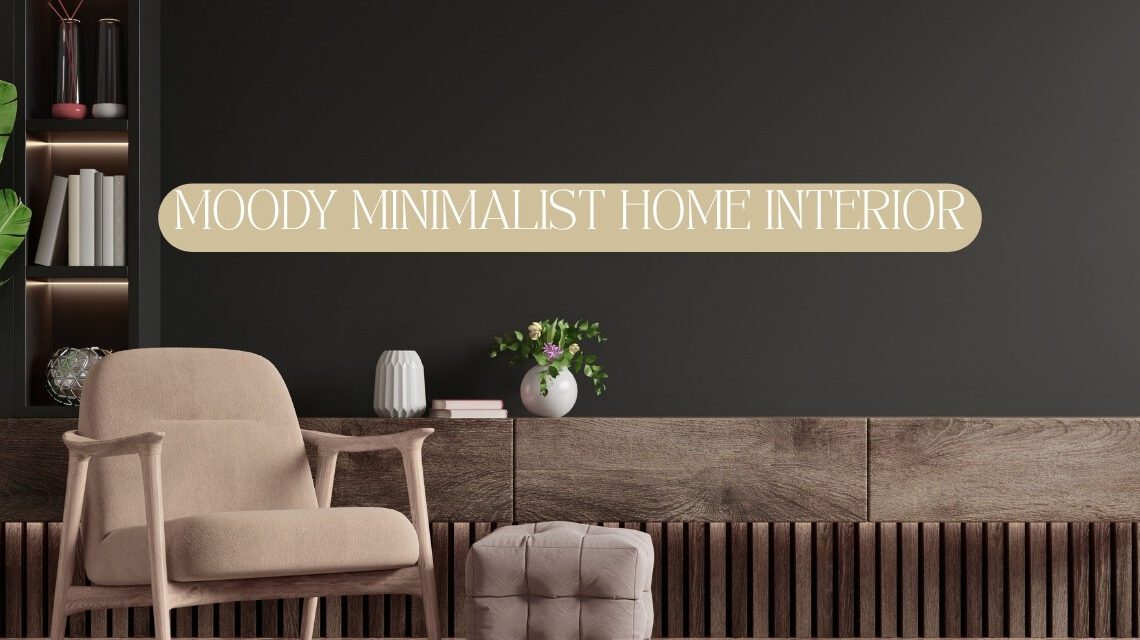
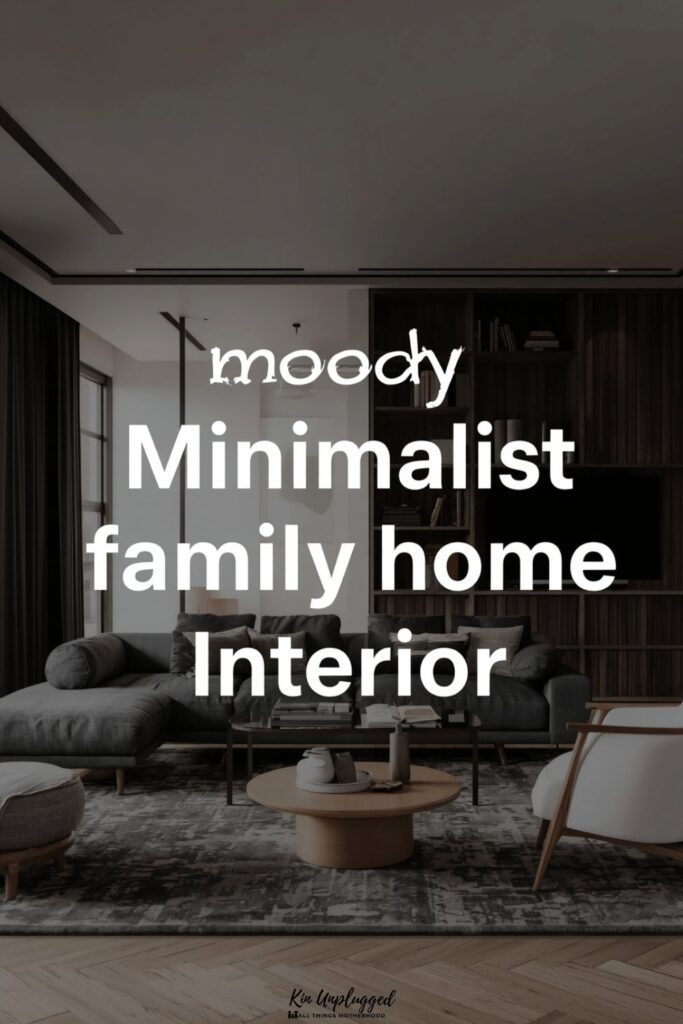
A moody minimalist interior works in a family home when the dark colours are balanced with clean lines, soft texture, closed storage and enough breathing space for real life. The simplest formula is this: deep matte walls, low visual clutter, natural materials, layered lighting, practical furniture and one personal detail in every room.
It should feel calm and grown-up but not cold.
YOU’LL LIKE: Top 25 Hacks to live a simplified family life (with kids!) that actually work
Think charcoal walls, walnut wood, low linen sofas, blackened bronze lamps, soft rugs, clay ceramics, warm bulbs, cream cushions and hidden baskets for toys.
READ: How to be a Minimalist Mom: 7 Research backed habits for busy homes
Not empty.
Not severe.
Not a home where everyone feels like they need permission to sit down.
The best version of moody minimalism is not about having less personality. It is about giving the home fewer, better signals.
Dark vibes meet sleek simplicity.
Deep Scandinavian hues meet Japandi calm.
Bare essentials meet family life.
That is the balance.
READ: Mother-Baby Love Wall Art: Minimalist Printable Decor for Family Homes – $7.50
What Is A Moody Minimalist Interior?
A moody minimalist interior is a pared-back home style built around darker colours, simple shapes, natural texture and controlled contrast.
It usually uses shades like charcoal, black-brown, deep olive, smoked blue, dark taupe, espresso, graphite, mushroom, clay and soft black.
The minimalist part keeps the room from feeling heavy.
The moody part keeps minimalism from feeling bare.
This is where Japandi and Scandinavian influence fit beautifully.
Japandi is often described as a meeting point between Japanese and Scandinavian design, with shared values around simplicity, craftsmanship, natural materials and calm. ArchDaily describes Japandi as a blend of Japanese and Scandinavian approaches with simplicity, minimalism, nature and craftsmanship at its centre. (ArchDaily)
Scandinavian design also leans heavily on function, clean shapes and natural materials. IKEA describes Scandinavian style as rooted in simplicity, functionality, clean lines and natural materials. (IKEA)
A family home needs those ideas but with more tolerance.
There will be shoes.
There will be snack bowls.
There will be school letters.
There will be a child standing in the living room wrapped in a blanket for reasons nobody understands.
A moody minimalist family home has to make space for all of that without losing its mood.
The Family-Friendly Moody Minimalist Formula
Use this as the base before buying anything.
| Layer | What it does | Family-home version |
|---|---|---|
| Deep base colour | Gives the room mood | Charcoal, smoked blue, deep olive, dark taupe |
| Light contrast | Stops the space feeling heavy | Cream, stone, warm white, oatmeal |
| Natural material | Adds softness and depth | Oak, walnut, rattan, linen, wool, clay |
| Closed storage | Keeps daily clutter quiet | Cabinets, baskets, ottomans, benches |
| Soft lighting | Makes dark rooms feel intentional | Lamps, wall lights, warm bulbs |
| Personal detail | Stops minimalism feeling generic | Family photo, child art, travel piece, old book |
YOU’LL WANT TO SEE: 27 Japandi Bathroom Design ideas that make Small Bathrooms Quiet, Soft and Expensive
The whole room does not need to be dark.
In fact, most family rooms should not be dark everywhere.
The mood often comes from contrast.
A charcoal wall behind a cream sofa.
A deep olive cabinet beside a pale rug.
A black-brown dining table under a warm paper pendant.
A dark hallway leading into a softer living room.
That is enough.
1. Start With One Dark Anchor
A moody minimalist interior does not need dark walls in every room.
Start with one dark anchor.
That might be a wall, sofa, cabinet, rug, dining table, media unit, kitchen island or built-in storage.
The anchor gives the room direction.
Without it, the space can end up looking like a collection of nice neutrals with no real point of view.
For family homes, the best anchors are usually practical pieces.
A dark storage wall.
A deep brown sofa.
A black wood dining table.
A charcoal media unit.
A smoked blue sideboard.
A dark olive boot room cabinet.
The anchor should do a job.
That is what makes the style work with children.
A beautiful dark cabinet that hides school bags is more useful than a dark sculpture nobody can touch.
2. Choose Dark Colours With Soft Undertones
Not all dark colours feel the same.
Flat black can be dramatic but it can also feel harsh in a family home.
Softer dark shades are usually easier to live with.
Try these instead:
| Instead of | Try |
|---|---|
| Pure black | Soft black, black-brown, off-black |
| Harsh charcoal | Warm graphite, smoked grey |
| Dark navy | Inky blue, blue-black, storm blue |
| Forest green | Deep olive, blackened sage |
| Dark brown | Espresso, tobacco, walnut |
| Grey | Mushroom, taupe, stone-brown |
A dark colour with a warm or earthy undertone feels more forgiving.
It works better with toys, books, family photos and the slightly imperfect mix of things most homes have.
Colour research is careful and context-dependent but one useful point is that colour perception is shaped by hue, lightness, chroma, viewing distance, angle and ambient light, not just the paint name on a tin. That comes through clearly in a broad review of colour and psychological functioning published on PubMed Central. (PMC)
That means dark paint needs testing.
A shade that looks rich online may look flat in a north-facing room.
A warm black in a shop may turn brown at home.
A deep green may look elegant in daylight and muddy at night.
Test the colour in morning light, afternoon light and lamp light before committing.
The evening test matters most for moody interiors.
That is when the room needs to do its best work.
3. Keep The Shapes Simple
Moody rooms become too much when the shapes are fussy.
The easiest way to keep the look calm is to use simple silhouettes.
Low sofa.
Plain cabinet fronts.
Long dining table.
Simple bench.
Round mirror.
Clean-lined lamps.
Straight curtains.
Low bed.
Slim shelves.
No busy legs, too many curves, ornate trims or overworked furniture.
The dark colours already bring depth.
The shapes should bring quiet.
This is where Scandinavian influence helps.
Clean lines and function stop the room from sliding into heavy drama.
For a family home, simple shapes are also easier to clean around, move around and style again after the room has been used properly.
A beautiful chair with five delicate legs is not always better than a simple one that can handle a child climbing onto it with a snack.
4. Use Closed Storage As A Design Feature
Minimalism can feel unrealistic in a family home because most families own a lot of small things.
The answer is not pretending those things do not exist.
The answer is closed storage that looks good enough to be part of the room.
Think dark fluted cabinets, walnut sideboards, black storage benches, deep olive wardrobes, charcoal media units and low wooden cupboards.
Closed storage is not glamorous but it is powerful.
It changes how a room feels in five minutes.
The creator economy often makes minimal interiors look easier than they are. A photograph shows the room after everything has been moved. Real family life needs somewhere for the moved things to go.
That is the blogging reality too.
A room that looks beautiful but has no storage is not helpful.
A room that shows where the children’s games, chargers, shoes, throws and homework actually live is far more useful.
Moody minimalism for families starts with storage not styling.
5. Let Texture Do The Talking
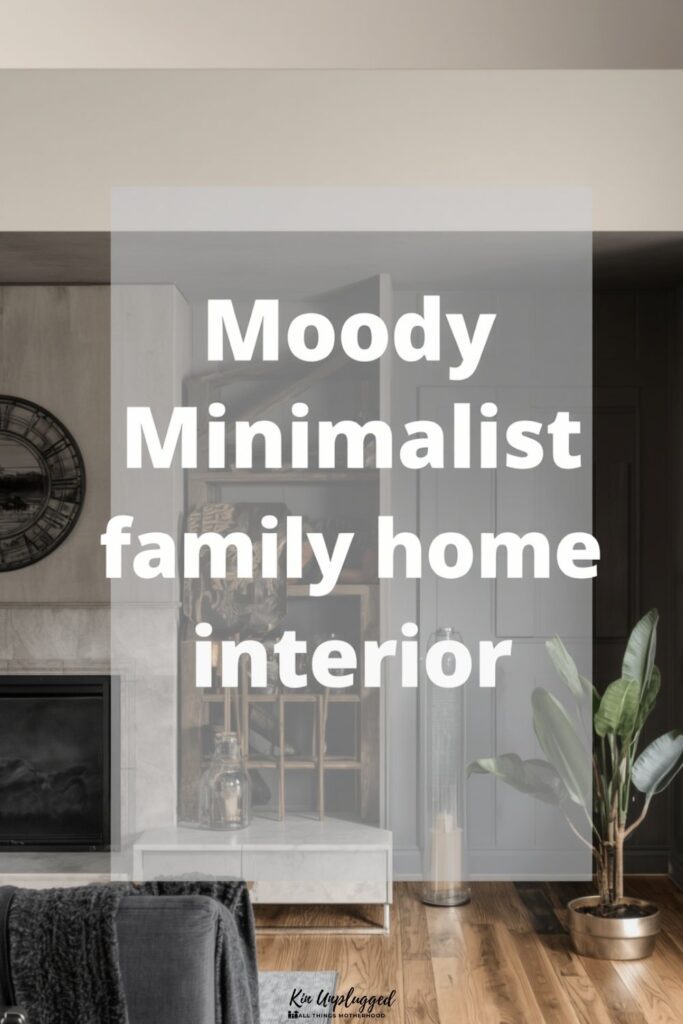
A dark minimalist room can feel cold if everything is smooth.
Texture is the fix.
Use wool, linen, bouclé, velvet, raw wood, rattan, stone, paper, clay, leather, woven baskets and matte ceramics.
The room can stay simple because the surfaces are doing the work.
Try a charcoal wall with a linen sofa.
A dark wood table with woven chairs.
A black cabinet with a stone lamp.
A deep olive wall with a wool rug.
A smoked blue bedroom with crumpled linen bedding.
A matte black bathroom with a wooden stool and cream towels.
Texture is what makes dark minimalism feel human.
It lets the room feel layered without adding lots of decoration.
That matters when there are children in the house.
The room already has movement.
Texture gives depth without adding more items to manage.
6. Use Japandi Calm Without Making The Home Feel Empty
Japandi-inspired rooms often look peaceful because there are fewer visible objects, more natural materials and a strong respect for negative space.
But family homes need a softer interpretation.
Do not strip the room until it feels like nobody lives there.
Instead, choose fewer visible objects and make them matter.
A low wooden table.
A handmade bowl.
A simple lamp.
A stack of books.
A framed family photo.
A soft rug.
A single branch in a dark vase.
This is the difference between empty and edited.
One feels cold.
The other feels cared for.
A family home should not erase signs of family life.
It should give them a better frame.
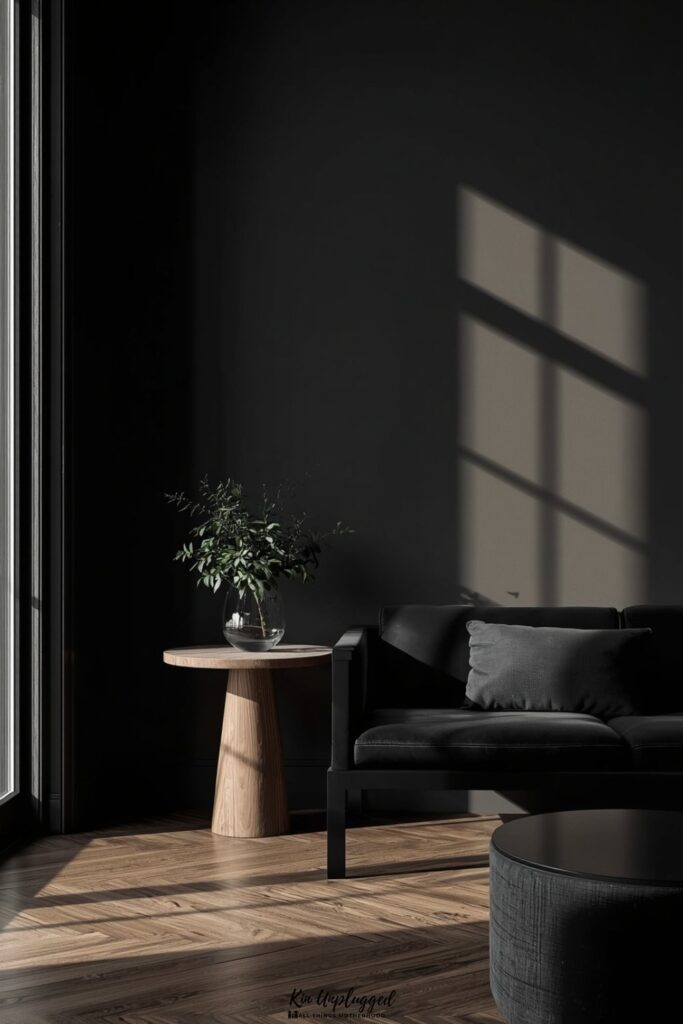
7. Make The Living Room Moody But Still Usable
The living room is often the hardest place to use moody minimalism because it carries so many jobs.
It needs to be restful, social, child-friendly and practical.
Start with a simple palette.
Charcoal, cream, walnut and black.
Or deep olive, oatmeal, oak and clay.
Or smoked blue, warm white, dark bronze and linen.
Then choose one big dark move.
Paint the media wall charcoal.
Choose a deep brown sofa.
Add dark built-in storage.
Use a black coffee table.
Choose a dark patterned rug.
The rest of the room should support it.
Family living rooms need softness too.
A low sofa with washable covers, a large rug, closed toy storage, warm lamps and one generous basket for throws can make the space feel calm without making it stiff.
A moody minimalist living room should recover quickly after a normal evening.
That is the test.
Not how it looks before anyone has sat down.
8. Use Warm Lighting Everywhere
Dark rooms depend on lighting.
One ceiling light will not do enough.
Use lamps, wall lights, picture lights, low-level lighting and warm bulbs.
Dark colours absorb more light than pale ones, so the room needs several small light sources instead of one bright overhead source.
Try this formula:
| Room | Lighting plan |
|---|---|
| Living room | Floor lamp, table lamp, wall light, picture light |
| Bedroom | Bedside lamps, low pendant, wardrobe light |
| Kitchen | Under-cabinet lights, pendant lights, soft corner lamp |
| Hallway | Wall lights, lamp on console, picture light |
| Bathroom | Mirror light, ceiling light, small warm accent if safe |
| Dining room | Low pendant, sideboard lamp, candles when practical |
Lighting is what turns dark walls from gloomy to intentional.
It also changes how the home feels at night.
For busy moms, evening lighting matters because the room has to shift from family activity to a softer grown-up space without everyone clearing out of the house.
That shift is valuable.
It is also achievable.
9. Bring In Cream Instead Of Bright White
Bright white can look too sharp beside deep colours.
Cream, stone, ivory, oatmeal and warm white usually work better.
They soften the contrast.
They also stop the room feeling like a black-and-white graphic.
Use cream curtains.
Stone-coloured rugs.
Oatmeal sofas.
Warm white walls.
Ivory bedding.
Soft white lampshades.
Cream ceramics.
The dark shades will still feel strong but the room becomes easier to live with.
This is especially important in homes with children because the room needs emotional softness, not only visual control.
A cream sofa may sound risky but washable covers, textured fabric and throws can make it practical.
A cream rug in a family room needs careful thought.
A cream lampshade is easy.
Choose the cream moments where they make sense.
10. Add Dark Built-Ins For A Sleek Family Home
Built-ins are one of the best ways to make a moody minimalist family home feel polished.
They hide what needs hiding.
They make the room look intentional.
They can turn clutter-prone areas into calm zones.
Try dark built-ins around the TV.
A black-brown bookcase in a dining room.
Deep olive hallway storage.
Charcoal wardrobes in a bedroom.
Smoked blue cabinets in a playroom corner.
Dark built-ins work best with simple fronts and minimal handles.
Push-to-open doors, slim pulls or integrated handles keep the look clean.
Leave a few open shelves for personal pieces.
Keep most of the storage closed.
That balance is important.
Too much open shelving can become another job.
11. Keep The Floor Natural
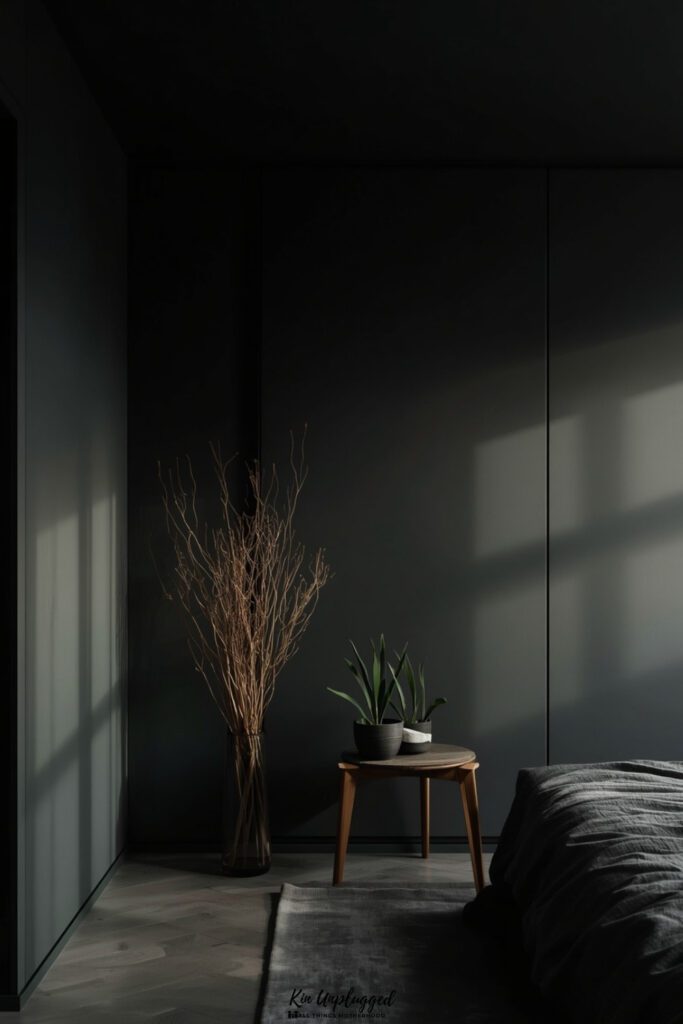
Moody minimalist interiors usually feel better with natural-looking floors.
Oak, walnut, pale wood, dark wood, stone, limestone-style tile, concrete-style tile or a simple woven rug can all work.
The floor grounds the room.
It also stops dark walls from feeling like they are floating.
For family homes, consider durability first.
A beautiful pale rug in a snack-heavy room may cause stress.
A darker woven rug, patterned wool rug or washable flatweave may be kinder.
Natural flooring also supports the Japandi and Scandinavian influence.
It adds warmth without needing lots of colour.
A moody room with natural flooring usually feels more settled than a moody room with shiny grey floors.
Matte finishes are your friend here.
12. Use Black Carefully
Black can look beautiful in a moody minimalist interior but too much black can flatten the room.
Use black as structure.
Black picture frames.
Black lamps.
Black handles.
Black side table.
Black curtain pole.
Black mirror.
Black dining chairs.
The bigger the black piece, the more texture it needs.
A black wood cabinet looks better than a flat black glossy one.
A black woven chair feels softer than a shiny plastic chair.
A black metal lamp with a paper shade feels more layered than black metal everywhere.
Black should sharpen the room, not swallow it.
That is the line.
13. Try Deep Olive For A Softer Moody Look
Deep olive is one of the most family-friendly moody colours.
It feels dark without feeling harsh.
It works with wood, cream, black, brass, stone, terracotta and muted pink.
Use it on cabinets, hallway storage, bedroom walls, a dining room wall or a bathroom vanity.
Deep olive is especially good for homes that feel too plain but where charcoal feels like too much.
It can also make family mess feel less visually sharp.
A deep olive boot room or hallway cabinet can hide fingerprints better than pale paint.
A deep olive living room wall can make a cream sofa look softer.
A deep olive bedroom can feel restful without being gloomy.
14. Use Dark Brown Instead Of Grey
Dark brown is having a much better moment than grey for family homes.
Espresso, walnut, tobacco, chocolate and black-brown feel rich and grounded.
They also work beautifully with cream, linen, clay, brass, black and muted blue.
A dark brown minimalist interior can feel warmer than charcoal.
Try a dark brown sofa.
A walnut dining table.
Espresso cabinets.
Chocolate velvet cushions.
A black-brown painted door.
A deep brown bedroom wall.
This is a strong choice for busy homes because dark brown often hides marks better than pale neutrals.
It also pairs well with wood already in the house.
That makes it less expensive to work into an existing home.
15. Add One Soft Sculptural Shape
Moody minimalism can become too straight.
Add one soft shape to loosen the room.
A round coffee table.
A curved chair.
A circular mirror.
A paper lantern.
A rounded vase.
A soft pouffe.
A curved headboard.
One sculptural shape is enough.
The room still feels minimal but it does not feel rigid.
This is useful in family homes because children already bring movement and softness to a space.
The furniture should not feel like it is fighting that.
A room with all sharp edges and dark tones can feel severe.
A room with one soft curve feels more welcoming.
16. Use Dark Doors For A Subtle Whole-Home Shift
Painting interior doors dark can change a home without repainting every room.
Try soft black doors with warm white walls.
Deep brown doors with oak floors.
Charcoal doors in a hallway.
Smoked blue doors upstairs.
Dark doors add rhythm through the house.
They also make plain rooms feel more designed.
For family homes, satin or durable wipeable finishes are usually more practical than very flat paint on doors.
Fingerprints happen.
Door edges take knocks.
A beautiful finish still needs to survive mornings.
This is one of those small design choices that makes the whole house feel more cohesive.
It also looks more custom than buying lots of new decor.
17. Make The Kitchen Moody But Not Heavy
A moody minimalist kitchen can work beautifully in a family home if there is enough light and storage.
Try dark lower cabinets with lighter upper walls.
Use black or deep brown cabinets with wood shelves.
Choose a dark island and keep the perimeter lighter.
Use a smoked blue or deep olive pantry wall.
Add warm under-cabinet lighting.
Keep counters as clear as possible.
Family kitchens collect things fast, so the minimalist part needs help.
Appliance garages, deep drawers, hidden charging stations, labelled baskets and closed pantry storage all matter.
A dark kitchen with cluttered counters can feel heavy quickly.
A dark kitchen with clear zones can feel calm and practical.
The kitchen needs function first, mood second.
That order keeps the space usable.
18. Try A Moody Minimalist Dining Area
Dining rooms and eating corners are perfect for moody minimalism.
They are used at specific times, so they can handle a stronger mood.
Try a dark wood table with simple chairs.
A charcoal wall behind a dining bench.
A low paper pendant.
A black sideboard.
Cream linen seat cushions.
One large piece of art.
A dark dining space can make everyday meals feel more grounded.
Not fancy.
Just more present.
For families, avoid surfaces that make every mark feel like a crisis.
Matte dark tables can show crumbs.
Very shiny dark tables can show fingerprints.
A wood grain finish is often easier to live with than a flat dark finish.
19. Let The Playroom Corner Disappear A Little
A moody minimalist family home still needs play space.
The goal is not to hide children.
The goal is to make their things easier to live beside.
Use dark closed storage for toys.
Choose baskets that match the room.
Keep one low shelf for daily play.
Rotate toys instead of displaying everything.
Use a dark cabinet that blends into the wall.
Add a soft rug and one child-height table if needed.
This works especially well in open-plan homes.
The play area can exist without visually taking over the whole downstairs.
Children do not need every toy visible to play well.
Often, fewer visible choices make play easier.
That is an audience psychology point too.
Too many options can make decisions harder.
Homes are no different.
20. Make Bedrooms Darker Than The Rest Of The House
Bedrooms can handle more mood than living spaces.
A dark bedroom can feel restful when the lighting and bedding are right.
Try smoked blue walls with cream bedding.
Charcoal walls with oak furniture.
Deep olive walls with linen curtains.
Dark taupe walls with black lamps.
Espresso headboard with warm white walls.
Keep the surfaces simple.
Bedside table.
Lamp.
Book.
Water glass.
Small dish.
That is enough for most nights.
For family homes, bedrooms often become laundry holding zones.
Closed wardrobes, under-bed storage and one proper chair or bench can help stop clothes from landing everywhere.
The room does not need to be perfect.
It needs to make rest feel possible.
21. Use Hallways As The Moody Thread
Hallways are often forgotten but they are ideal for moody minimalism.
A dark hallway can make the lighter rooms off it feel softer.
Try charcoal walls with warm wood hooks.
Deep olive panelling.
Black-brown doors.
A smoked blue console.
A dark runner.
Warm wall lights.
Hallways also handle the real work of family life: shoes, coats, bags, parcels, scooters, umbrellas and school items.
That means storage matters more than styling.
Use pegs, benches, baskets and cabinets.
Make the practical pieces dark and simple.
The hallway then becomes part of the design instead of the place where everything collapses at the door.
22. Use Fewer Objects But Better Grouping
Minimalism is not only about owning less.
It is also about grouping better.
Instead of small items scattered across five surfaces, put a few related pieces together.
A tray with a lamp, bowl and book.
A shelf with three ceramics.
A bench with one basket underneath.
A coffee table with one large bowl.
A console with one lamp and one framed photo.
The room feels calmer because the eye has fewer stopping points.
This matters online too.
Nielsen Norman Group has found across years of research that people scan online pages rather than reading every word and clear structure helps them find what matters. (Nielsen Norman Group)
Homes are scanned too.
People take in a room quickly.
Give the eye fewer, stronger places to land.
23. Add Family Photos In A Minimal Way
A moody minimalist home can still have family photos.
They just need a simple treatment.
Use black frames with wide white mounts.
Use dark wood frames.
Use one large family photo instead of many tiny ones.
Print photos in black and white.
Group three images in a straight line.
Put children’s art in proper frames.
This keeps the feeling personal without making the walls visually noisy.
Family photos are important because they add ownership.
Minimal interiors can look beautiful but anonymous.
A family home should not feel anonymous.
One personal wall can change that.
24. Keep Surfaces Realistic
A minimalist room with no daily objects on any surface may look beautiful but it may not work.
Most families need some visible objects.
A fruit bowl.
A tissue box.
Remote controls.
A lamp.
A school tray.
A charging spot.
A water bottle.
The trick is giving those objects a place.
Use trays, bowls, drawers and cabinets.
A dark tray on a dark table can make remotes disappear visually.
A ceramic bowl near the door can hold keys.
A lidded box can hide chargers.
A basket can hold school papers until they are dealt with.
A surface does not need to be empty. It needs to be controlled.
That is far more realistic.
25. Use Matte Finishes
Matte finishes suit moody minimalism better than shiny ones.
Matte paint.
Matte cabinets.
Honed stone.
Raw wood.
Unlacquered brass.
Soft ceramics.
Wool rugs.
Linen curtains.
Matte finishes absorb light and make dark colours feel softer.
They also suit the Japandi and Scandinavian side of the style because they feel natural and understated.
For family homes, check durability.
Some matte finishes mark easily, especially in high-touch areas.
Use wipeable matte paint in hallways, kitchens and children’s areas.
Use more delicate finishes in lower-contact spaces.
The finish has to match the room’s workload.
26. Build A Moody Minimalist Bathroom
Bathrooms are a good place to try this look because small spaces can handle stronger design choices.
Try a charcoal vanity with a white basin.
A black-framed mirror.
Deep olive walls.
Stone tiles.
Cream towels.
A wooden stool.
A dark shower curtain.
Warm lighting around the mirror.
Bathrooms need texture because they already have many hard surfaces.
Add softness with towels, bath mats, wood and warm light.
Ventilation matters too.
Dark bathrooms can show moisture problems if the room is not managed well.
The EPA recommends using ventilation such as a bathroom fan or open window to help manage moisture and reduce mold risk. (PMC)
Pretty choices still need to suit the room.
That is especially true in bathrooms.
27. Add One Slightly Strange Object
A moody minimalist interior needs one thing that stops it feeling too perfect.
A child’s clay pot.
A vintage stool.
A black vase with an odd shape.
A family photo from a blurry day out.
A hand-painted bowl.
A tiny sculpture from a holiday.
A framed note.
A lamp that looks a little unusual.
This is where the room gets soul.
Without one personal or slightly strange detail, moody minimalism can start to feel like a hotel.
The home should feel edited, not erased.
That difference matters.
28. Use Dark Curtains For Instant Mood
Curtains can change a room faster than furniture.
Dark curtains add height, softness and drama in one move.
Try charcoal linen curtains.
Espresso velvet curtains.
Dark olive cotton curtains.
Smoked blue curtains.
Black-brown woven curtains.
Hang them high and wide if the room allows.
This makes the window feel larger and the room feel more finished.
For family homes, washable or easy-clean fabrics may be worth choosing over delicate ones.
Curtains near sticky hands need to survive real contact.
Dark curtains can also help a room feel more restful in the evening.
That is one of the biggest benefits of this style.
It helps the house shift down a gear.
29. Make The TV Wall Disappear
The TV is often the least minimalist thing in the living room.
A dark wall can help.
Paint the TV wall charcoal, black-brown, smoked blue or deep olive.
The screen blends in more, especially when switched off.
Add closed storage underneath and keep the styling simple.
A lamp, one object, one stack of books.
No need to cover the whole area with tiny decor pieces.
This is one of the most practical moody minimalist interior ideas for family homes because most families use the TV.
The goal is not pretending it is not there.
The goal is making it less visually loud.
30. Add Softness Underfoot
Dark minimalist rooms can feel hard without soft flooring.
A large rug changes that.
Choose wool, jute, flatweave, textured cotton or a washable rug depending on the room.
For living rooms, size matters.
A rug that is too small makes the room feel unsettled.
Try to get at least the front legs of the sofa and chairs onto the rug.
For family homes, patterned or textured rugs are more forgiving than plain pale rugs.
A dark room with a soft rug feels more grounded.
It also gives children somewhere to sit, sprawl, build, read and play.
That is real use.
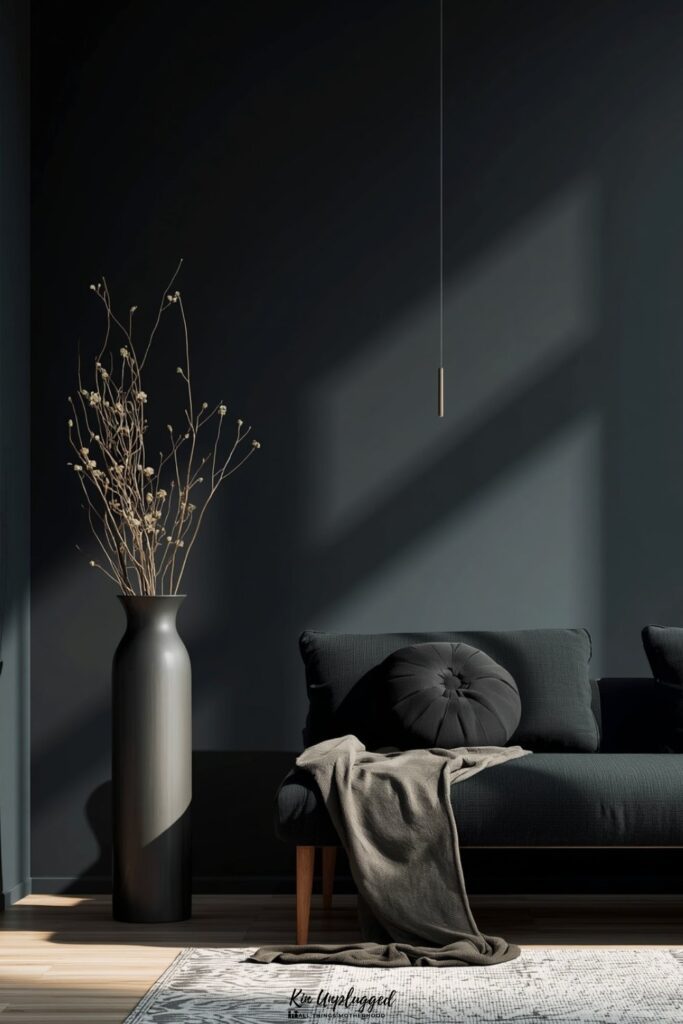
31. Use Moody Minimalism In A Home Office Corner
Many family homes do not have a separate office.
A moody minimalist work corner can still look good in a living room, bedroom or hallway.
Use a dark slim desk.
A simple chair.
A wall shelf.
A small lamp.
Closed boxes for papers.
A dark pinboard or fabric board.
Keep the colour close to the wall so the corner visually recedes.
This works well because a home office corner can easily look messy.
Dark, simple pieces help it feel contained.
For blogging and creator work, this matters too.
A calm work corner can help separate work from family life, even when both happen in the same house.
Not perfectly.
But enough to make the space feel more intentional.
32. Moody Minimalist Ideas By Room
Use this table as a quick planning guide.
| Room | Best dark move | Best softening layer |
|---|---|---|
| Living room | Charcoal media wall | Cream sofa, wool rug, lamps |
| Kitchen | Dark lower cabinets | Wood shelves, warm lighting |
| Dining area | Dark table or wall | Paper pendant, linen seats |
| Bedroom | Smoked blue or olive walls | Linen bedding, soft lamps |
| Hallway | Dark doors or cabinets | Wood bench, warm wall lights |
| Bathroom | Dark vanity | Cream towels, wood stool |
| Play corner | Dark toy storage | Soft rug, low table |
| Home office | Dark desk | Paper shade, closed boxes |
This is the easiest way to stop the style becoming too intense.
Every dark move needs a softening layer.
Every practical zone needs storage.
Every room needs one personal detail.
That is the rhythm.

33. What To Avoid In A Moody Minimalist Family Home
Avoid dark rooms with no lighting plan.
Avoid too many black glossy surfaces.
Avoid open shelving in areas where family clutter builds up.
Avoid furniture that looks beautiful but cannot handle daily use.
Avoid tiny decor pieces scattered everywhere.
Avoid pretending children’s things will never be visible.
Avoid choosing a dark paint based on one online photo.
Avoid making every room equally dark.
A moody minimalist home needs contrast and rest.
Some rooms can be deeper.
Some should be lighter.
Some corners can hold more personality.
Some surfaces can stay almost empty.
That variation makes the whole home easier to live in.
34. The Best Colours For Moody Minimalist Interiors
Here are the most useful colours for this look.
| Colour | Best for | Pairs well with |
|---|---|---|
| Soft black | Doors, cabinets, TV walls | Cream, oak, brass |
| Charcoal | Living rooms, bedrooms | Linen, walnut, stone |
| Deep olive | Hallways, bathrooms, cabinets | Wood, cream, terracotta |
| Smoked blue | Bedrooms, offices, walls | Warm white, black, oak |
| Espresso | Furniture, doors, kitchens | Stone, linen, brass |
| Dark taupe | Bedrooms, living rooms | Cream, clay, black |
| Mushroom brown | Walls, cabinetry | Oak, ivory, wool |
| Black-brown | Doors, shelving, tables | Paper shades, rattan, cream |
The most family-friendly shades are usually not the deepest ones.
They are the ones with softness inside them.
A colour can be dark and still feel gentle.
That is the sweet spot.
35. What To Buy First
If the home is not being fully redone, buy in this order.
1. Storage that hides the most annoying daily clutter.
2. Lighting that makes evenings feel softer.
3. A rug large enough to ground the room.
4. Curtains or blinds that add softness.
5. One dark anchor piece or paint colour.
6. Personal pieces that make the room feel like yours.
This order matters.
Paint will not solve a storage problem.
A new sofa will not fix bad lighting.
A dark wall will not feel stylish if the room has nowhere for daily life to land.
Start with the friction.
Then add the mood.
That is how the look becomes livable.
FAQs: Moody Minimalist Interior For A Family Home
What is moody minimalism in interior design?
Moody minimalism is an interior style that combines darker colours, simple furniture, clean lines, natural materials and fewer visible objects.
It feels deeper than classic minimalism because it uses dark tones like charcoal, black-brown, deep olive, smoked blue and espresso.
It still stays simple by using edited furniture, closed storage and calm surfaces.
Can a minimalist home work with children?
Yes, a minimalist home can work with children if it is based on storage, durability and realistic routines rather than empty rooms.
Closed cabinets, baskets, washable fabrics, strong rugs, simple furniture and toy rotation make the style much easier for family life.
The goal is not hiding children.
The goal is giving everyday things a clear place.
How do you make a dark interior feel warm?
Use warm lighting, natural wood, cream textiles, textured rugs, paper lampshades, linen, wool, clay, rattan and soft dark colours with warm undertones.
Avoid relying only on black, grey and white.
A dark room feels warmer when the materials have texture and the lighting is soft.
What colours work best for a moody minimalist home?
The best colours are soft black, charcoal, espresso, dark taupe, smoked blue, deep olive, mushroom brown, black-brown and warm grey.
Pair them with cream, stone, oatmeal, oak, walnut, brass, clay and linen.
That keeps the mood deep without making the home feel cold.
Is Japandi good for family homes?
Japandi can work very well in family homes because it values simplicity, natural materials, function and calm.
The family version needs more closed storage, durable fabrics, washable rugs and practical zones.
It should feel edited, not empty.
How do I make my living room moody but not gloomy?
Use one dark anchor, then balance it with cream textiles, warm lighting, natural wood and a large rug.
Add several lamps instead of relying on one ceiling light.
Keep the room simple but not bare.
A dark wall can look beautiful when the rest of the room has softness and light.
What is the difference between Scandinavian minimalism and Japandi?
Scandinavian minimalism often focuses on light, function, simple shapes and natural materials.
Japandi combines Scandinavian simplicity with Japanese-inspired restraint, craft, low profiles, natural textures and muted colours.
Both styles work well with moody minimalism when the colour palette is deeper and warmer.
Can small homes use moody minimalist interiors?
Yes, small homes can use moody minimalist interiors but the dark colour should usually be placed with care.
Try a dark door, dark cabinet, dark sofa, dark headboard or one painted wall instead of making every surface dark.
Use good lighting, mirrors, low furniture and closed storage to keep the space feeling clear.
Finally…
A moody minimalist interior can work beautifully in a family home when the design starts with real life instead of a perfect empty room.
Use dark colours with soft undertones, simple furniture, closed storage, natural materials and warm lighting.
Then add one personal detail in every room so the home feels owned, not styled into silence.
The best version of this look is not cold or strict.
It is calm, deep, practical and quietly grown-up.
A home can hold children, snacks, school bags, toys and tired evenings and still feel beautifully considered.
That is the real power of moody minimalism.
 0
0

 278
278