
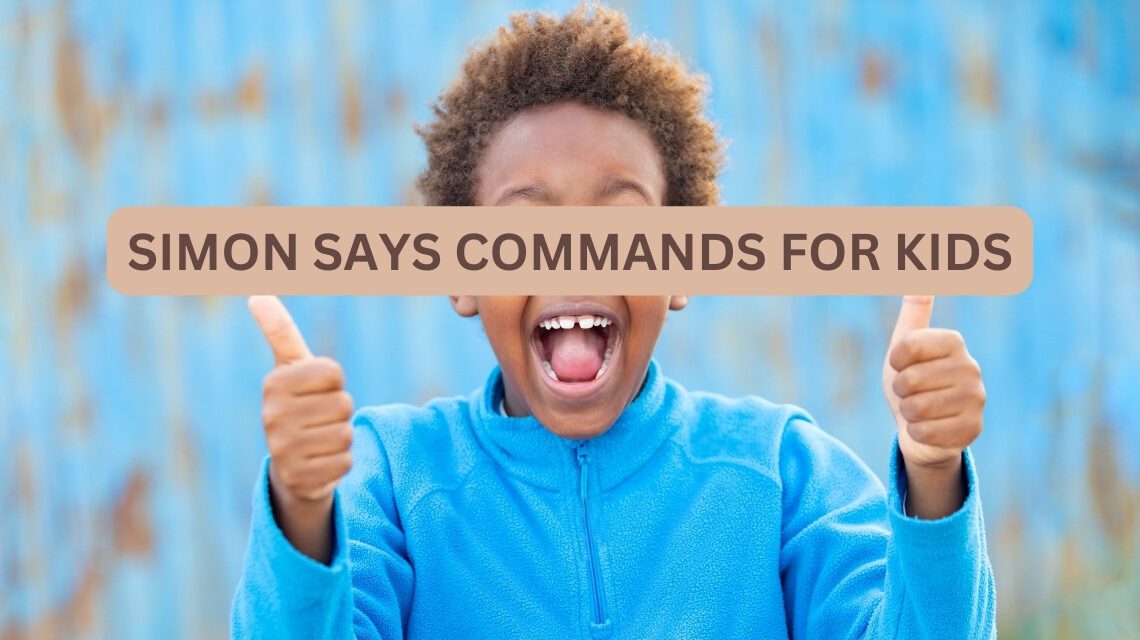
If you’re here because your child keeps not listening, start with this: fun and educational Simon Says commands work best when you keep it short, start easy and end on a win. Play for 4 minutes, use one step commands first and stop before anyone gets grumpy. You’ll get better listening later because you practised the skill when it was low pressure.
And yes… I know the moment.
You’re standing there thinking, I said it nicely. I said it twice. I’m not saying it a third time.
Visual timer kids can see
Movement flash cards for brain breaks
Why Simon Says works
Simon Says looks simple but it asks your child to do a lot at once.
They have to listen, hold a rule in mind, control their impulse to copy and act fast.
That combo is a big deal for young kids which is why researchers have studied why the game is especially challenging early on.
Speech and language experts also recommend classic direction following games like Simon Says because they help kids listen, pay attention and follow one and two-step directions while moving.
So if your child struggles with listening… this is a friendly place to practise.
No lectures. No stand offs. Just reps.
The 2 minute setup
You only need three things.
1) A rule they can repeat back
Say: We only move when I say Simon says.
2) A reset cue
Say: Hands on head means reset.
Use it whenever energy spikes.
3) A fair way to handle mistakes
For home play, I like: nobody is out.
They just do a quick reset and rejoin.
If you need a stricter version for older kids, I’ll show you later.
For now, win first.
Quick scan table
| Skill you want | Example Simon Says commands | Best ages | Make it easier | Make it harder |
| Listening and attention | touch nose, clap twice, freeze | 2–8 | show the action | no actions shown |
| Self-control | stay still, slow motion, wait 3 seconds | 3–12 | shorter waits | longer waits |
| Memory | do 2 actions, then 3 | 4–12 | 2-step max | 4-step chain |
| Early literacy | clap syllables, find rhymes, letter sounds | 4–10 | one sound only | two sounds in a row |
| Maths | count jumps, skip-count hops | 5–12 | count to 5 | count backwards |
| Social skills | give a high five, switch partners, compliment | 4–12 | scripted phrases | improv compliments |
| Body awareness | cross midline, balance, toe taps | 3–12 | hold a wall | eyes closed balance |
If you only read one thing today, read this:
Match the commands to the skill your child struggles with. That’s when Simon Says stops being random and starts working.
The educational switch
Here’s the trick that makes this stand out from every other list online.
You don’t need harder commands.
You need smarter patterns.
Use one of these switches to turn the same game into learning:
Switch 1: Add a reason
Simon says hop three times… because we’re counting by threes.
Switch 2: Add a choice
Simon says choose: crab walk or tiptoe.
Switch 3: Add a tiny challenge
Simon says do it in slow motion.
Switch 4: Add a story thread
Simon says we’re astronauts. Check your oxygen. Moon walk.
Switch 5: Add a reflect moment
Simon says stop. What was the rule again?
That last one is powerful because kids don’t follow rules they can’t say back.
Start here: 20 Starter commands that rarely fail
These are your first day commands.
They work even when kids are wiggly.
- Simon says touch your head
- Simon says touch your toes
- Simon says clap once
- Simon says clap twice
- Simon says blink three times
- Simon says stomp one foot
- Simon says hop in place
- Simon says freeze like a statue
- Simon says sit down
- Simon says stand up
- Simon says stretch your arms up
- Simon says put hands on hips
- Simon says turn around
- Simon says pat your tummy
- Simon says tap your knees
- Simon says show me your quiet mouth
- Simon says take one big breath
- Simon says shake your hands out
- Simon says march slowly
- Simon says walk to the wall and back
Busy mom note: do 10 of these and stop.
Stopping early is how you get Can we play again? later.
The edge of my seat version (A script)
This is the script for when your kid is right on the line.
You don’t need a big pep talk.
You need one clean start.
Say: I’m going to say five commands. If you get three right, you choose the last one.
Then do five commands from the starter list.
You’re handing them a win they can reach.
And once they taste that win… they try again.
Educational Simon Says commands for early literacy (Ages 4–8)
This set builds language skills without flashcards.
Syllables and sounds
Simon says clap the beats in your name
Simon says clap the beats in butterfly
Simon says whisper the first sound in sun
Simon says shout the last sound in cat
Simon says find something that starts with m
Simon says find something that starts with s
Simon says touch your head if you hear the b sound in ball
Simon says touch your knees if you hear the t sound in tree
Rhymes and word play
Simon says say a word that rhymes with cat
Simon says say a word that rhymes with hop
Simon says if I say fish, you say a rhyming word
Simon says if you can’t think of one, do one jump and try again
Easy sight word movement
Simon says spell your name in the air
Simon says draw a big letter A in the air
Simon says draw a tiny letter A in the air
Simon says make the letter T with your arms
Simon says make the letter O with your hands
Keep it light.
If they blank, you feed them one option and let them win.
Educational Simon Says commands for maths (ages 5–12)
These commands sneak maths into movement, which is perfect for kids who hate worksheets.
Counting and number sense
Simon says do five jumps
Simon says do three toe taps
Simon says do two jumps, then three claps
Simon says show me the number four on your fingers
Simon says show me the number seven on your fingers
Skip counting and patterns
Simon says hop while we count by twos to ten
Simon says clap while we count by fives to twenty
Simon says stomp on the tens: 10, 20, 30
Simon says freeze on 15
Quick mental maths
Simon says do 2 jumps plus 1 jump
Simon says do 5 claps minus 2 claps
Simon says show me 3 + 3 on your fingers
Simon says if I say eight, you show me one less
The goal is speed plus success.
Educational Simon Says commands for science and curiosity (ages 4–12)
This is how you sound like the fun mom who also teaches stuff… without trying too hard.
Body and senses
Simon says point to where you feel your heartbeat
Simon says take one breath in, one breath out
Simon says name one thing you can hear right now
Simon says name one thing you can see that’s moving
Nature and weather style observations
Simon says find something smooth
Simon says find something rough
Simon says find something that looks like a pattern
Simon says point to the brightest light you can see
Simon says point to the darkest shadow
Cause and effect thinking
Simon says move like you’re on ice
Simon says move like you’re in sticky mud
Simon says move like you’re in strong wind
This set feels like play.
But it’s building vocabulary and observation skills.
Simon Says Commands for social skills
This section is for siblings, playdates and classrooms.
Kind actions
Simon says give someone a high five
Simon says wave to someone
Simon says say good game
Simon says let someone else go first
Simon says pass the leader role to the person on your left
Communication practice
Simon says ask: Can I have a turn?
Simon says answer: Yes, after me.
Simon says say: Stop, I don’t like that.
Simon says say: Okay, I’ll give you space.
This is one of my favourite uses of Simon Says because you’re teaching scripts before the moment hits.
Simon Says commands for emotions and Self-regulation
READ: 20 Effective & Fun Self-regulation activities for Toddlers
This is the set you run when everyone is a bit… loud.
Simon says put one hand on your chest and breathe in
Simon says breathe out like you’re fogging a mirror
Simon says squeeze your hands into fists, then let go
Simon says press your feet into the floor
Simon says stretch tall like a tree
Simon says relax your shoulders
Simon says make your face soft
Simon says move in slow motion
Simon says freeze and listen for three sounds
I like these right before homework, dinner or bedtime.
It’s a reset without the lecture.
Simon Says commands that teach life skills
These are the commands that make your day easier later.
They feel like a game now and they show up as habits later.
Simon says put your shoes by the door
Simon says put your coat on the hook
Simon says carry your plate to the sink
Simon says wipe the table in a circle
Simon says check the floor for crumbs
Simon says put toys in the basket for 30 seconds
Simon says choose five things to tidy
Simon says match socks from the basket
If you want this to feel fair, say: We’re doing a two minute round.
Short rounds keep power struggles smaller.
The older kids set
This is where most lists get boring.
So let’s make it feel like a challenge.
Rule switches
Simon says do the opposite of what I say
Simon says if I say left, you go right
Simon says if I whisper, you do it fast
Simon says if I shout, you do it slow
Memory chains
Simon says touch head, clap, stomp
Simon says repeat it but backwards
Simon says add one more move to the end
Simon says keep the chain going
Brainy movement
Simon says spell a colour while hopping
Simon says name three animals while balancing
Simon says name five countries while marching
Simon says count down from 20 while tiptoeing
Older kids like levels.
So tell them: If you beat level 3, you get to be Simon.
For more age-tuned ideas, go here:
Simon Says for big kids
Classroom and group commands (fast transitions, less talking)
If you’re using this with a group, the win is simple.
You give fewer words and kids move more.
Try these:
Simon says hands on head, eyes on me
Simon says point to the door, then point to your seat
Simon says line up by birthday month
Simon says line up by shoe colour
Simon says find a partner, stand back-to-back
Simon says walk to your spot in silent steps
Simon says freeze, then breathe once
Simon Says variations to keep it fresh
You don’t need a new game. You need a new twist.
1) Silent Simon
You only use gestures.
Kids move only if you raise a Simon card or do a specific sign.
This helps kids who miss verbal directions.
It also helps when the room is noisy.
2) Team Simon
Split into two teams.
Team A only moves on Simon says, Team B only moves on Captain says.
It’s the same game but it feels brand new.
Older kids love the split rules.
3) The No One Is Out Version
Mistakes become a reset: hands on head, one breath, rejoin.
This keeps shy kids playing and reduces tears.
This version is my default for home.
Less drama, more reps.
Troubleshooting
This part matters because real life is not a chilled out circle time.
If your child keeps getting it wrong
Make it easier on purpose.
Do only commands where you model the action for two minutes.
Then stop.
Short and successful beats long and frustrating.
If siblings start accusing each other
Change the rule: no one is out and no one polices anyone.
You are the only judge.
Then run it as quick rounds: 90 seconds, reset, switch leader.
Speed reduces arguing.
If kids ignore the rule and do everything
Make the rule visible:
Hands on head means do nothing. Then practise that alone for 30 seconds.
Yes, practise doing nothing.
It sounds silly. It works.
A Simple 7 day Simon Says plan (for busy moms)
No big schedule. Just a small plan you can repeat.
Day 1: Starter commands only (10 commands, stop)
Day 2: Add 5 early literacy commands
Day 3: Add 5 maths commands
Day 4: Add the calm body set before dinner
Day 5: Do memory chains (2-step then 3-step)
Day 6: Let your child be Simon for 2 minutes
Day 7: Run Team Simon as a family game
FAQs
What are good Simon Says commands?
Good Simon Says commands are short, physical and easy to check.
Start with touch, clap, stomp, hop, freeze and one-step directions, then move to two-step chains.
How do you play Simon Says with kids?
One person is the leader and gives commands.
Players only follow commands that start with Simon says, and they must not follow commands without it.
What skills does Simon Says teach?
Simon Says helps practise listening, following directions, attention and self-control.
It can also support language and early learning when you add simple word, sound or counting prompts.
What age is Simon Says good for?
Many kids can start a simplified version around preschool age.
For younger kids, model the action and use one-step commands first, then increase difficulty slowly.
Why is Simon Says hard for young children?
Because it asks them to hold a rule in mind and stop an impulse to copy.
Research has found the game can be especially challenging for young children compared with similar inhibition tasks.
How do I use Simon Says in the classroom?
Use no one is out, keep rounds short and use it for transitions.
Choose commands that match your classroom routines, like lining up, freezing and moving to spots.
Finally…
Here’s the part I want you to remember when you’re standing in the kitchen and you can feel yourself about to repeat the same instruction again.
You don’t need a better speech. You need a better moment.
Simon Says gives you a moment where your child practises listening and wins at it. And wins stack.So tonight, do this: set a four-minute timer, run 10 starter commands, end on a win and stop.
Then tomorrow, do it again before the hard time of day hits.
 0
0

 278
278