
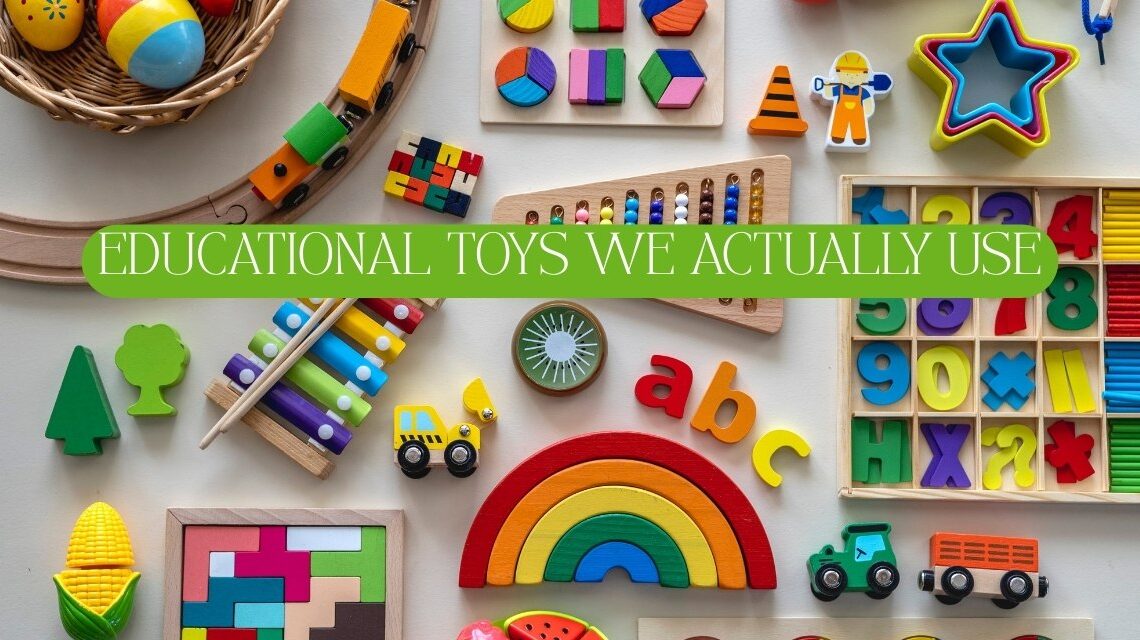
If you want the truth about the educational toys we actually use, here it is: not many, not the flashy ones and definitely not the ones that claim to teach your toddler calculus while singing at them in seven languages. The toys that get real use in family life are usually simple, open-ended, repeatable and good across more than one age. The rest tend to become expensive background noise with a very strong marketing department.
That is not me being anti-toy. It is me being anti-house-full-of-plastic-stuff-your-kid-ignored-after-eleven-minutes.
READ: How to clean baby bath toys (and keep them clean!)
Those are early for a reason. If a family only bought a handful of educational toys, those two categories would cover an absurd amount of play.
The American Academy of Pediatrics says play is essential for brain development and helps children build language, self-regulation, problem-solving and social skills. The National Association for the Education of Young Children also highlights open-ended materials because children can use them in many ways across ages, which supports sensory, dramatic and inventive play.
If your child’s playroom currently looks like a toy shop had a collapse, keep how to declutter kids toys without dramaopen too. If you want the shortlist by age, head next to best toys by age that actually get used after this.
Why most educational toys end up ignored
Because a lot of them are performing educational for the adult, not delivering useful play for the child. They look impressive in the box, have forty-seven advertised features and then somehow still produce the energy of a conference call.
NAEYC notes that some toys support children’s thinking, interaction and inventive expression far more than others and that some of the toys adults find most interesting are not especially effective for development. The CDC’s guidance for special playtime also says that toys that support imagination, like blocks and art materials, are better picks than toys that basically run the whole show themselves.
That is the issue right there. If the toy does everything, the child does very little.
A toy that blinks, talks, commands, quizzes and congratulates nonstop may look educational. But a toy that asks the child to think, stack, sort, pretend, test, fail, retry and invent is usually doing more real work.
The rule we keep coming back to
The best educational toys are the ones kids can use in more than one way, at more than one age and in more than one mood. That one rule cuts through a shocking amount of nonsense.
A toy that only works one way gets old fast. A toy that can become a tower, road, animal house, obstacle course, restaurant, pattern game and sibling argument starter has range.
That range matters because busy moms do not need a toy that is technically good for learning but only on alternate Thursdays under ideal humidity. They need toys that earn their shelf space.
What research-based play guidance points to instead
The AAP’s play guidance is pretty clear: play supports healthy development and playful interactions help children build planning organizing, emotional regulation and social skills. NAEYC also points to open-ended materials as especially valuable because children can decide how to use them, which encourages meaningful choices and deeper play.
HealthyChildren also notes that for older babies ordinary household objects like wooden spoons, egg cartons and containers can be deeply interesting. That is both reassuring and a little insulting after you’ve spent actual money on boutique educational toys.
The point is not that fancy toys are forbidden. The point is that open-ended, child-led play tends to hold up better than toys with one fixed script. That is why our real-use list is so short.
The only educational toys we actually use

1. Blocks
Yes, blocks. Basic. Unsexy. Ancient. Still undefeated.
Blocks last because they support motor skills, spatial reasoning, problem-solving, pretend play, pattern-making and trial and error without announcing any of that in a box with twelve exclamation marks. NAEYC’s play resources repeatedly point to open-ended materials like blocks because children can decide what they mean and what they do.
Babies mouth them, toddlers stack them, preschoolers build zoos and fire stations, and older kids suddenly become civil engineers with surprisingly strong opinions. That kind of staying power is rare.
If you want the next click here, send readers to best block sets for toddlers and preschoolers.
2. Magnetic tiles
Magnetic tiles are one of the few toys that justify the hype. They work because they are open-ended enough for simple stacking and advanced enough for planning, balance, shape play, pretend structures and collaborative builds.
They also age unusually well. A two year old can make wobbly little towers and a six year old can suddenly start building ball runs, castles, garages or suspiciously ambitious airports.
They are not magic. They are just one of the rare toys that keeps meeting the child where the child is.
3. Art supplies that are actually reachable
Not art supplies hidden in a high cupboard for special times, which is how many crayons go to die. I mean paper, chunky crayons, washable markers, stickers, tape, child-safe scissors and glue sticks set up so the child can use them often.
The CDC’s special playtime guidance specifically names crayons and paper as good choices because they let children use imagination. That matters because art materials are not just about producing little masterpieces for your fridge; they support fine motor practice, decision-making and self-expression.
Also, unlike many educational toys, art supplies do not become instantly pointless because the child used them once correctly. There is always another page.
4. Board books and picture books
Books count. Obviously they count.
Reading with children supports language and shared attention and books also double as props for pretend play, conversation starters, bedtime anchors and please sit still for one minute while I breathe through this day objects. The AAP’s play guidance connects playful adult-child interaction with language and relationship-building, which is a big part of why books stay in heavy rotation.
We use books because they keep giving. One book can be read, pointed at, acted out, memorised, retold, lined up, packed in a bag and weirdly slept with.
Internal link here: best books for toddlers and preschoolers.
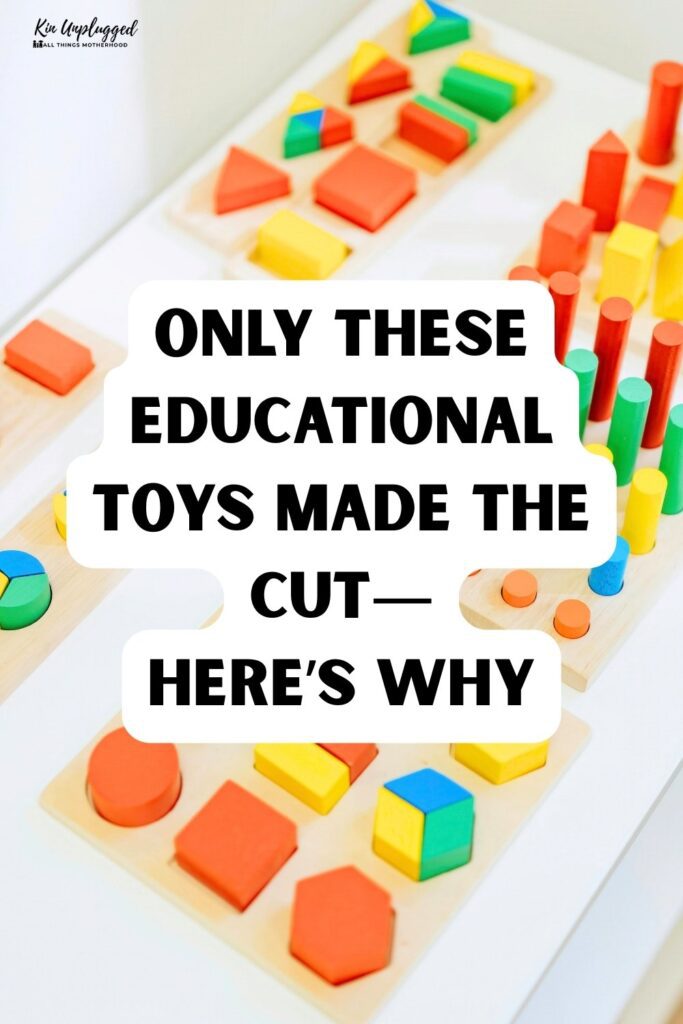
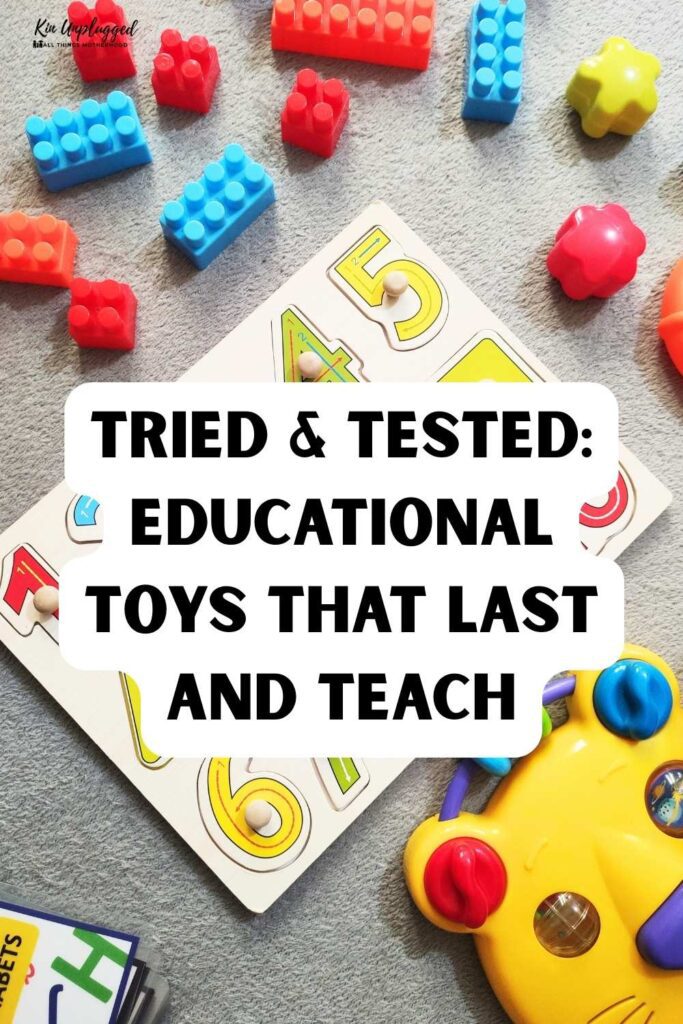
5. Puzzles with large pieces
A good puzzle earns its keep because it asks the child to notice shape, position, image clues, persistence and spatial fit. It also has a clear beginning and end, which is useful for kids who like closure and for adults who have seen enough toy sprawl for one lifetime.
The trick is not to overbuy. A few well-chosen puzzles beat a shelf full of puzzles no one wants to do because the pieces are either too easy, too hard or mysteriously gone.
Puzzles are especially helpful in that in-between zone where a child wants a job to do with their hands but does not necessarily want full imaginative play.
6. Pretend play basics
This is where educational gets mis-sold all the time. People hear the word and think alphabet gadgets, quiz toys and aggressive little tablets. Meanwhile, some of the richest learning is happening while a child stirs imaginary soup in a bowl with a spoon and informs you the sofa is now a bakery.
NAEYC’s guidance on open-ended materials and meaningful play supports exactly this kind of child-led use of materials. The AAP also links play with social, language and self-regulation development, which is a strong case for pretend play items that do not over-direct what the child must do.
For us, that means a few things only:
play kitchen pieces, toy food, dolls, animal figures, scarves, containers and maybe a doctor kit.
Not a giant pretend supermarket with 126 parts and a scanner that yells at you in three settings.
7. Sensory materials we can tolerate
Not every family wants kinetic sand in their grout. Fair enough.
But a manageable sensory setup can do a lot: play dough, water play, pom-poms for supervised sorting, rice bins if you are brave, scoops, cups, funnels or shaving foam on a tray if you enjoy living slightly on the edge.
NAEYC’s open-ended materials guidance supports sensory play because young children learn first through using their senses, then with growing intention.
The secret here is not finding the world’s most visionary sensory product. It is using simple materials in a contained way that your actual household can live with.
8. Large vehicles and animal figures
These do far more work than people give them credit for. Trucks, trains, diggers, farm animals, dinosaurs or simple animal sets often become the backbone of storytelling, sorting, lining up, role play, sound play and all kinds of odd family dramas.
One day the animals are in a zoo. The next day they are at school. Then somehow a crocodile is the dad and the bus is sick.
That is not random. That is a child trying on ideas, categories, stories and relationships.
9. Simple music toys and real household sound makers
I am not talking about a toy keyboard that blasts one preloaded demo tune until everyone begins seeing visions. I mean egg shakers, a child drum, rhythm sticks, xylophone, bells or plain household items like pots, containers and wooden spoons.
HealthyChildren notes that ordinary objects can fascinate babies and that is true long after babyhood too. Real sound-making is often more engaging than a toy that plays music at the child while calling it participation.
This is one of those categories that looks simple because it is simple. That is the point.
10. Loose parts
Loose parts are the overachievers of play. Lids, cups, rings, cardboard tubes, fabric scraps, shells, large buttons for older kids under supervision, scoops, baskets, peg people, stones, wooden coins, popsicle sticks for older children, bits and pieces that can become almost anything.
NAEYC highlights open-ended materials because children can use them for sensory, inventive and dramatic play across ages. Loose parts are basically that idea in its purest form.
They also have the useful quality of not acting offended if a child ignores them for two days and then suddenly becomes obsessed.
11. Gross motor basics
Stepping stones, a balance beam, balls, beanbags, tunnels, a small trampoline if you have the room and safety setup or even just couch cushions used sensibly. These are educational in the most obvious and least marketed sense: they help children move, judge distance, test balance, plan and regulate their bodies.
The CDC’s developmental milestones remind us that children develop across movement, learning, play and behavior together. That means educational should never be limited to quiet table toys.
Sometimes the most educational toy in the house is the one that stops everyone from turning feral at 4:45 p.m.
12. Household objects that beat the toy aisle
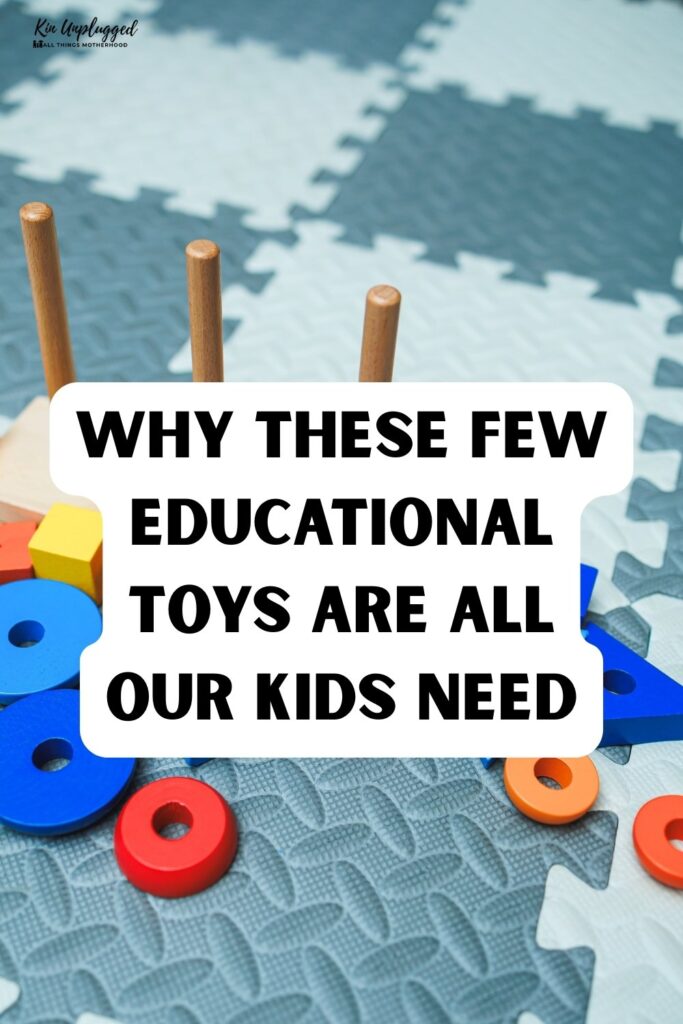
Wooden spoons. Measuring cups. Muffin tins. Plastic containers. Cardboard boxes. Scarves. Painter’s tape. Egg cartons. Cloth pegs for older kids. Bowls. Ladles.
HealthyChildren explicitly notes that ordinary household objects can be more fascinating to babies than formal toys. And honestly, many toddlers and preschoolers seem happy to carry that principle forward out of sheer spite.
This is useful because it means you do not have to keep shopping every time your child seems bored. Sometimes they need less polish and more possibility.
What we almost never bother with anymore
This part matters too.
We almost never bother with:
single-function electronic toys, quiz toys that congratulate constantly, giant sets with tiny themed bits, toys that only work with branded accessories or anything so loud and bossy it feels like a hostile coworker.
The CDC’s guidance for special playtime warns that if a toy moves and plays by itself, it is probably not a great choice for child-led special playtime. NAEYC’s research round-up on specific toys also points to real differences in how toys shape children’s thinking and interaction.
That does not mean a child will never enjoy those toys. It means they are rarely the toys that get lasting use or do the most developmental work.
How to tell if a toy is actually worth keeping
Use this test:
| Question | Good sign | Bad sign |
| Can it be used more than one way | child decides what it becomes | toy decides everything |
| Does it work across ages | baby, toddler and older child all use it differently | outgrown in six weeks |
| Does it support imagination or problem-solving | building, pretending, sorting, inventing | only press button, get response |
| Is it pleasant enough to live with | you do not dread hearing it | makes you want to fake a power cut |
| Does it invite repeat play | comes out often without prompting | forgotten instantly |
| Can siblings use it together | shared play happens naturally | causes only turf wars |
That table alone would save a lot of people a lot of money.
If readers are stuck in toy-overload mode, move them next to how many toys do kids actually need.
What educational should really mean
Not looks smart in an ad. Not has letters printed on it. Not a voice says the alphabet while your child stares into the middle distance.
A toy is educational if it helps a child notice, test, compare, imagine, repeat, communicate, move and solve. That can happen with blocks. It can happen with scarves. It can happen with cardboard and tape.
The AAP’s play guidance supports this broader view because it links play itself to cognitive, language, social and emotional growth.
So the better question is not, Which toy teaches reading at age two? The better question is, Which toys give my child the most to do?
By age, what gets the most use
Babies
For babies, simple is better. Soft books, rattles, teethers, mirrors made for babies, containers, stacking cups, textured balls and safe household objects often do more than complicated gadgets.
CDC safety guidance for infants also reminds parents to avoid small toys or anything that could be swallowed or cover the face.
Toddlers
Toddlers tend to get the most from blocks, books, pretend play basics, large puzzles, sensory play, simple vehicles, animal figures and crayons. This is the age where repetition is doing real work, even when it bores you half to death.
CDC parenting guidance for toddler special playtime recommends safe, imagination-friendly materials like large blocks, plastic pots and pans, crayons and paper.
Preschoolers
Preschoolers usually expand what they can do with the same core categories. Pretend play gets more elaborate, structures get more ambitious, art gets more intentional and books become fuel for questions and story retelling.
This is why buying better categories matters more than buying more items.
School age kids
Older kids can still use the same foundations, just differently. Blocks become architecture, magnetic tiles become engineering, pretend play becomes world-building and art supplies start doing heavier creative lifting.
The toy did not become educational when the child turned five. It was educational the whole time because it kept changing with the child.
Safety and sanity notes
Keep toys age-appropriate, check for small detachable parts and inspect worn items regularly. CDC safety guidance for infants and toddlers specifically warns about choking hazards and age-appropriate toy safety.
Also, not every useful toy has to live in your house at once. Rotation helps. Storage helps. A small, visible set often gets more use than a room so stuffed with options that nobody can think.
FAQs: The only educational toys we actually use
These are based on common Google-style questions around educational toys, learning toys and open-ended play.
What are the best educational toys for kids?
The best educational toys are usually open-ended toys like blocks, magnetic tiles, books, art supplies, pretend play items, puzzles and sensory materials. These toys let children think, experiment and use imagination instead of just pressing buttons.
Are educational toys actually worth it?
Some are, many are not. Toys tend to be worth it when they support repeated, child-led play across ages instead of doing all the work themselves. NAEYC notes that some toys have a much stronger effect on thinking, interaction and inventive expression than others.
What is an open-ended toy?
An open-ended toy can be used in many different ways and does not have one fixed outcome. NAEYC highlights open-ended materials because children can use them for sensory, dramatic and inventive play across ages.
Are electronic learning toys good for toddlers?
They are not always the best choice for lasting play. CDC guidance for special playtime suggests that toys that move and play by themselves are usually not ideal for child-led play, compared with materials like blocks, crayons and paper.
How many educational toys does a child need?
Usually far fewer than marketing suggests. A small group of versatile toys often does more than a huge collection of single-use items, especially when children can access them easily and use them often.
What toys help child development most?
Toys that support movement, language, problem-solving, imagination and social interaction tend to help most. The AAP links play itself with growth in planning organization, regulation and social skills.
Are household objects good for learning too?
Yes, in many cases. HealthyChildren notes that ordinary objects like wooden spoons, egg cartons and plastic containers can be deeply engaging, especially for babies.
Finally…
The only educational toys we actually use are not the loudest, smartest-looking or most aggressively marketed. They are the ones that leave room for the child to do something.That is the whole game. Less performance, more possibility. Fewer toys that instruct. More toys that invite and far fewer purchases made because some box implied your child’s future depended on a plastic penguin with a phonics setting.
 0
0

 278
278