
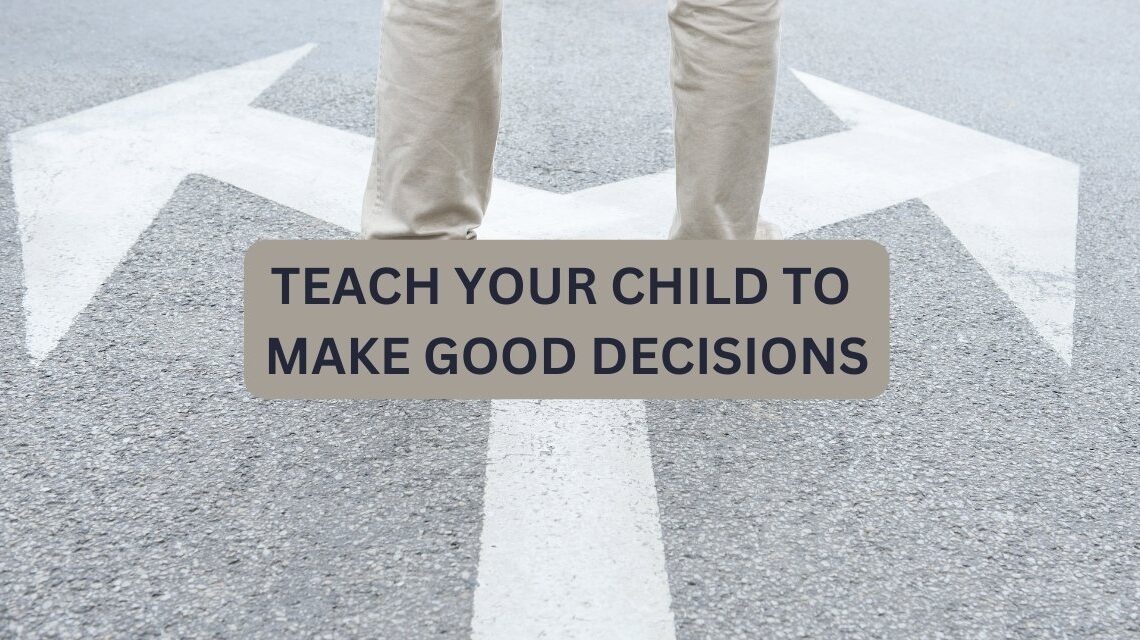
You teach your child to make good decisions by giving them small, safe choices, coaching the thinking behind the choice and letting consequences do some of the teaching.
I learned this the hard way, first as a Ghanaian child raised with strong do as you’re told energy and later as a mom in the UK where kids are often expected to practise independence early.
Answer: Start with two controlled choices, add one thinking question and follow through calmly. That looks like: You can do homework now or after snack, you choose, then What happens if we leave it too late? and then you hold the boundary kindly.
If you’re here because your child keeps making the same messy choices, stay with me.
This guide will help you shift from I told you so to I can think for myself, and it’s built for moms who are already doing a lot.
QUICK DECISION TIMER FOR KIDS
Pick your path
If your child is in the everything is a negotiation stage → jump to Toddlers and preschoolers.
If your child knows better but still does the wild thing → jump to School-age kids.
If your child is pre-teen or teen and pushes back hard → jump to Tweens and teens.
If your child melts down when choosing → jump to When they can’t decide.
If you want the full guide step by step → keep reading from the next section.
The real goal (it’s not obedience)
Most of us grew up thinking good decisions mean doing what I said.
But long-term, you want something stronger: a child who can pause, think and choose even when you’re not there.
That skill sits inside what researchers call executive function and self-regulation.
Harvard’s Center on the Developing Child explains executive function as the brain’s management system for planning, focusing and resisting impulses.
And the UK Education Endowment Foundation links stronger self-regulation and executive function to better learning and life outcomes.
So yes, this is about behaviour.
It’s also about brain skills.

A quick story: my first parenting fail with choices
When my oldest was smaller, I thought I was being a gentle genius by offering loads of options.
What do you want to wear, where do you want to sit, what do you want to eat, what game do you want to play?
It backfired so fast.
Too many choices turned into tears and I stood there thinking… why is a simple morning feeling so heavy.
That was my first big surprise: choice is a skill, not a personality.
Kids need practice. Not pressure.
The 4 part decision-making guide
Here’s the simple structure I use now.
It works with toddlers, school kids and teens, just with different wording.
1) Give a safe choice
Not ten options. Two options you can live with.
2) Add one thinking question
A question that helps them connect choice to outcome. Not a lecture.
3) Let the consequence teach
Natural when possible. Logical when natural would be unsafe.
4) Repair and review later
Not in the heat of it. Later, when everyone is calm.
That’s the whole engine. Now let’s make it age-proof.
Child decision-making development (what’s normal, what’s not)
Some kids can choose quickly. Some kids freeze.
Some kids make a decision just to feel in control. Some kids copy what their friends do because it feels safer.
This is normal child decision-making development. It changes as executive function grows over time and it grows fastest with practice, routines and supportive adults.
So if you’ve been asking Why can’t my child just think, take a breath. You’re teaching a skill that takes years.
The Two choice rule (the one change that fixes a lot)
If you only take one thing from this post, take this.
Offer two choices that both work for you. Then stop talking.
Examples:
Red top or blue top. Homework now or after snack. Bath first or tidy first.
This is allowing children to make their own choices while you still protect the boundary.
It gives them ownership without giving them the steering wheel on the motorway.
The One question add-on (so choices become learning)
After the child chooses, ask one question.
Try:
What happens next if you choose that?
How will that feel later?
What do you need to make that work?
One question is enough. Two questions start to feel like cross-examination.
Age-appropriate decision-making examples by stage
You don’t teach a toddler the same way you teach a 12-year-old.
But you can use the same structure.
Toddlers and preschoolers (ages 2–5)
At this age, their brain is fast, emotional and impulsive. Keep decisions small and immediate.
Good choices to practise:
- Which fruit with snack
- Which book at bedtime
- Which shoes, from two pairs
- Which toy to bring in the car
Language that works:
You choose: this or this.
Pick one.
I’ll wait.
What surprised me: my Ghanaian instinct was to correct quickly.
In the UK, I noticed how often parents let kids try, fail small and try again and I started copying that.
A tiny example: I used to stop spills before they happened. Now I keep a cloth nearby and let the oops be part of the lesson.
Want more toddler tools?
GET: Toddler Behavior Toolkit: Practical Strategies for a Calmer Home.
School age kids (ages 6–10)
This is the sweet spot for teaching thinking.
They can handle if, then logic, especially when it’s concrete.
Good choices to practise:
- Packing their bag the night before
- Picking after-school snack from a short list
- Deciding the order of homework tasks
- Managing small pocket money choices
My go-to questions:
What’s your plan?
What could go wrong?
What’s your backup plan?
This is where making your own decisions help make a decision.
Kids start to feel, When I choose, I can handle the result, and that confidence matters.
Tweens and teens (ages 11–16)
This stage is not about controlling.
It’s about coaching judgement while the world gets louder.
Good choices to practise:
- Planning revision time
- Handling friend situations
- Screen time trade-offs
- Travel to school, time management
- Setting boundaries with peers
The shift: stop telling them the answer first.
Start with curiosity.
Try:
Talk me through your thinking.
What matters most to you here?
What are you not seeing yet?
And yes, sometimes you still say no.
But you explain the why in one sentence, not a five-minute speech.
If you’re parenting a teen, you might also like: How to talk so your child actually listens.
The STOP-LINK-CHOOSE method (a kid-friendly checklist)
This is my in the moment tool. It’s short enough to use in real life.
STOP
Pause your body.
Hands down, breathe once.
LINK
Link choice to outcome.
What happens if…?
CHOOSE
Pick one option.
Then do the next small step.
You can teach this in calm moments first. Then it’s there when emotions rise.
A Decision making for kids worksheet
You don’t need anything fancy.
You can draw this on paper in two minutes.
Write four boxes:
1) What are my choices?
2) What might happen with each choice?
3) What matters most to me right now?
4) What’s my next step?
That’s it.
That is a Decision making for kids worksheet you can use at the kitchen table.
For younger kids, you can use pictures or simple words.
For older kids, you can add short-term vs long-term.
The Small Stakes Ladder (how to teach judgement without panic)
If every choice feels like a big moral lesson, kids will resist. So you build a ladder.
Step 1: Tiny choices
Snack, clothes, bedtime book.
Step 2: Medium choices
Homework order, pocket money, playdate planning.
Step 3: Bigger choices with guardrails
Phone rules, after-school clubs, friend boundaries.
The ladder matters because your child learns, I can choose and recover. That’s what turns mistakes into growth instead of shame.
Consequences that teach without being harsh
A consequence should feel connected.
It should not feel like revenge.
Natural consequences
They happen without you.
Forgot the homework, teacher follows up. Didn’t wear a coat, felt cold in the car.
Logical consequences
You set them because safety matters.
If you throw the toy, the toy is put away. If you can’t turn off the tablet, the tablet rests tomorrow.
The key is tone. Calm tone teaches better than big energy.
My Ghana–UK parenting surprise (and how it changed my approach)
In Ghana, there’s often a strong respect culture. Adults decide, kids follow and that can keep things orderly.
In the UK, I saw more guided independence. Kids are expected to practise choices early, even small things like ordering their own food.
At first, I judged it. Then I realised it was training and training builds capacity.
So now I blend both. I keep respect and structure and I add practice and explanation.
How to teach your child to make good decisions in the moment
This is for the supermarket aisle.
This is for the sibling fight.
The 20-second script
I’m going to give you two choices.
You choose one.
We’ll talk about it later.
Then later, you do the review.
The review (3 questions only)
What happened?
What did you choose?
What will you do next time?
Keep it short.
Kids learn best when they don’t feel cornered.
When your child can’t decide and every choice becomes a meltdown
This is more common than people admit.
Some kids freeze because they fear getting it wrong.
Here’s what helps.
1) Reduce choices to one plus a helper
Instead of what do you want, try do you want A or do you want me to choose today?
That’s still allowing children to make their own choices, because they choose the level of control.
It lowers pressure fast.
2) Use a timer
Pick in 10 seconds or I’ll pick.
Not as a threat.
As a limit that protects your time.
3) Practise choosing when calm
Decision skills build in calm moments.
Not during a meltdown.
If meltdowns are frequent, this post helps too: What to do when your child melts down.
The Values over vibes lesson (for older kids)
Older kids start making social decisions.
These choices shape them.
Teach a simple filter:
Is it safe?
Is it kind?
Does it match who I want to be?
If the answer is no, it’s not a good choice, even if it looks fun.
This is the heart of How to teach kids to make good choices.
The Friend Pressure Rehearsal
Most kids don’t fail because they didn’t know.
They fail because they panicked in the moment.
So you rehearse.
You say: Imagine your friend says, ‘Do it.’ What do you say?
They practise three lines:
No, I’m not doing that.
My mom will clock it.
Let’s do something else.
It sounds simple.
But rehearsal makes words available under pressure.
A quick note on temperament (because one child is not every child)
Some kids are bold.
Some kids are cautious.
Your job is not to change who they are.
Your job is to give them a thinking system that fits them.
For cautious kids, practise decision-making with very small stakes.
For bold kids, focus more on pause and consequence.
Parenting trap: rescuing too fast
I’ve done this. You see your child making a bad call and you jump in to save them.
Sometimes you should. Safety is non-negotiable.
But often, you can let it play out small because that’s where learning lives.
If you’re always rescuing, your child never gets to feel: I can handle it. That confidence is everything.
Another trap: turning every mistake into a character lecture
This one is common, especially when you’re tired.
A mistake happens and suddenly it’s you never listen.
Try to keep it present. This choice didn’t work, so we’re doing X next.
Then later you can talk about patterns but not in the heat.
The How do I make a decision mirror moment (teach them your process)
Kids learn decision-making by watching you do it.
So narrate your thinking sometimes.
Try:
I’m deciding between cooking now and cooking after I rest.
If I rest, I’ll have more patience.
So I’m resting for 10 minutes.
You are showing them a healthy process.
Not perfection.
If this guide helped, you’ll probably like my emails.
They’re short, practical and written for moms who don’t have time for long theory.
Join my email list here
You’ll get parenting scripts, mindset tools and try this today ideas you can use immediately.
If you’ve got one child who struggles more than the others, reply when you join and tell me their age.
I read those messages and it helps me write what you actually need.
FAQs
At what age should children start making decisions?
Children can start making small choices in toddlerhood, as long as the choices are safe and limited. As they grow, you increase responsibility in steps, so decision skills build over time.
How do I teach my child to make good choices when they don’t listen?
Use two controlled choices, ask one thinking question and follow through calmly with a logical consequence. Long lectures usually don’t land in the moment.
What are examples of age-appropriate choices for kids?
Age-appropriate decision-making examples include choosing clothes from two outfits, picking a snack from a short list, deciding homework order and planning how to spend pocket money with limits.
Should I let my child make their own mistakes?
Yes, when the mistake is safe and the lesson is small. Mistakes are often where judgement forms and executive function strengthens with practice and support.
How do I help a child who gets anxious choosing?
Reduce options, offer you choose or I choose today, use a short timer and practise choosing when calm. The goal is confidence, not speed.
How can I improve my child’s decision-making skills at home?
Build a small stakes ladder of choices, rehearse peer-pressure lines and model your own thinking out loud. Keep review conversations short and calm.
If you want more calm, practical parenting tools like this, join my email list by clicking HERE and I’ll send you my best use it today scripts.
 0
0

 278
278