
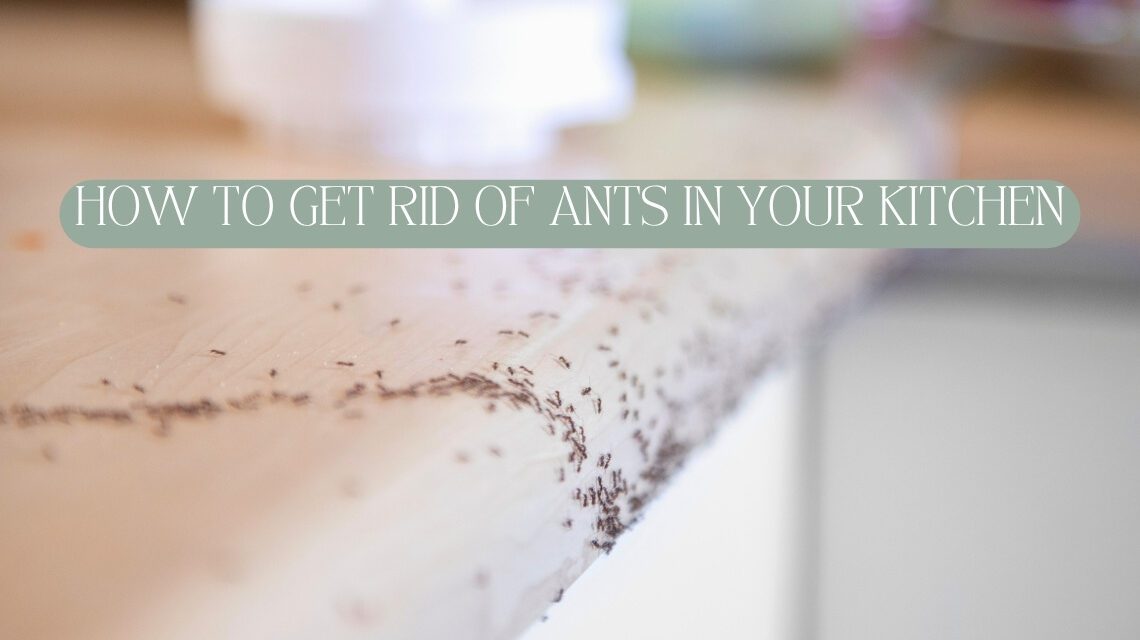
If the question is how to get rid of ants in the kitchen, the fastest useful answer is this: wipe the visible trail with soapy water, remove every open food source, follow the ants to the entry point, then use enclosed ant bait where children cannot reach it.
Do not spray the counter and hope for the best.
That usually leaves the kitchen smelling like a science cupboard and the ants still holding meetings behind the toaster.
The aim is not to make the kitchen smell aggressively clean.
The aim is to remove what the ants came for, break the trail they are using, then make it much harder for them to come back.
READ: How to get rid of Ants in the house (without losing your mind)
The quick kitchen ant plan
| Kitchen problem | Do first | If needed | Avoid |
|---|---|---|---|
| Ants on the counter | Wipe with warm soapy water | Check toaster, fruit bowl and sugar spills | Spraying near food prep areas |
| Ants near the sink | Dry the area and check for leaks | Seal gaps around pipes | Leaving wet cloths in the sink |
| Ants in the pantry | Remove open packets and wipe shelves | Move food into airtight containers | Folding cereal bags and pretending they are sealed |
| Ants coming from a wall gap | Watch the trail for a few minutes | Seal the gap after the trail is under control | Blocking one hole while the colony is still actively feeding |
| Ants returning daily | Use bait in a safe, hidden spot | Try outdoor bait near the trail | Killing only the ants seen on the counter |
Before wiping everything down, watch them for two minutes.
I know. That sounds disgusting.
But those two minutes can save days of repeat visits because ants usually show the route they are using if left alone briefly.
What to do in the first 10 minutes
Remove the food first
Start with the food source, not the ants.
Ants are not in the kitchen because they admire the tiles.
They are usually there for sugar, grease, crumbs, water, pet food, fruit, syrup, honey, cereal, bin residue or that one sticky patch under the jam jar that everyone has been pretending not to see.
Put open food into sealed containers.
Move fruit into the fridge for a few days.
Tie up the bin bag and take it out if it smells even slightly sweet or sour.
Wipe the trail with soapy water
Next, wipe the visible ant trail with warm water and washing up liquid.
The University of California Integrated Pest Management programme advises cleaning invading ants with soapy water to remove the scent trail they leave behind. It also recommends sealing entry points and using bait to target the colony, rather than relying on indoor sprays. UC IPM Ants in the Home (UC IPM)
Soapy water is not fancy but it is useful.
It removes the invisible trail that tells the next batch of ants where the kitchen buffet is.
Use kitchen roll or a cloth that can go straight into the wash.
Then wipe again with clean water so the counter does not feel like a bubble bath.
Follow the ants before the final wipe
If there is still a trail, follow it.
Look along the edge of the counter, behind the bin, near the back door, by the dishwasher, under the sink and around pipe gaps.
Ants often use boring little routes.
A tiny crack near a skirting board can be more important than the whole big dramatic scene happening on the worktop.
The place where the ants appear is not always the place where the problem starts.
That is annoying, but very on brand for household problems.
Why ants suddenly appear in the kitchen
Ants usually enter kitchens because the kitchen gives them something useful.
That may be food, water or a warm route indoors.
The University of Minnesota Extension explains that sanitation is an important step because food residue attracts ants. It also notes that ants make chemical trails to and from the nest, which is why following the trail can help locate where they are coming from. University of Minnesota Extension (University of Minnesota Extension)
One ant finds something.
It leaves a trail.
More ants arrive.
Suddenly the kitchen looks like someone sent out a group text.
This is why wiping the trail matters but it is also why wiping alone may not fix the problem.
If the colony still has access to food or water, more ants may arrive later.
The biggest mistake people make with kitchen ants
The biggest mistake is killing the visible ants and calling it done.
That feels satisfying for about 11 minutes.
Then another group appears, usually when dinner is half made and someone needs a snack immediately.
Visible ants are usually workers. The colony is the real problem.
Ant bait works because worker ants carry the bait back to the nest, which can reach the queen and the rest of the colony. UC IPM explains that bait needs to be slow acting so ants are not killed before they return to the nest. UC IPM Ants in the Home (UC IPM)
This is why sprays often feel fast but fail long term.
They can kill what is visible without dealing with the source.
What not to do when ants are in the kitchen
Do not spray all over food areas
Kitchen sprays can feel like the fastest option.
They are not always the smartest one.
The U.S. Environmental Protection Agency explains that pesticides are toxic by nature and must be used properly. It also notes that household pesticide exposure is an indoor air quality concern. EPA on pesticides and indoor air (US EPA)
That does not mean every product is evil.
It means a kitchen with food, children, lunchboxes and hands everywhere is not the place for casual spraying.
Use product labels properly.
Keep sprays away from food prep surfaces, dishes, high chairs, pet bowls and anything a child may touch while searching for a biscuit that was apparently needed urgently.
Do not mix every remedy at once
Do not use vinegar, peppermint oil, bait, spray, lemon juice, cinnamon and a stern voice all in one afternoon.
That can make the kitchen smell strange and may also make bait less effective.
Bait needs ants to take it.
If strong smells or sprays push them away from the bait, the colony may not get enough of it.
Pick a plan.
Clean, remove food, trace the route, then bait safely if ants keep returning.
Do not leave homemade bait where children can reach it
Homemade borax bait is often shared online as if every kitchen is a child free laboratory.
It is not.
Many kitchens contain a toddler, a dog, a cat, a curious older child, a baby throwing a spoon and someone asking what is for lunch while standing in front of a full fridge.
Poison Control says ant bait products are usually low concentration, but children who taste them may develop nausea and vomiting and skin or eye contact can cause irritation. It advises keeping ant baits out of reach of children and not placing them near toys or play areas. Poison Control on ant bait safety (Poison Control)
For family kitchens, enclosed bait stations are usually a more sensible choice than open homemade bait.
The family safe way to use ant bait in the kitchen
Choose enclosed bait stations
Use enclosed bait stations, not open blobs of bait on cardboard.
That is especially important in homes with children or pets.
Place bait where ants are travelling but where small hands and paws cannot reach.
Think behind an appliance, inside a locked under sink cupboard, behind the bin area if it is not reachable, or outside near the entry route.
Always follow the product label.
That tiny folded leaflet is annoying, yes, but it does know more about that product than a random comment section.
Do not put bait right beside uncovered food
Bait is attractive to ants.
That is the whole point.
So do not place it beside open fruit, bread, cereal or pet food and then wonder why the kitchen feels worse.
Remove competing food first.
Then place the bait near the trail or entry point.
If the ants ignore it, move it.
Ants can change food preferences, so one bait may work better than another depending on the species and season.
Give bait time to work
This is the part that tests a person.
Ant bait is not always instant.
UC IPM notes that bait control is not immediate and may take days or longer because the bait has to get back to the colony. UC IPM ant management (UC IPM)
That means ants may look more active at first.
Rude but normal.
They have found the bait.
The job is to let them take it back, not clean it away after 20 minutes because it looks offensive.
The kitchen ant search list
Ants are tiny but they are not subtle once a proper search starts.
Use this list before deciding the whole house is cursed.
| Area to check | What to look for | Quick fix |
|---|---|---|
| Toaster area | Crumbs underneath and behind | Unplug, empty tray, wipe counter |
| Fruit bowl | Split grapes, soft fruit, juice marks | Move fruit to fridge for a few days |
| Bin area | Sticky lid, leaks, food packaging | Wash bin lid and floor beneath |
| Sink area | Water, food bits, damp cloths | Dry sink edge and remove wet cloths |
| Pantry | Open sugar, cereal, flour, snacks | Use airtight containers |
| Dishwasher edge | Food residue and damp seals | Wipe seals and check underneath |
| Pet food station | Loose kibble and wet food residue | Lift bowls after meals |
| Back door | Gaps and crumbs near threshold | Clean track and seal gaps |
| Window sill | Plants, honeydew, tiny cracks | Move plants and wipe sill |
| Under appliances | Grease, crumbs, forgotten snacks | Pull out if safe and clean |
The toaster is often guilty.
So is the bin lid.
So is the back of the counter where a sticky bottle lives quietly, causing trouble and saying nothing.
A 30 minute kitchen reset for ants
Minute 1 to 5: Remove the obvious invitation
Put away bread, cereal, biscuits, sugar, fruit and anything sticky.
Check under packets and jars.
If the outside of a honey bottle, syrup bottle or jam jar is sticky, wash it before putting it away.
Ants do not need a full meal.
They are happy with a smear.
Honestly, the standards are not high.
Minute 6 to 10: Watch the route
Look at where the ants are walking.
Do not wipe yet if the trail is still active.
Follow the line as far as possible.
It may lead to a window, a pipe gap, a door frame, a crack by the skirting board or the underside of a cupboard.
Take a quick photo if needed so the route is not forgotten once the cleaning starts.
This is not for memories.
This is evidence.
Minute 11 to 20: Wash the trail
Use warm water and washing up liquid.
Wipe the counter, the edge of the counter, the wall line, the cupboard base and the floor path.
If the trail is near food prep surfaces, rinse after cleaning.
Dry the area properly, especially near sinks.
Ants like water too, which feels unfair when they already have the outdoors.
Minute 21 to 30: Block the easy wins
If the entry point is obvious, seal it once the active trail is handled.
Use silicone caulk for kitchen gaps, especially around pipe holes, skirting gaps and window edges.
For a same day temporary fix, petroleum jelly can slow ants at tiny gaps, but it is not a beautiful long term solution.
Nobody wants a permanently greasy skirting board.
Use it only as a short stopgap if needed.
What works when there are kids and food around
Keep the kitchen usable
A family kitchen cannot be out of action all day.
That is why the plan needs to be realistic.
The safest first steps are non spray steps.
Remove food.
Wash trails.
Dry wet areas.
Seal food.
Use enclosed bait only where children cannot reach it.
This lets the kitchen stay usable without turning breakfast into a pest control operation.
Make one clean food zone
For the next few days, keep most snacks in one sealed area.
This could be one cupboard shelf, one pantry box or one basket inside a cupboard.
The point is to reduce the number of places ants can find food.
Children will still ask for snacks every seven minutes.
But at least the ants will have fewer options.
Lift pet bowls between meals
Pet food is a common ant invitation.
Dry food, wet food and water bowls can all pull ants into the room.
Lift food bowls after meals and wipe the floor underneath.
For pets that need food down longer, place the bowl in a shallow dish of water like a little moat.
Do not do this if it makes the bowl unstable or if the pet will simply splash it everywhere because, of course, some will.
The odd but useful ant test
If ants keep coming back and will not touch the bait, they may be after a different type of food.
Some ants prefer sweet foods at certain times.
Others may go for greasy or protein based foods.
Try a supervised food test for 10 minutes in a safe spot that children and pets cannot reach.
Place a tiny dot of honey on one small card and a tiny dot of peanut butter on another.
Watch which one gets more ant attention, then remove both cards and clean the area.
This is not a treatment.
It is a clue.
If ants rush to honey, a sweet bait may perform better.
If they prefer peanut butter, a protein or grease based bait may be worth trying.
How to stop ants coming back tomorrow
Fix the food storage problem
Ants are excellent at finding poorly sealed food.
Rolled down cereal bags are not proper storage.
Neither are crisp packets clipped with great optimism.
Use sealed containers for sugar, cereal, flour, snacks, rice, pet food and anything sweet.
If this sounds boring, that is because it is.
Unfortunately, boring often works.
Clean the hidden kitchen line
Most people clean the middle of the counter.
Ants often travel around the edge.
Wipe the back line of counters, the wall edge, the base of small appliances, the side of the fridge and the floor edge under cupboards.
The kitchen may look clean from standing height while still being an ant theme park at skirting level.
That is quite rude of it.
Dry the sink area at night
A damp sink area can keep ants interested.
At night, rinse the sink, wipe the taps, dry the edge and move damp cloths to dry elsewhere.
Also check for slow leaks under the sink.
A tiny leak can keep the area attractive even when food is sealed.
Check outside the kitchen
The problem may be outside.
Look near the back door, patio, bins, compost area, cracks near the foundation and plants touching the house.
Branches and shrubs that touch the building can give ants an easy route indoors, which is why the University of Minnesota Extension recommends pruning plants that touch the building. University of Minnesota Extension (University of Minnesota Extension)
Outdoor routes matter because indoor cleaning can only do so much if the ants have a neat little path straight to the kitchen.
Very organised of them.
Deeply inconvenient.
Natural methods that help and what they cannot do
Vinegar can disrupt trails
A vinegar and water solution may disrupt ant trails for a short time.
The University of Minnesota Extension notes that a mild vinegar and water solution can temporarily disrupt ant activity. University of Minnesota Extension (University of Minnesota Extension)
That does not mean vinegar kills the colony.
It mostly helps confuse the trail.
Use it after food has been removed and the route has been checked.
Do not use vinegar on natural stone counters such as marble or limestone because it can damage them.
Cinnamon and strong smells are not a full plan
Cinnamon, lemon and peppermint are often suggested for ants.
They may deter ants briefly in some spots.
They can also make the kitchen smell like a confused bakery.
The issue is that repellents do not deal with the colony.
They may move the trail somewhere else.
That is not victory.
That is relocation.
Boiling water is not for kitchen gaps
Boiling water is sometimes mentioned for outdoor nests.
It is not a sensible kitchen method.
Do not pour boiling water into walls, skirting gaps, under appliances or near electrical areas.
That is how a small ant problem starts applying for a promotion.
When to call pest control
Most small kitchen ant problems can be improved with cleaning, sealing and bait.
Some need professional help.
Call pest control if:
- ants keep returning after two weeks of careful cleaning and baiting
- there are ants in several rooms
- ants are coming from inside walls
- there is sawdust like material near wood
- large black ants are appearing regularly
- there are ants near electrical outlets
- there is a baby, toddler, pet or medically vulnerable person at home and pesticide use feels risky
Large black ants may be carpenter ants.
Carpenter ants can damage wood because they nest in it, so they need more careful handling than a few sugar seeking ants near the counter.
If the situation feels beyond a normal kitchen trail, get it checked.
There is no prize for fighting insects with sheer stubbornness.
Although many of us have tried.
A simple ant proof night routine
This is the part that makes the next morning better.
Not perfect.
Just better.
Before bed:
- wipe the counter edges
- put fruit away
- seal bread and cereal
- rinse sticky bottles
- dry the sink edge
- take out full bins
- lift pet food bowls
- check that bait stations are still in safe spots
- leave no open snacks on the sofa, table or kitchen island
The sofa snack issue deserves its own mention.
Children can leave one raisin in a cushion and somehow summon half the natural world.
Do not underestimate the raisin.
Join Kin Unplugged by email
For practical family home ideas, mom life fixes and the kind of small systems that make the day less irritating, join the Kin Unplugged email list.
No performance.
No perfect house energy.
Just useful things that can fit into real family life, including the days when the ants, the laundry and the children have all chosen teamwork.
How to get rid of ants in the kitchen for good
The honest answer is that fast removal and long term control are not the same thing.
Fast removal means cleaning the trail, removing food and drying wet areas.
Long term control means finding the entry point, sealing access, storing food properly and using bait safely if the colony keeps sending ants indoors.
Here is the simple order:
- Watch the trail.
- Remove the food.
- Wash with soapy water.
- Dry the area.
- Seal food properly.
- Place enclosed bait safely if ants return.
- Seal the entry point.
- Check outside routes.
- Repeat the night routine for a week.
That is the least dramatic plan.
It is also the one most likely to work without making the kitchen feel grim.
Frequently asked questions
What is the fastest way to get rid of ants in the kitchen?
The fastest way is to remove the food source, wipe the trail with warm soapy water, dry the area and find the entry point.
If ants keep returning, use enclosed ant bait in a safe spot that children and pets cannot reach.
Spraying visible ants may look faster but it often fails to deal with the colony.
Why do I suddenly have ants in my kitchen?
Ants usually appear suddenly because one or two ants found food or water, then left a scent trail for others.
Common triggers include crumbs, fruit, sugar, syrup, pet food, bin residue, wet sink areas and tiny gaps near doors or pipes.
Rain and warm weather can also push ants indoors.
Does vinegar get rid of ants in the kitchen?
Vinegar can help disrupt ant trails for a short time.
It does not usually kill the colony.
Use vinegar carefully and avoid it on natural stone counters.
Warm soapy water is often the simplest first step for wiping trails on kitchen surfaces.
What smell do ants hate?
Ants may avoid strong smells such as vinegar, peppermint, citrus or cinnamon.
The problem is that smells usually repel ants rather than solve the colony issue.
Repelling ants can push the trail to another part of the kitchen, which is not exactly the dream.
How do I find where ants are coming from?
Leave the trail alone for a few minutes and watch where the ants travel.
Check counter edges, skirting boards, back doors, windows, pipe gaps, under sink areas, dishwasher edges and cracks near appliances.
A phone photo can help mark the route before cleaning starts.
Should ant bait go inside or outside?
Outdoor bait is often better when the entry route can be found because it draws ants away from the kitchen.
Indoor bait may be useful for serious indoor trails, but it must be kept away from children, pets, food prep areas and play spaces.
Always follow the product label.
Why are ants not taking the bait?
Ants may ignore bait if there is other food nearby or if the bait does not match what they want.
Clean away competing food first.
If they still ignore it, try a different bait type or move the bait closer to the trail in a safe spot.
Is ant bait safe around kids?
Ant bait should always be kept out of reach of children.
Poison Control notes that many ant baits are low concentration but children who taste them can have symptoms such as nausea or vomiting and contact with skin or eyes can irritate.
Use enclosed bait stations, follow the label and keep them away from toys, play areas and food.
Can ants live in kitchen walls?
Yes, ants can travel through wall gaps, voids, pipe spaces and cracks.
Some ants may nest indoors, especially if there is moisture or damaged wood.
If ants appear from walls repeatedly or if large black ants are involved, professional pest control is a sensible step.
How long does it take to get rid of kitchen ants?
Visible ants can reduce quickly after cleaning and food removal.
A colony problem may take several days or longer if bait is needed.
If ants are still active after two weeks of careful cleaning, sealing and safe baiting, it may be time for pest control.
Finally…
The best way to handle ants in the kitchen is to stay practical.
Not frantic.
Not spray happy.
Not sprinkling cinnamon in every corner until the kitchen smells like a festive cupboard.
Remove the food, wipe the trail, dry the water, follow the route, use enclosed bait safely if needed and seal the gap once the traffic is under control.
That is how to get rid of ants in the kitchen fast without making the whole house feel gross.
And if one lonely ant appears tomorrow, do not panic.
Watch where it goes.
It may be the clue that fixes the problem properly.
 0
0

 278
278