
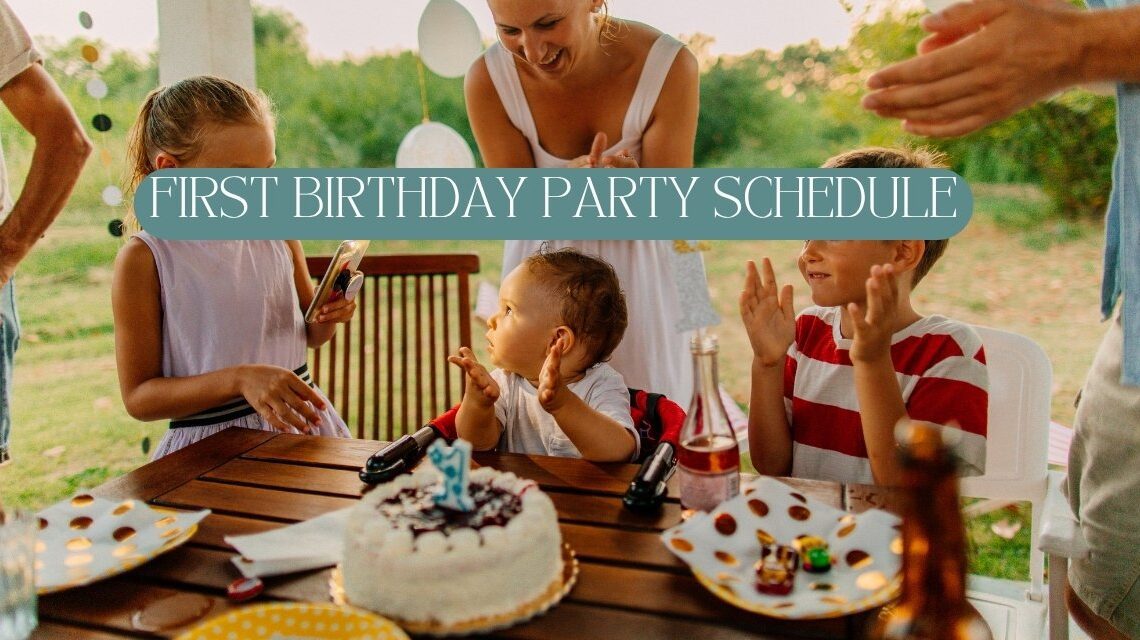
A 90-minute first birthday party schedule is long enough for guests to arrive, eat, take photos, sing happy birthday and celebrate properly, without asking a one-year-old to perform like a tiny cruise director for an entire afternoon. Start shortly after the birthday baby’s usual nap, serve food early and bring out the cake before the final 30 minutes.
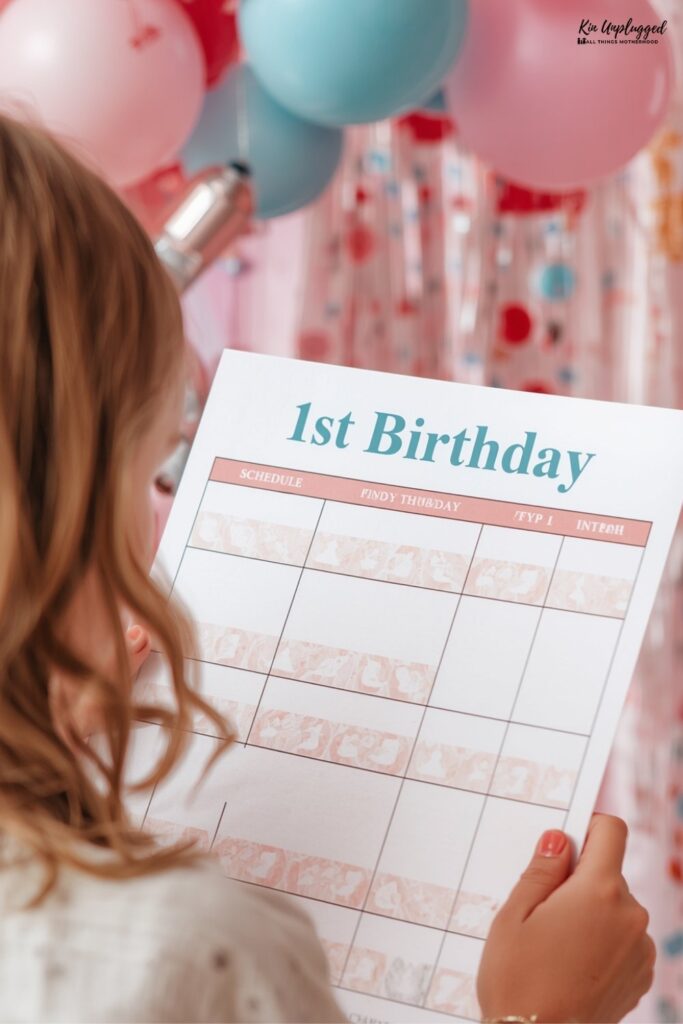
The full schedule: 15 minutes for arrivals, 20 minutes for food, 15 minutes for one gentle activity, 15 minutes for cake, 15 minutes for photos and mingling then 10 minutes for a clear goodbye.
Before ordering six balloon arches and accidentally turning the living room into a regional conference centre, these three purchases do most of the visual work.
First Birthday Party Buying and Planning Table
| What to Plan | Best Choice for 90 Minutes | Quantity or Timing | Why It Earns Its Place |
|---|---|---|---|
| Party start time | 30 to 60 minutes after a reliable nap | Confirm one week before | A rested baby has a better chance of enjoying the important parts |
| Guest arrival window | First 15 minutes | Print the actual start time on the invitation | Late arrivals do not hold up food or cake |
| Decorations | One photo backdrop, table decor and a number-one detail | Set up the night before | Three visual anchors look intentional without filling every surface |
| Balloons | One secured garland or small cluster | Inflate the day before | Gives photographs impact without needing several installations |
| Food | One adult-friendly main, two sides and a baby-safe plate | Serve at minute 15 | Guests can eat before the cake sequence begins |
| Baby snacks | Soft, age-appropriate finger foods | Prepare before guests arrive | Avoids cutting grapes while answering the door |
| Activity | One open-ended floor activity | Minutes 35 to 50 | Babies can join briefly without needing instructions |
| Cake | One display cake plus optional cupcakes | Bring out at minute 50 | Keeps the main moment inside the baby’s happier window |
| Photographs | One short planned list | Minutes 60 to 75 | Stops family photos from swallowing the whole party |
| Gifts | Open later | After guests leave | Protects the schedule and avoids an audience for wrapping-paper snacking |
| Favours | Useful or edible | Place beside the exit | Guests can leave without searching for a bag |
| Cleanup | One hidden clearing tub and lined bin | Ready before the party | Mess disappears quickly without a full kitchen reset |
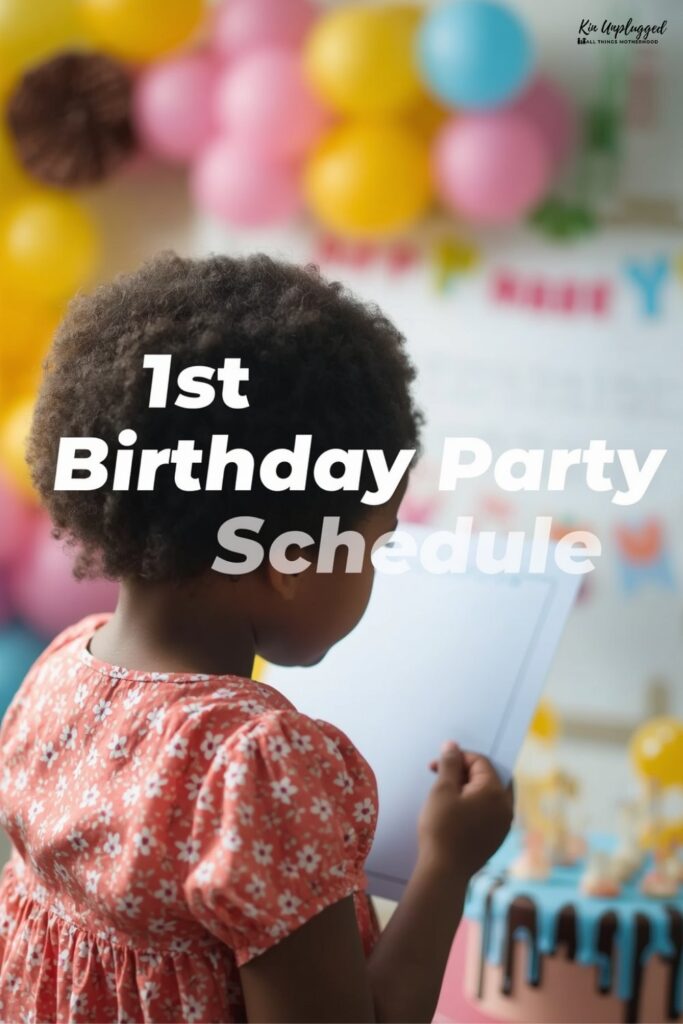
The Complete 90-Minute First Birthday Party Schedule
This schedule works because nothing important depends on a one-year-old sitting still, following instructions or being delighted by a room full of people staring at them. It also puts cake early enough to avoid the familiar ending where the birthday baby is crying, a grandparent is starting another group photo and someone has misplaced the cake knife.
0:00 to 0:15 — Arrivals and the Soft Opening
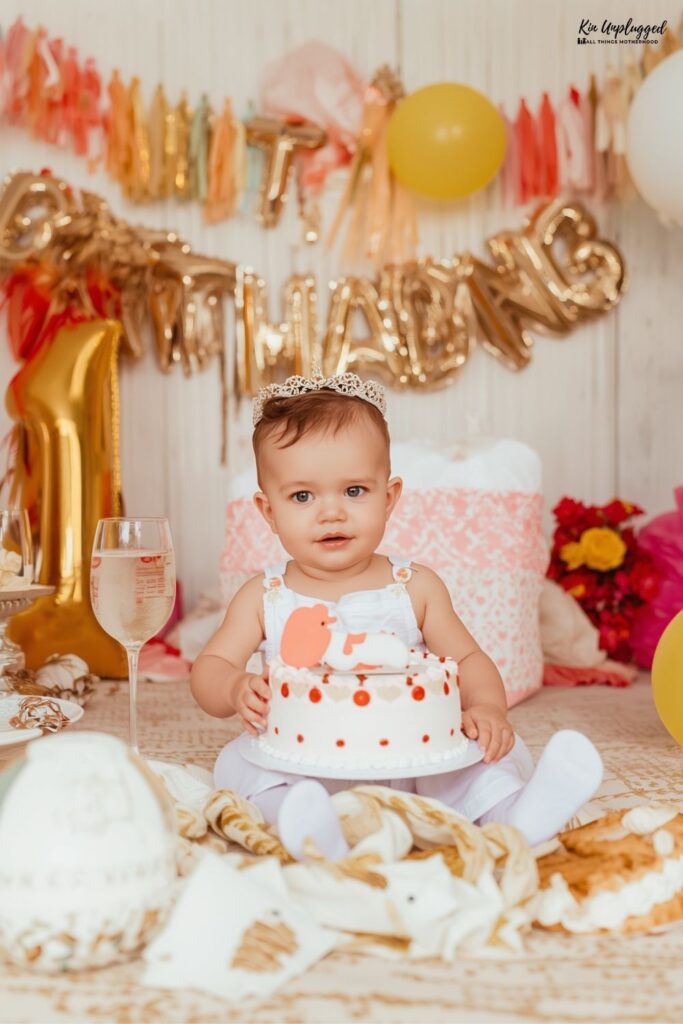
Keep the first 15 minutes unstructured. Guests arrive, coats come off, babies inspect each other suspiciously and adults settle into the room.
Offer drinks immediately but hold off on any formal activity. A late guest should be able to walk in without feeling like they’ve missed the opening scene of a West End production.
Set out one quiet arrival station close to the entrance. Good options include:
- A large birthday card for guests to sign
- Twelve printed monthly photographs displayed on a table
- A small basket of fabric scarves and sensory balls
- A “one wish for one” keepsake box
- A Polaroid guest-book station
- A framed first-year facts sheet
The monthly photograph display gives guests something to talk about and makes the party feel personal before anything officially starts. It also turns photos already sitting on a phone into decoration, which feels unusually efficient.
Keep the birthday baby away from the door. Let the baby stay with whoever feels safest while new faces arrive in smaller waves rather than all at once.
0:15 to 0:35 — Food Is Served
Serve food earlier than instinct suggests. Guests often arrive hungry, young children are easier to manage on a full stomach and an early meal protects the second half of the schedule.
A buffet works best when adults can fill one plate without assembling seven separate components. Think sliders, a pasta dish, filled rolls, tacos prepared in advance or a grazing table with clearly separated baby-safe options.
Keep the menu focused: one substantial main, one vegetarian option if needed, two simple sides, a bowl of prepared fruit, water and one other drink and cake later.
This is not the moment for a menu with individual finishing sauces or anything that needs last-minute assembly. No first birthday has been improved by the host disappearing into the kitchen for twenty minutes.
A first birthday menu should account for the toddlers in the room. The American Academy of Pediatrics is specific about round, firm foods: grapes should be quartered and hot dogs cut lengthwise before either reaches a young child’s plate.
Place baby food on its own tray with its own serving utensils. This keeps suitable pieces from getting mixed in with harder foods meant for adults.
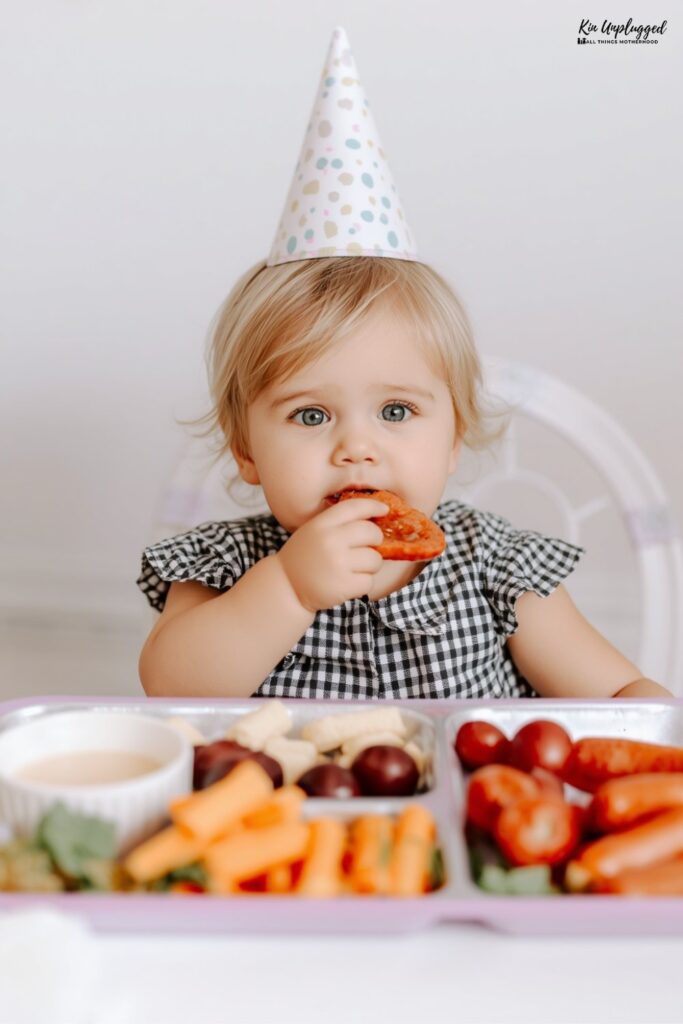
Keep children seated while eating and keep the play area away from the food table. Eating should wrap up before energetic movement begins.
For an outdoor party, put cold food over ice and refill smaller dishes rather than laying everything out at once. USDA guidance is precise on timing: perishable food should not sit at room temperature longer than two hours or one hour once it’s above 90°F.
0:35 to 0:50 — One Activity, Not an Entertainment Programme
The activity section lasts 15 minutes and should feel optional. At this age, the best party games are invitations to explore rather than events with rules, winners and a parent crouched on the floor pleading with eight babies to pass a parcel correctly.
Pick one main activity and prepare it before guests arrive.
The First-Year Floor Gallery
Print six to twelve photographs from the baby’s first year and attach them to thick cards. Place them around a foam mat with baby-safe mirrors and sensory objects.
Babies can crawl between the photographs while adults naturally pause to talk about them. The activity is personal, cheap to put together and directly tied to the reason everyone is there.
The Birthday Time Capsule Table
Ask each household to write one hope, prediction or piece of advice for the child to read on a future birthday. Use cards with specific prompts, so nobody spends ten minutes staring at a blank card.
Place the finished cards in a labelled box and put it away after the party. It becomes a genuine family keepsake instead of another decoration bound for a cupboard.
The One-Year Sound Basket
Fill a low basket with safe instruments such as sealed shakers, soft wrist bells and small drums designed for babies. Start one familiar song, let the children make noise for a few minutes and stop while it’s still charming rather than grating.
Check every item against the manufacturer’s age guidance and inspect it for loose pieces before use. Keep damaged toys and any deflated or broken balloons well out of reach.
The Texture Path
Arrange several large, secured textures across a clean floor mat: faux grass, a quilted panel, smooth fabric, corrugated card under a sealed cover and a soft play tile. Babies can crawl or stand across the path with an adult close by.
Every material needs to be firmly fixed, too large to fit in a child’s mouth and free of loose fibres, beads or decorative pieces.
The Family Fingerprint Number One
Draw or print a large number one on thick paper. Adults add a fingerprint around the outline, then sign their name in fine pen once the ink dries.
Use a washable, non-toxic ink pad under adult control throughout. This works especially well for a smaller family gathering, since the finished piece holds the names of everyone who was there.
The aim is one memorable interaction, not constant stimulation. Stop after 15 minutes even if the activity is still going well — that leaves the room’s attention for cake, which most guests have quietly been waiting for anyway.
Minute 50 to 65: Cake, Candle and the Main Photographs
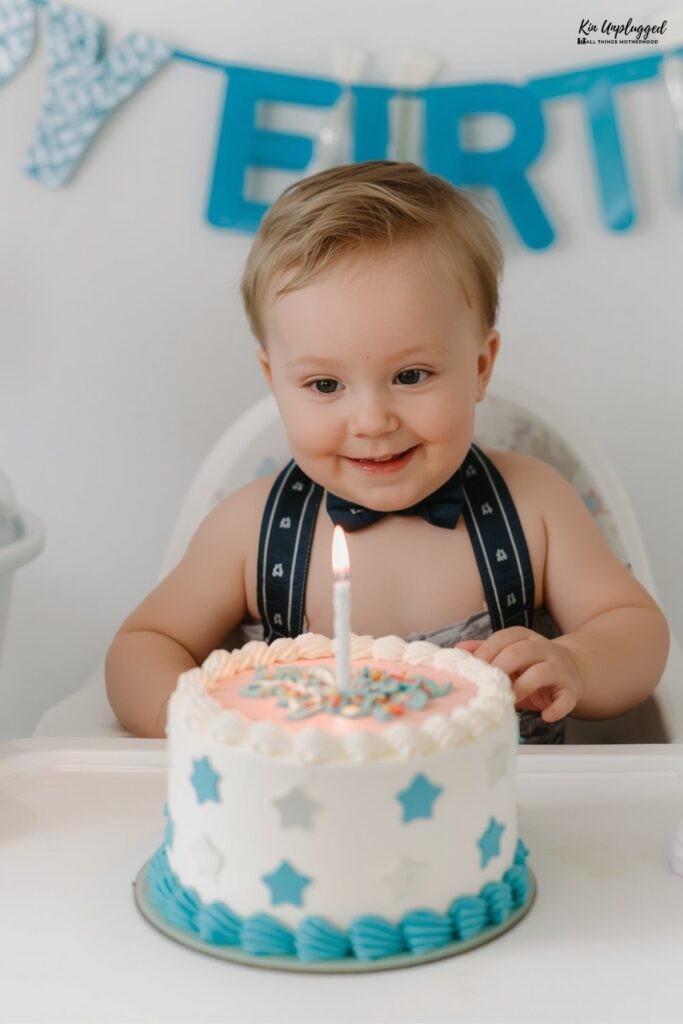
Bring the cake out at minute 50. This timing catches the birthday baby after food and play but before tiredness starts negotiating a takeover.
Prepare the cake area before guests arrive: candle already inserted, lighter stored safely nearby, cake knife and server on the table, a bib or coverall within reach, the highchair cleaned and positioned, a phone or camera charged, one person assigned to take photographs, wipes ready and plates and forks unwrapped.
The assigned photographer matters more than it sounds. Without one, every adult films the song from the same angle and the birthday baby ends up with a dozen nearly identical videos but no photograph with both parents in it.
Keep the birthday song short and light the candle only once everyone is actually watching. An adult should blow it out if the baby can’t, rather than leaning the flame closer for a better photo.
A smash cake is optional. A cupcake, a slice of the main cake or a baby-appropriate alternative produces the same joyful mess without paying for a second iced structure.
If a separate smash cake is used, keep the design soft and simple. Fondant pieces, cocktail sticks, toppers and any small non-food embellishments should come off before the cake reaches the baby.
Take the priority photograph before the baby touches the cake. Frosting moves fast and there’s rarely a way back to a clean outfit once it starts.
The most useful photo order: birthday baby alone, birthday baby with parents, birthday baby with siblings, birthday baby with grandparents, one full family photograph, candle and cake, then the first taste. This order protects the photographs you can’t get a second chance at.
Minute 65 to 80: Cake Is Served and Adults Actually Talk
Serve cake right after the song. Guests have already eaten, so small portions are enough for everyone.
Cupcakes save time here, since nobody needs equal slices cut while a queue forms behind them. A small decorated cake for photos plus matching cupcakes for guests works well for most group sizes.
For a bigger group, keep a plain sheet cake in the kitchen so the display cake can stay small while the sheet cake quietly handles feeding everyone. This window also gives guests time to actually talk with the parents, so keep the music low and skip starting anything new.
Minute 80 to 90: The Deliberate Goodbye
A good first birthday party ends while it still feels good, not once the birthday baby announces the ending through tears and a sudden objection to every relative in the room. At minute 80, lower the music and begin a visible closing action: favour bags coming out, coats being gathered or one final group photo.
A simple closing line works well: “Thank you for celebrating this first year with us — we’re going to let the birthday baby wind down now, so please grab cake and a favour on your way out.” No apology is needed. The stated finish time was part of the invitation and ninety minutes has already delivered food, cake, photographs and time together.
Place favours directly beside the exit rather than handing them out across the room, so goodbyes happen naturally. Skip anything noisy with tiny loose parts — everyone present has attended a party, eaten cake and kept a small child alive in public and that’s enough for one afternoon.
Why a 90-Minute First Birthday Party Works
A one-year-old doesn’t need a long event to understand something special is happening. Familiar people, a rested start, food, a song and a small amount of play are genuinely plenty.
Longer parties tend to drift into missed naps, delayed meals and an overtired baby, which is exactly the outcome a fixed, shorter schedule is built to avoid. Planning around the baby’s usual sleep pattern, rather than a time that only suits the adults, keeps the whole afternoon calmer for everyone in the room.
The best party time is shortly after a dependable nap, not automatically noon. For many families, that means a late-morning celebration after the first nap or a mid-afternoon one after the second. Put both a start and a finish time on the invitation — “2:00 to 3:30 p.m.” reads as intentional and helps guests plan meals, naps and travel around it.
The Quiet Architecture Behind the Schedule
The ninety minutes aren’t simply cut into equal blocks; each section sets up the one after it. Arrivals come before food because guests need somewhere to land first. Food comes before play because hungry toddlers don’t get more reasonable with time.
Play comes before cake because it gives babies a chance to move after eating and cake sits before the final stretch because it’s too important to leave until the baby is worn out. Photographs attach to moments already happening instead of becoming their own production and the goodbye is planned rather than left to arrive through a slow, gradual collapse.
That sequence is the actual difference between a short party that feels rushed and a short party that feels full.
A First Birthday Party Setup That Saves Time
Divide the space into four small zones before guests arrive.
The arrival zone keeps the guest book, birthday card or time-capsule cards near the entrance, with a pen that works and a surface high enough to stay out of reach of babies.
The food zone keeps adult food, children’s food and drinks in one area, with baby-safe items on a clearly separate tray and hot drinks kept well away from table edges. Plates belong at the start of the buffet and cutlery at the end, since nobody can carry a fork, napkin, drink and plate at once without a third hand.
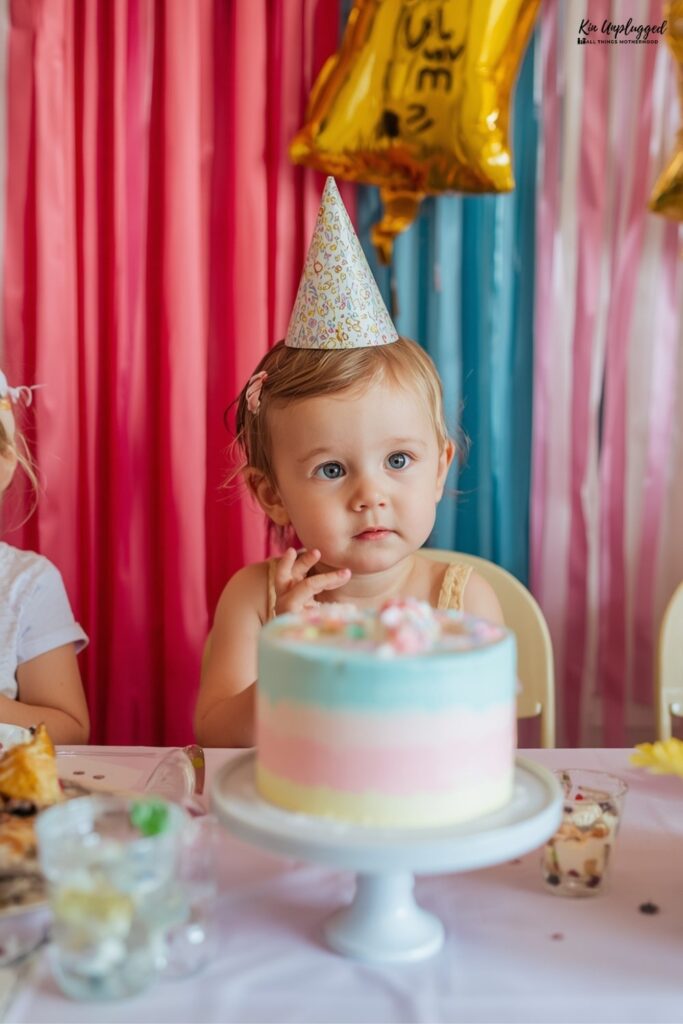
The play zone is defined by a rug or foam mat, with small decorations, trailing cables and unstable furniture cleared out first. Keep it visible from where the adults are sitting, since a lovely activity tucked away in another room just means someone supervising it alone.
The cake zone puts the highchair where the light is good without facing the baby into a bright window, with the backdrop kept simple — a balloon garland, a name sign or a fabric panel plus the highchair is enough.
The First Birthday Party Host Box
Put one open container somewhere hidden but reachable before the party starts. This host box quietly heads off dozens of small interruptions: wipes, kitchen roll, stain remover, bin bags, spare candles, matches, tape and scissors, a phone charger, safety pins, a spare bib, nappy supplies, plasters, a marker pen, a serving spoon, the cake knife and two clean tea towels.
Add a second, empty tub under the food table for used utensils and empty packets, so nothing needs a full clear-up mid-party. It also solves the oddly common problem of the cake knife disappearing minutes before the cake appears.
How Much Food Is Needed for Ninety Minutes
The right amount depends on the time of day. A party across a normal mealtime needs a proper meal; a mid-afternoon one can run lighter.
| Item | Suggested Starting Quantity |
|---|---|
| Main food | 1 serving per guest, plus 10% |
| Small savoury items | 4 to 6 per adult |
| Toddler portions | Roughly half an adult portion |
| Cupcakes | 1 per guest, plus 10% |
| Display cake | Based on remaining servings needed |
| Fruit | ½ to 1 cup per adult |
| Bottled or canned drinks | 2 per adult |
| Water | Freely available throughout |
For a party between 11:30 a.m. and 1:30 p.m., plan a full serving per adult and child. For one between 2:30 and 4:00 p.m., lighter savoury bites, fruit and cake are usually enough, as long as the invitation says so clearly. Confirm allergies during the RSVP process and adjust quantities for the number of older kids on the guest list.
What to Do About Gifts
Skip gift-opening inside the ninety minutes. A one-year-old might open one present with real enthusiasm, ignore the next five entirely and become deeply committed to a ribbon instead.
Opening gifts in front of the room also turns a shared celebration into a long observation exercise, with older kids crowding in and adults quietly watching the clock. Set gifts on one table and open them privately later, which also makes it far easier to track who gave what for proper thank-you notes.
A small sign does the job: “Thank you for celebrating with us. Gifts will be opened after the party so there’s more time to enjoy everyone’s company.”
A Backup Plan for Tears, Naps and Late Arrivals
Even a well-built schedule needs one flexible seam, since babies are not known for respecting event-management documents. If the birthday baby gets upset during arrivals, move food forward by five minutes; guests will be occupied and the baby gets a quieter reset.
If the baby tires out during the activity, skip straight to cake. If several guests run late, don’t delay food past minute 20, since latecomers can simply join the buffet on arrival.
If the birthday baby falls asleep before cake, take the cake photos anyway and let guests eat — a candle photo can happen later with immediate family, since waking a sleeping one-year-old for ceremonial sponge rarely produces the warm image everyone’s hoping for. The schedule should bend once, not fall apart completely.
Small Details That Make the Party Personal
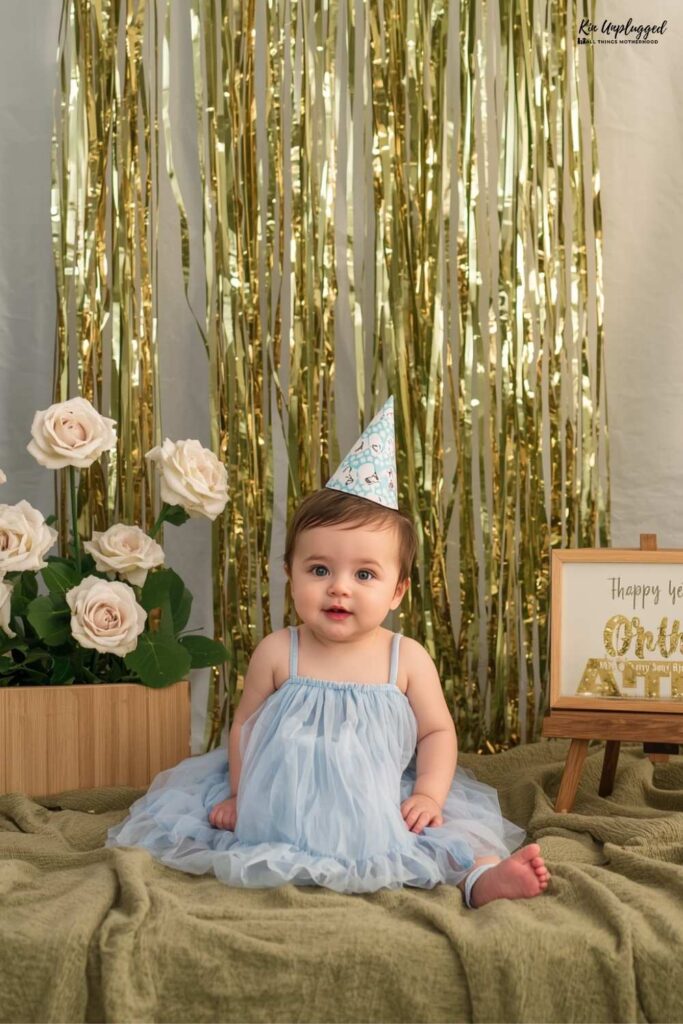
A first birthday becomes distinctive through specific family details, not a bigger pile of decorations. Serve one food connected to the baby’s first year — a grandparent’s recipe or a snack the baby genuinely loves with a small card explaining why it’s there.
Name a drink after a first-year milestone, display one object from the first year beside a photo of it in use and ask grandparents to bring a photo of the parents at exactly one year old for a side-by-side comparison. A thirty-second audio message from each close family member, saved into one dated folder, is worth more later than it costs to set up now.
Repeating the same fabric, ribbon or printed motif across the cake table, invitation and favour tag is a small touch that makes a simple setup read as considered rather than thrown together.
Frequently Asked Questions
How long should a first birthday party last? A first birthday party should usually last between 90 minutes and two hours. Ninety minutes is enough for arrivals, food, one simple activity, cake and photographs, while still protecting the baby’s normal routine.
What time of day is best for a first birthday party? The best time is 30 to 60 minutes after the birthday baby’s most reliable nap, in late morning or mid-afternoon depending on the household. A rested baby matters more than serving food at a traditional hour.
Do first birthday parties need games? No. Most one-year-olds cannot follow group instructions or wait their turn, so one open-ended activity, like a sensory basket or a photo gallery, suits the age far better than a structured game.
Should presents be opened at a first birthday party? Presents are usually better opened after the party. It keeps the ninety-minute schedule moving, avoids overwhelming the birthday baby and makes it far easier to track who gave what for thank-you notes.
Is a smash cake necessary for a first birthday? No. A cupcake, a small slice of birthday cake or a baby-friendly alternative delivers the same joyful moment without the cost of a second cake.
How early should a first birthday party be planned? Six to eight weeks ahead if a venue, caterer or photographer is involved; three to four weeks is usually enough for a small at-home celebration.
Bringing It Together
A first birthday doesn’t need an entire afternoon to feel important. The right 90-minute first birthday party schedule makes room for everything that matters, then ends before the birthday baby or any of the adults in the room, has completely run out of patience.
Start after a nap, feed people early, choose one thoughtful activity and bring the cake out at minute fifty. Take the photographs that matter, send everyone home while it still feels easy and keep the rest of the day quiet enough to actually remember it.
The first year was already a long stretch. The party doesn’t need to be. For more real world party timelines like this one, built for actual toddlers rather than a mood board, the newsletter is where they show up first.
 0
0

 278
278